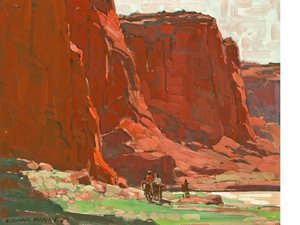
A Pioneer of Sierra Nevada Impressionism
Edgar Alwyn Payne (1883 – 1947) stands as a singular figure in American landscape painting, particularly renowned for his evocative depictions of the Sierra Nevada mountains and his contributions to Southwestern mural art. Born near Cassville, Missouri—a region steeped in Ozark folklore and rugged beauty—Payne’s early life instilled within him an adventurous spirit that would propel him across continents before establishing himself as a celebrated artist. His formative years were marked by extensive travel, beginning with youthful explorations of Europe and continuing through expeditions to Mexico and Canada, fostering a profound appreciation for diverse cultures and artistic traditions. However, it was the American West—specifically California—that irrevocably captured his imagination and became the primary focus of his creative endeavors.Early Influences & Artistic Training
Payne’s artistic journey commenced with carpentry apprenticeships in Arkansas, providing him with practical skills alongside an early exposure to visual arts. Recognizing his talent, he enrolled at the Art Institute of Chicago at a young age, albeit briefly abandoning formal instruction for self-directed study—a decision that proved pivotal in shaping his distinctive style. Rejecting the rigid academic conventions prevalent at the time, Payne embraced Impressionism’s emphasis on capturing fleeting moments of light and color, mirroring the influence of artists like Claude Monet and Camille Pissarro. This approach was further honed through experimentation with plein air painting—working directly from nature—a technique championed by luminaries such as John Muir and Ansel Adams, cementing his connection to the grandeur of the American wilderness. He believed that “mixing brains with paint” was essential for achieving true artistic excellence.The California Years & Artistic Style
California became Payne’s artistic sanctuary in 1909, where he spent considerable time honing his craft at Laguna Beach and immersing himself in the burgeoning San Francisco art scene. He befriended fellow artist Elsie Palmer, forging a relationship that blossomed into marriage—a testament to his personal conviction and artistic ambition. Returning to Illinois in 1911, Payne found Palmer pursuing her own artistic pursuits, symbolizing the reciprocal inspiration inherent in their partnership. His paintings are characterized by luminous color palettes, loose brushstrokes, and an acute sensitivity to atmospheric conditions—elements that convey not merely visual representation but also emotional resonance. He skillfully employed techniques like glazing and impasto to build up textured surfaces, capturing the essence of geological formations and conveying a palpable sense of movement. Payne’s masterful rendering of light was particularly noteworthy; he sought to capture the ephemeral qualities of sunlight filtering through mountain peaks and forests—a challenge that demanded unwavering dedication and meticulous observation.Major Achievements & Legacy
Payne’s prolific output encompassed landscapes, portraits, murals, and theater designs—demonstrating his versatility as an artist. His monumental murals adorning buildings in Santa Fe and Albuquerque stand as enduring symbols of Southwestern artistic heritage. Notably, “Indians Riding Through Canyon de Chelly” (1908), commissioned by the Navajo Nation, remains a seminal work capturing the spirit of Native American culture and the dramatic landscapes of Arizona. Payne’s paintings—particularly his Sierra Nevada series—are held in prestigious collections worldwide and continue to inspire artists today. His unwavering devotion to plein air painting and his masterful rendering of light and color solidified his place as one of America's foremost Impressionist landscape painters, leaving an indelible mark on the history of American art. He was recognized for his ability to convey both visual beauty and profound emotional depth—a rare accomplishment in any artistic discipline.Fragen & Antworten
Aus welcher Epoche stammte Edgar Alwyn Payne?
Edgar Alwyn Payne war in der Epoche der Moderne tätig. Diese Periode ordnet das künstlerische Schaffen historisch ein.
Woher kommt Edgar Alwyn Payne?
Edgar Alwyn Payne wurde in Vereinigte Staaten von Amerika geboren.
Wo lassen sich die Kunstwerke von Edgar Alwyn Payne nach Farben sortiert entdecken?
Die Werke von Edgar Alwyn Payne können auf der Farbindex-Seite des Künstlers nach Farben sortiert erkundet werden.