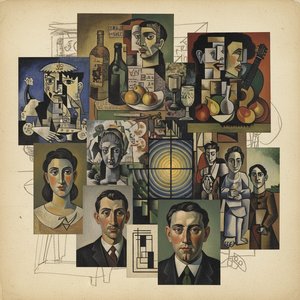
Georges Braque: Pioneering Cubism & the Evolution of Modern Form
Georges Braque (1882-1963), born in Argenteuil, France, stands as a monumental figure in 20th-century art—a sculptor and painter whose relentless experimentation fundamentally reshaped artistic conventions. His formative years instilled within him not only a mastery of craftsmanship honed by his father’s profession but also an acute sensitivity to visual structure and form, shaping the trajectory of his groundbreaking career.
- Early Life & Artistic Foundations: Braque's upbringing amidst the bustling Parisian atelier of his family fostered a deep understanding of artistic materials and processes. Simultaneously, he pursued formal training at the École des Beaux-Arts in Le Havre, establishing a crucial duality that would inform his later artistic endeavors—a grounding in tradition juxtaposed with an unwavering desire to dismantle established norms.
- Parisian Immersion & Artistic Encounters: Moving to Paris in 1902, Braque continued his studies at the Académie Humbert, immersing himself in the vibrant intellectual and artistic currents of the era. Crucially, he crossed paths with fellow innovators like Marie Laurencin and Francis Picabia, sparking collaborative dialogues that propelled them toward the genesis of Cubism—a revolutionary movement destined to redefine visual representation.
The Birth of Cubism
Braque’s partnership with Pablo Picasso marked a pivotal moment in art history. Together, they embarked on an audacious quest to liberate painting from illusionistic perspective, dissecting objects into geometric fragments and reconstructing them simultaneously from multiple viewpoints. This approach—characterized by fractured planes and overlapping forms—challenged the conventions of Impressionism and Post-Impressionism, ushering in a new paradigm for artistic expression.
- Analytical Cubism (1908-1912): The initial phase of Cubism witnessed an intense focus on reducing objects to their essential geometric components—cubes, cylinders, and cones—primarily rendered in muted tones. Braque’s meticulous attention to detail and his masterful manipulation of tonal gradations conveyed a profound sense of spatial ambiguity, inviting viewers to actively engage with the artwork's complexities.
- Synthetic Cubism (1912-1914): Building upon Analytical Cubism’s foundational principles, Synthetic Cubism incorporated collage elements—fragments of newspaper, fabric, and other materials—into painted surfaces. This technique expanded the artistic vocabulary, blurring distinctions between painting and sculpture and reflecting the broader cultural anxieties of the time concerning industrialization and fragmentation.
Untitled (3378): A Reflection of Braque’s Vision
“Untitled (3378),” created around 1960, exemplifies Braque's enduring commitment to exploring the interplay between form and color. The painting depicts a woman with striking blue hair—a deliberate stylistic choice that underscores Braque’s fascination with chromatic abstraction. Rendered in watercolor and graphite on paper, it showcases a masterful blend of textural nuances and tonal harmonies.
The artwork's composition—characterized by downward gazes and subtle layering—suggests introspection and contemplation. The muted color palette—primarily reds, blues, and yellows—contributes to an atmosphere of quiet intensity, inviting viewers to contemplate the subject’s emotional resonance. As a testament to Braque’s artistic legacy, this piece embodies his pioneering spirit and his unwavering pursuit of innovative visual language.
Reproductions of “Untitled (3378)” offer collectors and interior designers alike an opportunity to experience the profound beauty and intellectual depth of Braque's oeuvre. TopImpressionists.com presents exceptional quality reproductions that faithfully capture the artwork’s original vibrancy and textural richness—a celebration of artistic genius.



 Αγοράστε την αναπαραγωγή
 Αποστολή
 Κοινοποίηση
 Λεπτομέρειες

 Λήψη
Λήψη
 Παρόμοια έργα
 Ακτινογραφία
 Παρουσίαση
 Περισσότερα λεπτομέρεια






































 Η επιλογή με γυαλί είναι διαθέσιμη μόνο για μεγέθη κάτω από 110 εκ.