

 Προεπισκόπηση σε πραγματική κλίμακα
 Αποστολή
 Κοινοποίηση
 Λεπτομέρειες
 Οδηγός

 Λήψη
Λήψη
 Παρόμοια αντικείμενα συλλογής
 Ακτινογραφία
 Παρουσίαση
 Ερωτήσεις & Απαντήσεις
 Στατιστικά
Boating Party


 Περισσότερα
Ο Γουσταβός Καλιμπώτ είναι ένας πρωτοποριακός γάλλος ζωγράφος, γνωστός για τις ρεαλιστικές και ιμπρεσιονιστικές απεικονίσεις της σύγχρονης Παριζίνης. Δείτε τα έργα του!
Giclée / Εκτυπώσεις Τέχνης
Εκτύπωση giclée ή σε καμβά ποιότητας μουσείου με γρήγορη παραγωγή και ευέλικτες επιλογές φινιρίσματος. ( Αγορά χειροποίητου πίνακα Μετάβαση σε Ψηφιακή Αποτέλεσμα)




P118B €10

P118H €10

P118W €10

P438Z €10

P508JH €12

P508YH €12

P805H €10

P805Z €10

P919BZ €10

P919G €10

P919XJ €10

P959ZH €10

P968JZ €12

W106C €8

W218G €10

W218JH €8

W218Y €10

W307PJ €10

W316G €10

W316PJ €8

W316Y €10

W398PJ €8

W4111J €10

W500HY €15

W500JH €15

W692G €12

W849H €8

W940BG €15

W953PJ €8




Πρότυπο
κατόπιν παραγγελίας
CM
INCH
Επιλέξτε από τις προκαθορισμένες διαστάσεις μας που διατηρούν τις αρχικές αναλογίες του έργου τέχνης.
Loading sizes...

πλάτος
ύψος
Εισάγετε το πλάτος και το ύψος που επιθυμείτε, ώστε να ταιριάζουν στο κάδሮ ή στον τοίχο σας. Μια εκτύπωση μπορεί μόνο να υποστεί κοψίμό και ποτέ να μην γίνει μεγαλύτερη από την αρχική εικόνα, επομένως η επιλογή μεγέθους με διαφορετικό σχήμα συνεπάγεται απώλεια ενός μέρους της εικόνας. Σας στέλνουμε ένα ψηφιακό mockup για έγκριση πριν προχωρήσουμε σε οποιαδήποτε εκτύπωση. Η εικόνα που εμφανίζεται σε αυτή τη σελίδα δεν δείχνει την πραγματική κοπή — μόνο το mockup την παρουσιάζει.
Παγκόσμια Αποστολή () σε 2 εβδομάδες αντί για τις συνήθεις 4/5 εβδομάδες. (10 Νοέμβριος)

Δωρεάν γρήγορη διεθνής αποστολή

Κάμβας από Λινό Υψηλής Ποιότητας

Πλήρης ασφάλιση μεταφοράς

Εγγύηση επιστροφής δασμών και φόρων εισαγωγής

Εγγύηση Απόλυτης Ομοιότητας Χρωμάτων

Πολιτική Επιστροφής 100 Ημερών (Μόνο σε περίπτωση ελαττωμάτων)

Εγγύηση επιστροφής 100% των χρημάτων

Προσφορά για πολλαπλές παραγγελίες
 Η επιλογή με γυαλί είναι διαθέσιμη μόνο για μεγέθη κάτω από 110 εκ.

Boating Party
Giclée / Εκτυπώσεις Τέχνης
Διαστάσεις Αναπαραγωγής
-


Τελική Τιμή
€ 62
A Snapshot of Parisian Leisure: Gustave Caillebotte’s ‘Boating Party’
Gustave Caillebotte's “Boating Party,” completed in 1876, isn’t merely a depiction of an afternoon outing; it’s a meticulously crafted distillation of Impressionist ideals and a poignant reflection on the burgeoning modernity of late nineteenth-century Paris. Painted during a period marked by rapid industrialization and social upheaval, Caillebotte captures a moment of tranquil beauty amidst the dynamism of urban life—a deliberate contrast that speaks volumes about his artistic vision. The painting resides within the Musée d’Orsay’s collection, designated as a National Treasure of France, cementing its place in art history and ensuring its continued appreciation for generations to come.The Impressionist Technique: Capturing Fleeting Light
Caillebotte's mastery lies not just in his subject matter but also in his groundbreaking application of Impressionist technique. Abandoning the academic conventions of realism prevalent at the time, he embraced a looser brushstroke style—characterized by visible pigment particles and an emphasis on capturing the ephemeral effects of light. Unlike traditional artists who sought to render objects with painstaking detail, Caillebotte prioritized conveying atmosphere and sensation. Observe how the dappled sunlight filters through the foliage lining the riverbank, illuminating the figures within the boat and creating a shimmering haze that softens the edges of the scene. This deliberate disregard for precise representation aligns perfectly with Impressionism’s core belief: art should strive to capture the immediacy of experience rather than presenting idealized versions of reality.A Window into Parisian Society
“Boating Party” offers a fascinating glimpse into the social landscape of Paris during Caillebotte's era. The painting portrays a group of affluent Parisians enjoying leisure activities—a common pastime for the bourgeoisie—reflecting the growing importance of outdoor pursuits and socializing amongst the educated elite. The central figure, dressed in a top hat and wielding an oar with confident grace, embodies the spirit of self-assured masculinity characteristic of the time. Surrounding him are fellow gentlemen, engaged in conversation and contemplation, subtly hinting at the intellectual debates and artistic ferment shaping Parisian culture. Notably, Caillebotte’s inclusion of a dog adds an element of domesticity to the urban tableau—a detail that underscores the painting's portrayal of everyday life rather than grand historical narratives.Symbolism Beyond Surface Beauty
While aesthetically pleasing, “Boating Party” is imbued with symbolic significance. The boat itself represents stability and aspiration – a vessel carrying individuals towards a future filled with possibilities. The figures within are not simply observing the scenery; they are actively participating in it, embodying the humanist values championed by Impressionists. Furthermore, Caillebotte’s compositional choices—particularly his use of perspective—serve to heighten the sense of depth and immersion, inviting viewers into the scene as if they were present alongside the boating party. The artist's careful attention to detail contributes to a feeling of authenticity and invites contemplation on themes of leisure, social status, and the beauty found in ordinary moments.Emotional Resonance: Tranquility Amidst Change
Ultimately, “Boating Party” transcends its formal qualities to evoke a profound emotional response. Despite the backdrop of rapid societal transformation, Caillebotte manages to convey a palpable sense of serenity—a respite from the pressures of urban life and an appreciation for the simple pleasures of companionship. The painting’s luminous palette and delicate brushstrokes capture not just what is seen but also how it feels – a testament to Caillebotte's ability to translate visual experience into emotive resonance. It remains a powerful reminder that even amidst change, beauty—and moments of quiet contemplation—can endure.Ερωτήσεις και Απαντήσεις
Ποιο είναι το σχήμα του "Boating Party";
Το έργο "Boating Party" του Γουσταβός Καλιμπώττης είναι μια σύνθεση σε μορφή Landscape. Αξίζει να ελέγξετε τις αναλογίες πριν επιλέξετε το μέγεθος της εκτύπωσης.
Ποια είναι η αιτία της κατάστασης των πνευματικών δικαιωμάτων για το έργο "Boating Party" του Γουσταβός Καλιμπώττης;
Το έργο "Boating Party" του Γουσταβός Καλιμπώττης ανήκει στο δημόσιο κτήμα - τα δικαιώματα αυτορության έχουν λήξει. Η διάρκεια της προστασίας των πνευματικών δικαιωμάτων υπολογίζεται από το έτος θανάτου του καλλιτέχνη, ο οποίος συνέβη το 1894.
Περί τι αφορά το "Boating Party";
Τα θέματα που περιλαμβάνονται στο "Boating Party" του Γουσταβός Καλιμπώττης περιλαμβάνουν το/τα parisian leisure, urban scene, boat landscape, summer afternoon, outdoor activity, french impressionism, top hat figure, relaxation. Μαζί, συνοψίζουν το περιεχόμενο του έργου τέχνης.
Σχετικά Έργα Τέχνης




Βιογραφικό Καλλιτέχνη
A Parisian of the New Age: The Life and Art of Gustave Caillebotte
Gustave Caillebotte, born into a prosperous Parisian family in 1848, stands as a uniquely positioned artist—a witness and chronicler of the dramatic transformations reshaping his city. His father, Martial Caillebotte, inherited a successful textile business and served as a judge, providing Gustave with both financial security and an invaluable vantage point from which to observe the burgeoning modern world. Initially drawn to the structured path of law – earning degrees in law in 1868 and 1870 – Caillebotte’s true calling swiftly revealed itself within the realm of art. He embarked on serious training under Léon Bonnat, immersing himself deeply in painting while simultaneously cultivating a keen fascination with photography, an emerging medium that would profoundly influence his artistic vision—its framing, perspective, and ability to capture fleeting moments becoming integral elements of his distinctive style. Caillebotte’s engagement wasn't merely about documenting change; it was a deliberate act of engaging with the aesthetic possibilities inherent in this dynamic era.Realism Infused with Impressionist Light
Caillebotte’s artistic trajectory diverged from the rigid confines of academic tradition, yet he never fully embraced the purely optical explorations characteristic of many of his Impressionist contemporaries. He found a kindred spirit in artists like Edgar Degas and Giuseppe de Nittis, sharing a fascination with modern life but approaching it through a lens of meticulous realism. His early masterpiece, Les Raboteurs de Parquet (The Floor Scrapers), exhibited at the 1875 Salon, immediately established his reputation as a bold and unconventional painter. The work depicts three laborers painstakingly scraping a wooden floor—a scene of quiet industry rendered with an unflinching honesty that initially shocked some viewers while captivating others. It wasn’t simply the subject matter – the working class rarely graced the canvases of high art – but also the composition: cropped, almost jarringly direct, and deliberately devoid of sentimental idealization. This commitment to portraying contemporary life without resorting to romantic embellishment continued in works like View of Rooftops (Snow), where he masterfully captured the stark beauty of Parisian rooftops blanketed in winter’s embrace, utilizing a high vantage point and subtle atmospheric effects—techniques that hinted at his growing influence from photography and Japanese prints. However, Caillebotte wasn't entirely immune to the allure of Impressionism; his palette gradually lightened, and he began experimenting with broken brushstrokes and shimmering reflections, particularly evident in his evocative depictions of Parisian boulevards and urban landscapes.A Patron and a Pioneer: Navigating the Art World
Beyond his own artistic endeavors, Caillebotte played an unexpectedly significant role in supporting the burgeoning Impressionist movement. His financial independence—a direct result of his father’s success – allowed him to become a crucial patron, purchasing works by Monet, Renoir, Pissarro, Cézanne, Degas, and others at a time when their art was largely dismissed by the conservative Salon jury. This wasn't merely a matter of collecting; Caillebotte actively championed these artists, tirelessly organizing and financing several of the Impressionist exhibitions that defied conventional artistic norms—a bold move that challenged the established order. He understood that the future of art lay in embracing innovation and portraying the realities of modern life. His dedication extended to his own collection, which he bequeathed to the French state upon his untimely death in 1894 – a bequest initially met with skepticism but ultimately forming the cornerstone of the Musée d’Orsay's renowned Impressionist holdings. Caillebotte’s unique perspective also manifested in his compositions; works like Boulevard vu d’en haut (Boulevard Seen from Above), painted in 1880, demonstrate a strikingly modern sensibility—employing an elevated viewpoint and dynamic cropping that subtly foreshadowed the photographic perspectives of the 20th century. This innovative approach to composition, possibly influenced by Japanese prints and his own photographic experiments, set him apart as a true pioneer, anticipating future artistic developments.Notable Works
- Les Raboteurs de Parquet (The Floor Scrapers) (1875): A groundbreaking work showcasing Caillebotte’s realism and unconventional composition.
- View of Rooftops (Snow) (1878): Demonstrates his use of high vantage points and atmospheric effects, influenced by photography and Japanese prints.
- Boulevard vu d’en haut (Boulevard Seen from Above) (1880): A strikingly modern composition with a dynamic perspective.
- Paris Street; Rainy Day (1877): Perhaps his most famous work, capturing the bustling energy of Parisian life in a unique and evocative manner.
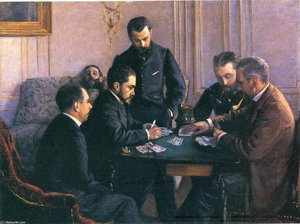
- The Bezique Game(1881) : A captivating Impressionist painting of Parisian leisure.
Legacy and Rediscovery: A Modern Master Reclaimed
For decades following his death, Caillebotte’s work remained largely obscured, overshadowed by the more celebrated figures of Impressionism. It wasn't until the late 20th century that a comprehensive reassessment of his art began to take hold, fueled by meticulous scholarly research and major exhibitions—a testament to the enduring power of his vision. This rediscovery revealed an artist of remarkable technical skill, intellectual depth, and visionary insight. Caillebotte’s paintings are not simply depictions of modern life; they are profound meditations on the complexities of urban existence, the shifting social landscape, and the evolving relationship between art and reality. His ability to seamlessly blend realism with Impressionist techniques, his innovative compositions, and his unwavering commitment to portraying the world around him have secured his place as a pivotal figure in 19th-century art—an artist who dared to capture the spirit of a new age.
Γουσταβός Καλιμπώττης
1848 - 1894 , Γαλλία
Γρήγορα στοιχεία
- Artistic Movement Or Style: Ρεαλισμός, Ενπυσηματισμός
- Artists Or Movements Influenced By This Artist: ['Ενπυσηματισμός']
- Artists Who Influenced This Artist:
- Degas
- Nittis
- Date Of Birth: 19 Αυγ 1848
- Date Of Death: 21 Φεβ 1894
- Full Name: Gustave Caillebotte
- Nationality: Γάλλος
- Notable Artworks:
- Les Raboteurs de Parquet
- Rooftops (Snow)
- Boulevard vu d’en haut
- Place Of Birth: Παρίσι, Γαλλία
Σχετικά άρθρα

Gustave Caillebotte: Bridging Realism & Modernity in Parisian Life
Explore the life & art of Gustave Caillebotte, a pivotal figure bridging Realism & Impressionism. Discover his iconic Parisian scenes and lasting legacy with TopImpressionists.

Οι 10 Κορυφαίοι Ιμπρεσιονιστές Πίνακες που Άλλαξαν την Τέχνη | TopImpressionists.gr
Ανακαλύψτε τους 10 κορυφαίους πίνακες ιμπρεσιονισμού από Μονέ, Ρενουάρ & Ντεγκά. Ιστορίες τέχνης, τεχνικές και χρώματα που άλλαξαν την εποχή! Υψηλής ποιότητας αναπαραγωγές στην TopImpressionists.gr. Εξερευνήστε τη συλλογή online.

Οι 25 Κορυφαίοι Πίνακες του Gustav Klimt: Έμπνευση για Διακόσμηση και Τέχνη
Ανακαλύψτε τους 25 πιο εμβληματικούς πίνακες του Gustav Klimt! Εξερευνήστε την τέχνη Art Nouveau, τον συμβολισμό και τα χρυσά χρώματα που καθόρισαν το έργο του. Βρείτε αναπαραγωγές υψηλής ποιότητας για διακόσμηση σπιτιού στο TopImpressionists.com.

Impressionism: Τα 10 Εικόνες που Άλλαξαν την Τέχνη | TopImpressionists.gr
Ανακαλύψτε τα 10 κορυφαία έργα ιμπρεσιονισμού! Μονέ, Ρενουάρ & άλλοι ζωγράφοι αποτυπωμένοι σε πίνακες που εμπνέουν. Βρείτε αναπαραγωγές υψηλής ποιότητας για να διακοσμήσετε τον χώρο σας. Εξερευνήστε την πλήρη συλλογή στο TopImpressionists.gr

Οι 10 Κορυφαίοι Καλλιτεχνικοί Θησαυροί του Ιμπρεσιονισμού | .gr
Ανακαλύψτε τους 10 κορυφαίους πίνακες ιμπρεσιονισμού από Μονέ, Ρενουάρ & Ντεγκά. Ιστορίες τέχνης, τεχνικές και έμπνευση διακόσμησης. Βρείτε αναπαραγωγές υψηλής ποιότητας στο !
Εξερευνήστε έργα τέχνης ταξινομημένα ανά θέμα, στυλ και χαρακτηριστικά.


