

Εμφανίζεται: · Συμπεριλαμβανομένου του πλαισίου:
 Προεπισκόπηση σε πραγματική κλίμακα
 Αποστολή
 Κοινοποίηση
 Λεπτομέρειες
 Οδηγός

 Λήψη
Λήψη
 Παρόμοια αντικείμενα συλλογής
 Ακτινογραφία
 Παρουσίαση
 Ερωτήσεις & Απαντήσεις
 Στατιστικά

€ 240
Χειροποίητη Αναπαραγωγή σε Έλαιο
Χειροποίητη ελαιογραφία σε καμβά στο δικό σας μέγεθος και πλαίσιο, κατά παραγγελία από τους καλλιτέχνες μας. ( Μετάβαση σε Εκτυπώσεις Μετάβαση σε Ψηφιακή Αποτέλεσμα)
Διαστάσεις
·Πρότυπο
κατόπιν παραγγελίας
CM
INCH
Επιλέξτε από τις προκαθορισμένες διαστάσεις μας που διατηρούν τις αρχικές αναλογίες του έργου τέχνης.
Φόρτωση μεγεθών...

πλάτος
ύψος
Πληκτρολογήστε το πλάτος και το ύψος που επιθυμείτε, ώστε να ταιριάζουν στο κάδሮ ή στον τοίχο σας. Ε เนื่องจาก πρόκειται για χειροποίητη ζωγραφική, σε περίπτωση διαστάσεων με διαφορετικό σχήμα, ο καλλιτέχνης μπορεί να ζωγραφίσει λίγο παραπάνω γύρω από το έργο ή να αφαιρέσει ένα μέρος — η επιλογή είναι δική σας. Σας στέλνουμε ένα ψηφιακό mockup για έγκριση πριν ξεκινήσει η δημιουργία του έργου. Η εικόνα που εμφανίζεται σε αυτή τη σελίδα δεν δείχνει το τελικό αποτέλεσμα — μόνο το mockup το αναδεικνύει.
 Διαβάστε περισσότερα
Ολοκλήρωση
·
Λευκό €1

Αντιστροφή με θολό φινίρισμα €1

Εκτεταμένη περιφέρεια €1

P118B €10

P118H €10

P118W €10

P438Z €10

P508JH €12

P508YH €12

P805H €10

P805Z €10

P919BZ €10

P919G €10

P919XJ €10

P959ZH €10

P968JZ €12

W106C €8

W218G €10

W218JH €8

W218Y €10

W307PJ €10

W316G €10

W316PJ €8

W316Y €10

W398PJ €8

W4111J €10

W500HY €15

W500JH €15

W692G €12

W849H €8

W940BG €15

W953PJ €8

H24-GOLD €30

H24-SILVER €30

H36-GOLD €45

H36-SILVER €45
Αποστέλλεται σε προστατευτικό σωλήνα, έτοιμο για το δικό σας κάδρονια.
Πρόσθετες υπηρεσίες
προαιρετικόΤι περιλαμβάνουν τα επιπλέον στοιχεία;
Παραδείγματα όσων μπορούν να αλλάξουν: Αντικατάσταση του προσώπου με φωτογραφία του πελάτη· Προσθήκη κατοικιδίου (π.χ. αντικατάσταση γάτας με σκύλο)· Ενσωμάτωση κρυφού μηνύματος στο φόντο· Αλλαγή τοπίου ή στοιχείων στο φόντο.
Μετά την παραγγελία, η ομάδα του TopImpressionists.com θα στείλει email στον πελάτη για οδηγίες και θα παρέχει μια προεπισκόπηση (mockup)
Μετά την παραγγελία, η ομάδα του TopImpressionists.com θα στείλει email στον πελάτη για οδηγίες και θα παρέχει μια προεπισκόπηση (mockup)
Παγκόσμια Αποστολή () σε 3-4 εβδομάδες αντί για τις συνήθεις 5 εβδομάδες. (7 Νοέμβριος). Χωρίς συμβιβασμούς στην ποιότητα.
Βερνίκι Προστασίας
Πληροφορίες έργου
Λεπτομέρειες Χάραξης σε Πλακέτα Χαλκού
This elegant plaque features the artist's name and the title of the artwork, finely engraved for a timeless presentation.
It is made from bronze with a refined, elegant finish. The text is precisely laser-engraved for a sharp and permanent result. Measuring 9x2 cm, the plaque is compact yet easy to read. It's built to be durable and scratch-resistant, offering a professional, museum-quality look. Mounting is simple thanks to the included adhesive backing.
Λεπτομέρειες Διαφανούς Ακρυλικής Πλακίδας
The plaque includes essential engraved details such as the artist's name, the title of the artwork, the date it was created, the type of media used-like oil on canvas or watercolor-a brief description of the piece, and a QR code that links to the complete artwork information.
It is crafted from clear acrylic, offering a sleek, modern appearance. The text is UV-engraved in black to ensure strong visual contrast. With a size of 10x15 cm, it ensures optimal readability. It comes equipped with two metal hooks for secure wall mounting. The plaque is designed to be weather-resistant, making it suitable for various environments, and it includes interactive features that work seamlessly with smartphone scanning.
Λεπτομέρειες Πλακίδας Ακρυλικού Μαύρου Χρώματος
This elegant plaque includes engraved information such as the artist's name, the title of the artwork, the date it was created, the type of media used (like oil on canvas or watercolor), a short description of the artwork, and a QR code for quick access to more information.
The plaque itself is made from refined black acrylic with a premium finish. The text is laser-engraved in white for high contrast and readability. Its size is 10x15 cm, designed to be easy to read. It comes with two metal hooks for professional mounting. The design is sleek and fits any interior style. It is also weather-resistant and durable, with built-in digital integration for mobile compatibility.
Η επιλογή με γυαλί είναι διαθέσιμη μόνο για μεγέθη κάτω από 110 εκ.
 Η επιλογή με γυαλί είναι διαθέσιμη μόνο για μεγέθη κάτω από 110 εκ.
- Δωρεάν γρήγορη διεθνής αποστολή
- Κάμβας από Λινό Υψηλής Ποιότητας
- Πλήρης ασφάλιση μεταφοράς
- Εγγύηση επιστροφής δασμών και φόρων εισαγωγής
- Εγγύηση Απόλυτης Ομοιότητας Χρωμάτων
- Πολιτική Επιστροφής 100 Ημερών (Μόνο σε περίπτωση ελαττωμάτων)
- Εγγύηση επιστροφής 100% των χρημάτων
- Προσφορά για πολλαπλές παραγγελίες


Περιγραφή Συλλεκτικού Αντικειμένου
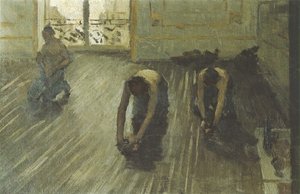
Gustave Caillebotte's 'The Floor Scrapers (study)' captures Parisian laborers with striking realism and light. Explore this iconic Impressionist work depicting urban life, showcasing Caillebotte’s unique perspective.
Βιογραφικό Καλλιτέχνη
Ο Γουσταβός Καλιμπώτ είναι ένας πρωτοποριακός γάλλος ζωγράφος, γνωστός για τις ρεαλιστικές και ιμπρεσιονιστικές απεικονίσεις της σύγχρονης Παριζίνης. Δείτε τα έργα του!
Σχετικά με το έργο
The Floor Scrapers (Study) 02: A Glimpse into Parisian Labor
Gustave Caillebotte’s “The Floor Scrapers (Study) 02,” painted in 1875, isn't merely a depiction of three men diligently working; it’s a meticulously observed and subtly powerful portrait of urban life in late 19th-century Paris. This early work, often considered a pivotal piece in Caillebotte’s artistic development, offers a rare and intimate view into the lives of the city's working class – a subject largely absent from the grand narratives of the era. The painting immediately draws the eye with its stark contrast: the muted tones of the darkened room, punctuated by the bright white of the freshly sanded floorboards, create an almost photographic realism that was revolutionary for its time.
Caillebotte’s artistic journey began with a formal training in law and engineering, but it was his encounter with photography – particularly the work of Nadar – that profoundly shaped his approach to painting. He recognized the power of capturing fleeting moments and precise details, mirroring the photographic process. This influence is evident in the meticulous rendering of the men’s postures, their tools, and the textures of the wood. The composition itself feels deliberately staged, reminiscent of a photograph, with its careful attention to perspective and lighting. The figures are not idealized; they are presented as ordinary laborers, their faces obscured by shadow, emphasizing their anonymity within the bustling city.
Impressionistic Techniques and a Revolutionary Perspective
“The Floor Scrapers” exemplifies Caillebotte’s early embrace of Impressionism, though with a distinct realism that sets him apart from many of his contemporaries. He employed broken brushstrokes to capture the play of light on the wood and the men's clothing, creating a sense of movement and atmosphere. The use of complementary colors – the cool blues and greens of the shadows against the warm browns and yellows of the floor – adds depth and vibrancy to the scene. Notably, Caillebotte’s decision to depict these laborers in a darkened room, bathed in the diffused light of an unseen window, was a bold departure from traditional studio settings. This choice immediately imbued the painting with a sense of immediacy and authenticity.
Furthermore, Caillebotte's innovative perspective—a low-angle shot that emphasizes the scale of the men and their work—was groundbreaking. It forces the viewer to confront the scene directly, fostering a feeling of intimacy and engagement. The composition isn’t about glorifying labor; it’s about presenting it as a fundamental aspect of urban existence. The painting's technical mastery lies in its ability to convey both the physical reality of the work and the emotional weight of the men’s efforts.
Symbolism and Social Commentary
While seemingly straightforward, “The Floor Scrapers” carries subtle layers of symbolism. The act of scraping floors represents a repetitive, demanding task – a symbol of the daily grind endured by countless working-class individuals in Paris at the time. The absence of any discernible hierarchy or leadership among the men suggests a shared experience of labor and resilience. It’s important to note that Caillebotte was one of the first artists to depict urban proletariat, a subject rarely addressed in art during this period. This choice speaks volumes about his desire to challenge conventional artistic norms and offer a more nuanced representation of Parisian society.
The painting's historical context is crucial to understanding its significance. Paris in the 1870s was undergoing rapid industrialization, leading to significant social and economic changes. The working class faced harsh conditions, long hours, and low wages. Caillebotte’s work serves as a poignant reminder of these realities, offering a glimpse into the lives of those often overlooked by history.
A Timeless Reflection on Labor and Urban Life
“The Floor Scrapers (Study) 02” remains a powerful and evocative artwork. It's not just a depiction of three men working; it’s a meditation on labor, poverty, and the human condition. Caillebotte’s meticulous observation, innovative perspective, and subtle symbolism combine to create a work that continues to resonate with viewers today. Reproductions of this painting offer an opportunity to appreciate Caillebotte's artistic vision and gain a deeper understanding of Parisian life in the 19th century – a testament to the enduring power of art to illuminate social realities.
Ερωτήσεις και Απαντήσεις
Με τι υλικά είναι φτιαγμένο το "The Floor Scrapers (study) 02" και σε ποιο στυλ;
Το έργο "The Floor Scrapers (study) 02" είναι φτιαγμένο με την τεχνική Acrylic On Canvas, σε στυλ Impressionist Painting.
Υπάρχει κάποιο ενημερωτικό φυλλάδιο για το "The Floor Scrapers (study) 02" του Γουσταβός Καλιμπώττης που να απευθύνεται σε φοιτητές;
Η σελίδα Οδηγός για το έργο "The Floor Scrapers (study) 02" του Γουσταβός Καλιμπώττης προσφέρει ένα εκτυπώσιμο ενημερωτικό φυλλάδιο δύο σελίδων: το έργο τέχνης με τον πίνακα ταυτότητάς του, μια χρονική ζώνη που το τοποθετεί μέσα στη διάρκεια της ζωής του καλλιτέχνη, άλλα έργα του ίδιου δημιουργού, την αναλυτική παλέτα χρωμάτων και έτοιμες για αντιγραφή αναφορές σε τέσσερα στυλ.
Ποιο χρώμα κυριαρχεί στο "The Floor Scrapers (study) 02";
Το χρώμα που ξεχωρίζει περισσότερο στο "The Floor Scrapers (study) 02" είναι το Espresso (#504d40). Το κυρίαρχο χρώμα είναι χρήσιμο όταν συνδυάζετε ένα έργο τέχνης με έναν εσωτερικό χώρο.
Γρήγορα στοιχεία και κвиζ τέχνης
Σχετικά με τον Γουσταβός Καλιμπώττης

Γουσταβός Καλιμπώττης
1848 - 1894, Γαλλία
Βιογραφικό Καλλιτέχνη
A Parisian of the New Age: The Life and Art of Gustave Caillebotte
Gustave Caillebotte, born into a prosperous Parisian family in 1848, stands as a uniquely positioned artist—a witness and chronicler of the dramatic transformations reshaping his city. His father, Martial Caillebotte, inherited a successful textile business and served as a judge, providing Gustave with both financial security and an invaluable vantage point from which to observe the burgeoning modern world. Initially drawn to the structured path of law – earning degrees in law in 1868 and 1870 – Caillebotte’s true calling swiftly revealed itself within the realm of art. He embarked on serious training under Léon Bonnat, immersing himself deeply in painting while simultaneously cultivating a keen fascination with photography, an emerging medium that would profoundly influence his artistic vision—its framing, perspective, and ability to capture fleeting moments becoming integral elements of his distinctive style. Caillebotte’s engagement wasn't merely about documenting change; it was a deliberate act of engaging with the aesthetic possibilities inherent in this dynamic era.Realism Infused with Impressionist Light
Caillebotte’s artistic trajectory diverged from the rigid confines of academic tradition, yet he never fully embraced the purely optical explorations characteristic of many of his Impressionist contemporaries. He found a kindred spirit in artists like Edgar Degas and Giuseppe de Nittis, sharing a fascination with modern life but approaching it through a lens of meticulous realism. His early masterpiece, Les Raboteurs de Parquet (The Floor Scrapers), exhibited at the 1875 Salon, immediately established his reputation as a bold and unconventional painter. The work depicts three laborers painstakingly scraping a wooden floor—a scene of quiet industry rendered with an unflinching honesty that initially shocked some viewers while captivating others. It wasn’t simply the subject matter – the working class rarely graced the canvases of high art – but also the composition: cropped, almost jarringly direct, and deliberately devoid of sentimental idealization. This commitment to portraying contemporary life without resorting to romantic embellishment continued in works like View of Rooftops (Snow), where he masterfully captured the stark beauty of Parisian rooftops blanketed in winter’s embrace, utilizing a high vantage point and subtle atmospheric effects—techniques that hinted at his growing influence from photography and Japanese prints. However, Caillebotte wasn't entirely immune to the allure of Impressionism; his palette gradually lightened, and he began experimenting with broken brushstrokes and shimmering reflections, particularly evident in his evocative depictions of Parisian boulevards and urban landscapes.A Patron and a Pioneer: Navigating the Art World
Beyond his own artistic endeavors, Caillebotte played an unexpectedly significant role in supporting the burgeoning Impressionist movement. His financial independence—a direct result of his father’s success – allowed him to become a crucial patron, purchasing works by Monet, Renoir, Pissarro, Cézanne, Degas, and others at a time when their art was largely dismissed by the conservative Salon jury. This wasn't merely a matter of collecting; Caillebotte actively championed these artists, tirelessly organizing and financing several of the Impressionist exhibitions that defied conventional artistic norms—a bold move that challenged the established order. He understood that the future of art lay in embracing innovation and portraying the realities of modern life. His dedication extended to his own collection, which he bequeathed to the French state upon his untimely death in 1894 – a bequest initially met with skepticism but ultimately forming the cornerstone of the Musée d’Orsay's renowned Impressionist holdings. Caillebotte’s unique perspective also manifested in his compositions; works like Boulevard vu d’en haut (Boulevard Seen from Above), painted in 1880, demonstrate a strikingly modern sensibility—employing an elevated viewpoint and dynamic cropping that subtly foreshadowed the photographic perspectives of the 20th century. This innovative approach to composition, possibly influenced by Japanese prints and his own photographic experiments, set him apart as a true pioneer, anticipating future artistic developments.Notable Works
- Les Raboteurs de Parquet (The Floor Scrapers) (1875): A groundbreaking work showcasing Caillebotte’s realism and unconventional composition.
- View of Rooftops (Snow) (1878): Demonstrates his use of high vantage points and atmospheric effects, influenced by photography and Japanese prints.
- Boulevard vu d’en haut (Boulevard Seen from Above) (1880): A strikingly modern composition with a dynamic perspective.
- Paris Street; Rainy Day (1877): Perhaps his most famous work, capturing the bustling energy of Parisian life in a unique and evocative manner.
- The Bezique Game(1881) : A captivating Impressionist painting of Parisian leisure.
Legacy and Rediscovery: A Modern Master Reclaimed
For decades following his death, Caillebotte’s work remained largely obscured, overshadowed by the more celebrated figures of Impressionism. It wasn't until the late 20th century that a comprehensive reassessment of his art began to take hold, fueled by meticulous scholarly research and major exhibitions—a testament to the enduring power of his vision. This rediscovery revealed an artist of remarkable technical skill, intellectual depth, and visionary insight. Caillebotte’s paintings are not simply depictions of modern life; they are profound meditations on the complexities of urban existence, the shifting social landscape, and the evolving relationship between art and reality. His ability to seamlessly blend realism with Impressionist techniques, his innovative compositions, and his unwavering commitment to portraying the world around him have secured his place as a pivotal figure in 19th-century art—an artist who dared to capture the spirit of a new age.Γρήγορα στοιχεία για τον/την Γουσταβός Καλιμπώττης
- Artistic Movement Or Style: Ρεαλισμός, Ενπυσηματισμός
- Artists Or Movements Influenced By This Artist: ['Ενπυσηματισμός']
- Artists Who Influenced This Artist:
- Degas
- Nittis
- Date Of Birth: 19 Αυγ 1848
- Date Of Death: 21 Φεβ 1894
- Full Name: Gustave Caillebotte
- Nationality: Γάλλος
- Notable Artworks:
- Les Raboteurs de Parquet
- Rooftops (Snow)
- Boulevard vu d’en haut
- Place Of Birth: Παρίσι, Γαλλία
Σχετικά Έργα Τέχνης


Εξερευνήστε έργα τέχνης ταξινομημένα ανά θέμα, στυλ και χαρακτηριστικά.


Γουσταβός Καλιμπώττης
The Floor Scrapers (study) 02
() ·
Συμπεριλαμβανομένου του πλαισίου: · Χειροποίητο με λάδια σε λινό
Σύνολο