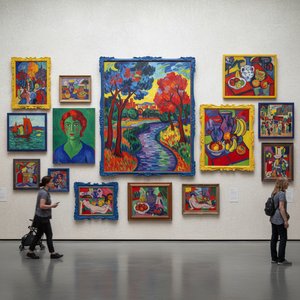
A Glimpse into Intimacy: Exploring Matisse’s Untitled Portrait
This captivating portrait by Henri Matisse offers a compelling study of feminine presence, rendered with the artist's signature sensitivity to color and form. While titled simply “untitled (8766),” this work reveals much about Matisse’s evolving style and his enduring fascination with capturing the essence of his subjects. The painting depicts a woman seated, her gaze direct yet contemplative, creating an immediate connection with the viewer.
Subject & Composition
The focal point is undoubtedly the woman herself. She is adorned with a necklace, drawing attention to her neckline, and notably bears a cross on her forehead – a detail that invites speculation about its significance, perhaps hinting at faith or personal devotion. The vibrant red curtain in the background provides a dramatic contrast to the woman’s more subdued attire, a flowing green cloth draped elegantly around her form. This use of contrasting colors is characteristic of Matisse's approach, creating visual energy and depth within the composition. Her seated posture suggests a moment of quiet introspection, inviting us into her private world.
Style & Technique
Though undated, this work likely falls within Matisse’s period of artistic exploration leading up to and including his Fauvist phase (roughly 1905-1908). While not as explosively colorful as some of his later works, the seeds of that bold aesthetic are present here. The brushwork appears fluid and expressive, prioritizing color relationships over strict representational accuracy.
Matisse’s emphasis on simplified forms and flattened planes anticipates his later experiments with abstraction. He doesn't aim for photographic realism but rather to convey a feeling, an impression of the woman’s character through color and line.
Historical Context & Influences
Born into a family of grain merchants, Matisse initially pursued law before dedicating himself to art. His early training at the Académie Julian and École Nationale des Beaux-Arts exposed him to traditional techniques, but he quickly began to forge his own path.
Influenced by artists like Chardin, Poussin, and Watteau, he developed a keen eye for composition and color harmony. However, it was his encounter with Post-Impressionists like Van Gogh and Gauguin that truly liberated him, inspiring him to embrace bold colors and expressive brushwork. This portrait reflects this transitional period, bridging the gap between academic tradition and the radical innovations of Fauvism.
Symbolism & Emotional Impact
The symbolism within the painting is subtle yet potent. The cross on the forehead could represent religious faith, a personal struggle, or simply an element of adornment. The red curtain acts as both a backdrop and a symbolic barrier, perhaps suggesting a sense of privacy or hidden emotions.
The overall effect is one of quiet dignity and inner strength. The woman’s gaze invites empathy, drawing the viewer into her world and prompting contemplation about her story.
For Collectors & Designers
This untitled portrait by Matisse offers a unique opportunity to own or reproduce a work that embodies the spirit of early 20th-century modernism. Its rich color palette and evocative composition make it a stunning focal point for any interior space. The painting’s intimate scale and contemplative mood lend themselves well to bedrooms, studies, or living rooms seeking a touch of artistic sophistication.
- Color Palette: Greens, reds, blues, creating a harmonious yet dynamic visual experience.
- Style: Transitional – bridging academic tradition with the emerging Fauvist movement.
- Emotional Tone: Introspective, dignified, and quietly powerful.
Whether you are an art collector seeking a significant piece or an interior designer looking for inspiration, this Matisse portrait is sure to captivate and inspire.



 Δείτε σε πραγματικό χώρο
 Αγορά χειροποίητου πίνακα
 Αποστολή
 Κοινοποίηση
 Λεπτομέρειες

 Λήψη
Λήψη
 Παρόμοια αντικείμενα συλλογής
 Ακτινογραφία
 Παρουσίαση

 Διαβάστε περισσότερα






































 Η επιλογή με γυαλί είναι διαθέσιμη μόνο για μεγέθη κάτω από 110 εκ.