Βιογραφία Καλλιτέχνη
Early Life and Artistic Beginnings
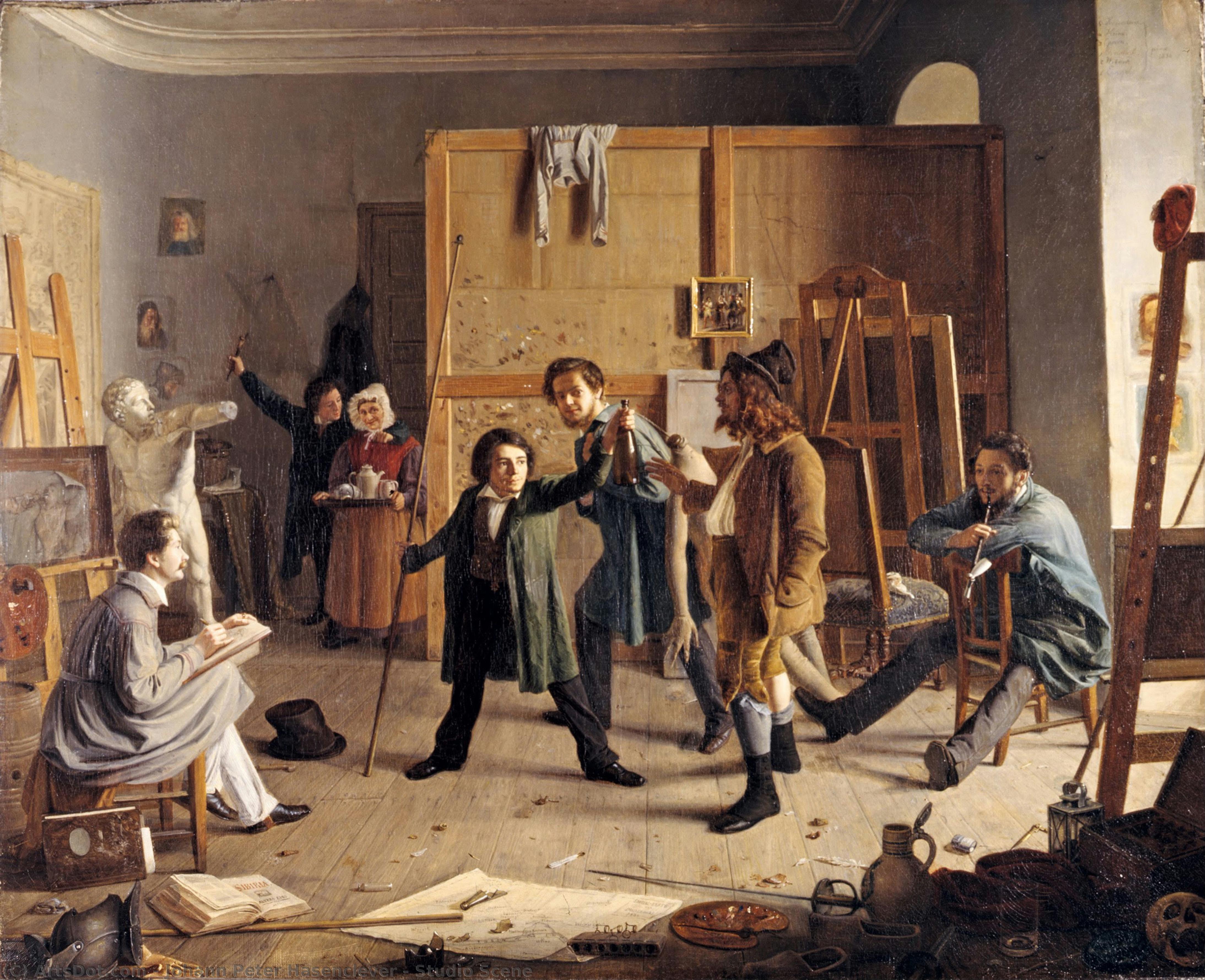
Johann Peter Hasenclever, born in the industrial town of Remscheid, Germany, on May 18th, 1810, emerged as a pivotal figure within the Düsseldorf School of painting. His father, a toolsmith deeply rooted in the local iron trade, provided a practical upbringing, yet it was an early aptitude for drawing that would chart a different course for young Johann Peter. At age ten, he began schooling in Ronsdorf and soon found himself under the tutelage of Johann Peter Fasbender, a teacher who recognized and actively nurtured his burgeoning talent. This encouragement proved crucial; at seventeen, Hasenclever enrolled at the prestigious Kunstakademie Düsseldorf, initially studying architecture before pivoting to history painting under the direction of Friedrich Wilhelm von Schadow. However, this first foray into formal training was short-lived—Schadow’s expressed doubts about his abilities led to a temporary retreat from academic instruction.
Undeterred, Hasenclever returned to study in 1836 with Theodor Hildebrandt, an artist deeply inspired by the Dutch Golden Age masters. This second attempt at formal education proved transformative. Genre painting, still relatively nascent in Germany, captivated him, and he began to develop a style that would become synonymous with capturing the nuances of everyday life.
The Rise to Prominence: Munich and the *Jobsiade* Illustrations
A move to Munich in 1838 marked a turning point in Hasenclever’s career. It was here he received his first significant commission—to create illustrations for Carl Arnold Kortum's satirical poem, the *Jobsiade*. This work, a humorous and often ironic chronicle of a “perpetual student” whose life takes an unexpected turn as a night watchman, provided Hasenclever with fertile ground to explore his burgeoning talent. He produced twenty paintings that were subsequently lithographed for publication, bringing his art to a wider audience. The series resonated deeply, capturing the spirit of the time and establishing him as a rising star. A pivotal moment came in 1840 when King Ludwig I of Bavaria acquired “Hieronymus Jobs at the Exam,” solidifying Hasenclever’s reputation and paving the way for his return to Düsseldorf three years later.
Düsseldorf, Biedermeier Life, and Social Commentary
Upon his return to Düsseldorf in 1843, Hasenclever was welcomed as a celebrated artist and inducted into the Prussian Academy of Arts. This period saw him fully embrace depictions of everyday life during the Biedermeier era—a time characterized by domesticity, simplicity, and a focus on middle-class values. However, Hasenclever’s work transcended mere idyllic representation. He possessed a keen eye for social commentary, subtly embedding critiques within his seemingly innocuous scenes. His paintings often reveal humorous observations of human foibles and the complexities of societal norms.
His personal life also flourished during this time; he married Caroline Anna Babette Trentini in 1843, and they had three children. Hasenclever’s commitment to social issues extended beyond his art. He became involved in the political movements of the Vormärz period—the years leading up to the revolutions of 1848—and was among the first German artists to actively incorporate social critique into their work, joining the anti-academic artist's association “Crignic” and contributing to the satirical *Düsseldorfer Monathefte*.
Influences, Style, and Lasting Legacy
Hasenclever’s artistic development was shaped by a diverse range of influences. The Dutch Golden Age masters, particularly their genre scenes, provided a foundation for his meticulous attention to detail and realistic portrayal of everyday life. He also drew inspiration from English painters like William Hogarth and Thomas Rowlandson, admiring their satirical wit and ability to capture the nuances of human character. David Wilkie’s “The Opening of the Will” proved especially impactful, influencing Hasenclever's use of theatrical lighting and exaggerated physiognomy.
His style is characterized by a blend of realism and humor, often infused with subtle social commentary. He masterfully depicted interiors and scenes of middle-class life, capturing both the charm and the underlying tensions of Biedermeier society.
Final Years and Historical Significance
Tragically, Johann Peter Hasenclever’s life was cut short by typhus in December 1853 at the age of forty-three. Shortly before his death, Karl Marx himself praised his work, specifically highlighting “Worker's Delegation Before the Magistrate” as an example of proletarian art—a testament to the power and resonance of his social commentary. While largely overlooked for a period after his passing, Hasenclever experienced a revival in interest during the 1960s and 70s, particularly within the German Democratic Republic, where art historians like Wolfgang Hütt recognized the Marxist elements present in his paintings. Today, he is celebrated as one of Germany’s most important genre painters of the 19th century, an artist who not only captured the spirit of his time but also dared to challenge its conventions and offer a critical reflection on society. His influence can be seen in the work of artists such as Carl Spitzweg and Wilhelm Busch, solidifying his place as a significant figure in German art history.


 Προεπισκόπηση
 Μετάβαση στην Εκτύπωση
 Αποστολή
 Κοινοποίηση
 Λεπτομέρειες

 Λήψη
Λήψη
 Παρόμοια έργα
 Ακτινογραφία
 Παρουσίαση


 Περισσότερα λεπτομέρεια






































 Η επιλογή με γυαλί είναι διαθέσιμη μόνο για μεγέθη κάτω από 110 εκ.



