
 Προεπισκόπηση σε πραγματική κλίμακα
 Αποστολή
 Κοινοποίηση
 Λεπτομέρειες
 Οδηγός

 Λήψη
Λήψη
 Παρόμοια αντικείμενα συλλογής
 Ακτινογραφία
 Παρουσίαση
 Q&A
Q&A Στατιστικά
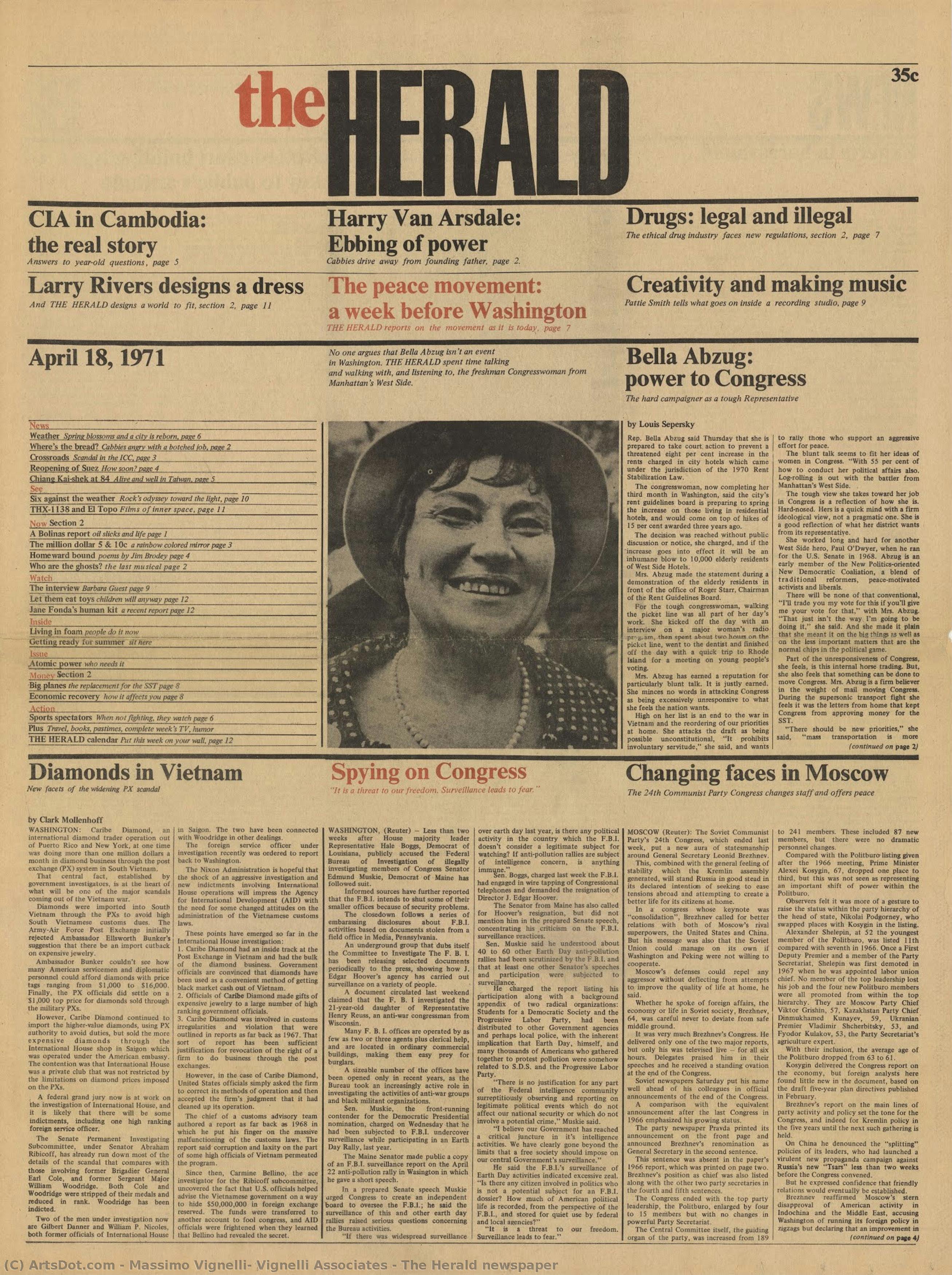
The Herald newspaper

- 43.0 x 57.0 cm


Experience the modernist grid design of The Herald newspaper by Massimo Vignelli (1971), showcasing vintage graphic communication art; discover this iconic piece today.
 Περισσότερα
Μπρεζιέλι: Ιταλός σχεδιαστής σύγχρονης τέχνης γνωστός για τον μινιμαλισμό και τις απλές γραφικές του δημιουργίες όπως το μετρό της Νέα Υόρκης και οι εταιρικές ταυτότητες. Ανακαλύψτε την κληρονομιά του!
Το έργο τέχνης που εμφανίζεται σε αυτή τη σελίδα προστατεύεται από τους νόμους περί πνευματικών δικαιωμάτων, γεγονός που σημαίνει ότι δεν μπορούμε νομικά να δημιουργήσουμε ή να πουλήσουμε μια ταυτόσημη αναπαραγωγή του. Αυτή η προστασία επιβάλλεται βάσει διεθνών συμφωνιών, όπως η Σύμβαση της Βέρνης καθώς και από τους εθνικούς νόμους, συμπεριλαμβανομένων αυτών που ορίζονται από το Νομοθεσία περί πνευματικών δικαιωμάτων των ΗΠΑ - Τίτλος 17. Όλα τα δικαιώματα κατοχυρωμένα. Απαγορεύεται η αναπαραγωγή χωρίς άδεια.
Αυτή η μέθοδος συμμορφώνεται πλήρως με τους κανονισμούς περί πνευματικών δικαιωμάτων, καθώς δεν περιλαμβάνει την αντιγραφή ή την αναπαραγωγή του προστατευόμενου έργου. Αντίθετα, πρόκειται για μια δημιουργική ερμηνεία — ένα νέο έργο που επηρεάζεται από το πρωτότυπο, χωρίς όμως να είναι πανομοιότυπο με αυτό.
Giclée / Εκτυπώσεις Τέχνης
Εκτύπωση giclée ή σε καμβά ποιότητας μουσείου με γρήγορη παραγωγή και ευέλικτες επιλογές φινιρίσματος. ( Αγορά χειροποίητου πίνακα Μετάβαση σε Ψηφιακή Αποτέλεσμα)




P118B €10

P118H €10

P118W €10

P438Z €10

P508JH €12

P508YH €12

P805H €10

P805Z €10

P919BZ €10

P919G €10

P919XJ €10

P959ZH €10

P968JZ €12

W106C €8

W218G €10

W218JH €8

W218Y €10

W307PJ €10

W316G €10

W316PJ €8

W316Y €10

W398PJ €8

W4111J €10

W500HY €15

W500JH €15

W692G €12

W849H €8

W940BG €15

W953PJ €8




Πρότυπο
κατόπιν παραγγελίας
CM
INCH
Επιλέξτε από τις προκαθορισμένες διαστάσεις μας που διατηρούν τις αρχικές αναλογίες του έργου τέχνης.
Loading sizes...

πλάτος
ύψος
Εισάγετε το πλάτος και το ύψος που επιθυμείτε, ώστε να ταιριάζουν στο κάδሮ ή στον τοίχο σας. Μια εκτύπωση μπορεί μόνο να υποστεί κοψίμό και ποτέ να μην γίνει μεγαλύτερη από την αρχική εικόνα, επομένως η επιλογή μεγέθους με διαφορετικό σχήμα συνεπάγεται απώλεια ενός μέρους της εικόνας. Σας στέλνουμε ένα ψηφιακό mockup για έγκριση πριν προχωρήσουμε σε οποιαδήποτε εκτύπωση. Η εικόνα που εμφανίζεται σε αυτή τη σελίδα δεν δείχνει την πραγματική κοπή — μόνο το mockup την παρουσιάζει.
Παγκόσμια Αποστολή () σε 2 εβδομάδες αντί για τις συνήθεις 4/5 εβδομάδες. (1 Νοέμβριος)

Δωρεάν γρήγορη διεθνής αποστολή

Κάμβας από Λινό Υψηλής Ποιότητας

Πλήρης ασφάλιση μεταφοράς

Εγγύηση επιστροφής δασμών και φόρων εισαγωγής

Εγγύηση Απόλυτης Ομοιότητας Χρωμάτων

Πολιτική Επιστροφής 100 Ημερών (Μόνο σε περίπτωση ελαττωμάτων)

Εγγύηση επιστροφής 100% των χρημάτων

Προσφορά για πολλαπλές παραγγελίες
 Η επιλογή με γυαλί είναι διαθέσιμη μόνο για μεγέθη κάτω από 110 εκ.

The Herald newspaper
Giclée / Εκτυπώσεις Τέχνης
Διαστάσεις Αναπαραγωγής
-


Τελική Τιμή
€ 61
The Grid of Modern Communication: Vignelli's The Herald
To encounter this piece is to step directly into the vibrant, structured chaos of mid-century New York journalism. This reproduction of The Herald newspaper from April 1971, conceived by Massimo Vignelli and his associates, is far more than mere ephemera; it is a meticulously designed artifact of visual communication history. It captures a moment when design principles—simplicity, functionality, and rigorous structure—were being aggressively applied to the seemingly unruly medium of print journalism. The very act of presenting this newspaper front page transforms what might be considered disposable media into a profound study in modernist graphic discipline.
A Masterclass in Structured Design
Vignelli’s genius, always rooted in an almost architectural understanding of space, is on full display here. The description notes the structure: a rigid grid of six columns and sixteen modules per column. This underlying skeleton dictates every element—the placement of headlines like "Diamonds in Vietnam," the accompanying portrait of the smiling woman, and the smaller articles detailing everything from spying congress to changing leaves in Moscow. Vignelli’s commitment to using a single typeface, Times Roman, across various weights and sizes, speaks volumes about his belief in universal legibility. It is a powerful testament to the idea that restraint—the disciplined use of negative space and consistent typography—can generate an overwhelming sense of order and sophistication.
Historical Resonance and Materiality
The year 1971 places this work within a fascinating cultural nexus, post-war modernism grappling with the burgeoning media landscape. While the paper itself ultimately folded due to distribution issues, its surviving design remains potent. For the collector or designer, understanding this context is key. This piece speaks to an era obsessed with efficiency and clarity in information transfer. When considering a reproduction for your space, you are not just acquiring art; you are curating a dialogue about how we consume knowledge—a conversation between the fleeting headline and the enduring power of good design.
Symbolism of the Grid
The grid itself functions as the primary symbolic element. In an age where digital information often feels overwhelming, this physical manifestation of order offers a visual anchor. It symbolizes control, but not oppressive control; rather, it suggests that even complex narratives—the confluence of international events and local interest—can be organized into digestible, beautiful patterns. The interplay between the large, arresting photograph and the tightly packed textual modules creates a dynamic tension, mirroring the very energy of a bustling city like New York in that era.
Bringing Modernist Precision Home
For interior design or gallery display, this piece offers an unparalleled opportunity to inject intellectual rigor into a space. It pairs beautifully with minimalist furniture, mid-century modern accents, or any setting that appreciates the clean lines of 20th-century industrial aesthetics. Owning this reproduction is an homage to Massimo Vignelli’s lifelong dedication to elevating the mundane—the daily newspaper—into something enduringly beautiful and intellectually stimulating.
Ερωτήσεις και Απαντήσεις
Σε ποιο καλλιτεχνικό ρεύμα ανήκει το "The Herald newspaper";
Το καλλιτεχνικό ρεύμα που συνδέεται με το "The Herald newspaper" του Massimo Vignelli, Vignelli Associates είναι το Modernism. Αυτή η ταξινόμηση τοποθετεί το έργο ανάμεσα σε σχετικούς καλλιτέχνες και έργα τέχνης.
Ποια είναι η προτεινόμενη χρήση μιας εκτύπωσης του "The Herald newspaper";
Η προτεινόμενη χρήση μιας εκτύπωσης του "The Herald newspaper" είναι η Statement.
Ποιο είναι το σχήμα και οι διαστάσεις του έργου "The Herald newspaper" του Massimo Vignelli, Vignelli Associates;
Το σχήμα του "The Herald newspaper" είναι Portrait και οι πρωτότυπες διαστάσεις είναι 43 x 57 cm. Και τα δύο είναι χρήσιμα κατά τον σχεδιασμό μιας αναπαραγωγής.
Βιογραφικό Καλλιτέχνη
Μια Ζωή Αφιερωμένη στο Σχήμα: Ο Κόσμος του Massimo Vignelli
Γεννημένος στο Μιλάνο της Ιταλίας το 1931, το ταξίδι του Massimo Vignoli ήταν μια πορεία αφοσιωμένη αδιάσπαστα στις αρχές του μοντερνιστικού σχεδιασμού. Από νεαρή ηλικία, επέδειξε μια ενστικτώδη κατανόηση της οπτικής επικοινωνίας, ξεκινώντας την επίσημη εκπαίδευσή του στην αρχιτεκτονική στο Politecnico di Milano και στη συνέχεια συνεχίζοντας στο Università Iuav di Venezia. Ωστόσο, ήταν η μαθητεία με τους σεβαστούς αδελφούς Castiglioni – πρωτοπόρους στον ιταλικό βιομηχανικό σχεδιασμό – που πυροδότησε πραγματικά το πάθος του για τη διαμόρφωση του κόσμου μέσω της στοχαστικής δημιουργίας. Αυτή η πρώιμη επαφή εμφύτευσε σε αυτόν την πίστη στη λειτουργικότητα, την απλότητα και τη δύναμη των κομψών λύσεων για τα καθημερινά προβλήματα. Δεν σχεδίαζε απλώς αντικείμενα· δημιουργούσε εμπειρίες, βελτιστοποιούσε τις αλληλεπιδράσεις και αναβάθμιζε το κοινό σε κάτι αξέχαστο. Αυτή η formative περίοδος έθεσε τα θεμέλια για μια καριέρα που θα επαναπροσδιορίσει την οπτική κουλτούρα σε ολόκληρες ηπείρους.Από την Ιταλία στη Νέα Υόρκη: Μια Διηπειρωτική Όραση
Η πορεία του Vignelli τον οδήγησε στην Αμερική το 1966, όπου لعبόταν καθοριστικό ρόλο στη δημιουργία του γραφείου της Unimark International στη Νέα Υόρκη. Αυτό σήμανε μια κομβική στιγμή, όχι μόνο για την καριέρα του αλλά και για το τοπίο του αμερικανικού σχεδιασμού. Η Unimark ανέδρυσε γρήγορα τη φήμη της, και οι συνεισφορές του Vignelli – πιο χαρακτηριστικά το διαχρονικό λογότυπο της American Airlines – εδραίωσαν τη φήμη του ως δάσκαλος της εταιρικής ταυτότητας. Ωστόσο, μια αυξανόμενη απόκλιση στη δημιουργική φιλοσοφία τον ώθησε να ξεκινήσει μια ανεξάρτητη επιχείρηση. Το 1971, μαζί με τη σύζυγό του και διαχρονική συνεργάτη του, Lella Vignelli, ίδρυσε το Vignelli Associates. Αυτή η συνεργασία αποδείχθηκε εξαιρετικά καρποφόρος, αποτελώντας συνώνυμο με εξελιγμένες λύσεις σχεδιασμού που περιλάμβαναν γραφικό σχεδιασμό, εσωτερική διακόσμηση, σχεδιασμό προϊόντων και αρχιτεκτονική. Η φιλοσοφία της εταιρείας είχε ρίζες στην πεποίθηση ότι ο καλός σχεδιασμός πρέπει να είναι προσβάσιμος, διαχρονικός και βαθιά χρήσιμος – αρχές τις οποίες υποστήριξαν σταθερά σε όλη τους την καριέρα.Εμβληματικές Δημιουργίες: Μια Κληρονομιά Διαύγειας
Η επιρροή του Massimo Vignelli είναι υφασμένη στο ίδιο το κοινωνικό ιστό της σύγχρονο ζωής. Ίσως η πιο αναγνωρίσιμη επίτευξή του είναι ο επανασχεδιασμός του χάρτη του Μετρό της Νέας Υόρκης το 1972. Παρόλο που αρχικά προκάλεσε αμφισβητήσεις λόγω της απόκλισης από την αυστηρή γεωγραφική ακρίβεια, αποτέλεσε μια τολμηρή δήλωση διαύγειας και χρηστικότητας. Ο Vignelli έθεσε σε προτεραιότητα την αναγνωσιμότητα και την διαισθητική πλοήγηση έναντι της κυριολεκτικής αναπαράστασης, δημιουργώντας έναν διαγραμματικό χάρτη που συνεχίζει να καθοδηγεί εκατομμύρια επιβάτες καθημερινά. Αυτό το έργο ενσαρκώνει τη βασική του σχεδιαστική φιλοσοφία: την προτεραιότητα στην επικοινωνία πάνω από όλα. Πέρα από τον χάρτη του μετρό, το Vignelli Associates άφησε ένα αμείωτο αποτύπωμα σε αμέτρητα brands και θεσμούς. Η εργασία τους για το Bloomingdale’s – συμπεριλαμβανομένης της εμβληματικής καφέ χάρτινης σακούλας με το απλό λευκό λογότυπό της – μετέτρεψε μια εμπειρία αγορών σε μια δήλωση στυλ. Σχεδίασαν έπιπλα για την Knoll, συσκευασίες για την Heller και εταιρικές ταυτότητες που έγιναν αμέσως αναγνωρίσιμα σύμβολα ποιότητας και καινοτομίας. Το Heller Rainbow Dinnerware αποτελεί μαρτυρία της μινιμαλιστικής του αισθητικής, αναδεικνύοντας έντονα χρώματα μέσα σε καθαρές γεωμετρικές μορφές. Το αφίσα της Tredicesima Triennale di Milano ενσαρκώνει την τολμηρή χρήση του χρώματος και του σχήματος, ενώ το εξώφυλλο του Knoll Design επιδεικνύει την ικανότητά του να δημιουργεί εντυπωσιακά οπτικά στοιχεία για διάσημα brands.Μια Διαχρονική Επιρροή: Πέρα από την Αισθητική
Η επίδραση του Massimo Vignelli εκτείνεται πολύ πέρα από μεμονωμένα έργα· αναδιαμόρφωσε θεμελιωδώς τον τρόπο με τον οποίο αντιλαμβανόμαστε τον ίδιο τον σχεδιασμό. Ήταν ένας ακλόνητος υποστηρικτής της τυπογραφικής πειθαρχίας, προτείνοντας με φήμη ένα περιορισμένο παλέτα γραμματοσειρών – πιστεύοντας ότι η πραγματική δημιουργικότητα δεν βρίσκεται στις ατέλειωτες επιλογές αλλά στην άριστη εκτέλεση με προσεκτικά επιλεγμένα εργαλεία. Το βιβλίο του, The Vignelli Canon, έγινε ένα manifesto για τους σχεδιαστές, περιγράφοντας τις αρχές της διαύγειας, της απλότητας και της διαχρονικής κομψότητας. Δεν δημιουργούσε απλώς οπτικά ευχάριστα αντικείμενα· προσπαθούσε να δημιουργήσει τάξη μέσα στο χάος, να επικοινωνήσει αποτελεσματικά και να αναβαθμίσει την ανθρώπινη εμπειρία μέσω της στοχαστικής σχεδίασης. Το έργο του συνεχίζει να εμπνέει γενιές σχεδιαστών, υπενθυμίζοντάς τους ότι η πραγματική καινοτομία βρίσκεται στην αφαίρεση του περιττού και στην εστίαση στο ουσιαστικό. Το Vignelli Center for Design Studies στο Rochester Institute of Technology αποτελεί μια μόνιμη τιμή στη κληρονομιά του, διατηρώντας ένα εκτεταμένο αρχείο της εργασίας του και προωθώντας την αδιάκοπη εξερεύνηση των πρωτοποριακών του ιδεών. Πέθανε το 2014, αλλά οι δημιουργίες του παραμένουν ισχυρά παρούσες, διαμορφώνοντας τον κόσμο μας με την αιώνια κομψότητά τους και την αδιάσπαστη δέσμευσή τους στη διαύγεια.
Massimo Vignelli, Vignelli Associates
1931 - 2014 , Ιταλία
Γρήγορα στοιχεία
- Artistic Movement Or Style: Μοντερνισμός
- Artists Who Influenced This Artist:
- Αχιλλές Καστιλγιόνι
- Πιερ Γιακόμο Καστιλγιόνι
- Date Of Birth: 1931
- Full Name: Massimo Vignelli
- Nationality: Ιταλός
- Notable Artworks:
- Σχεδιασμός Μετρό Νέας Υόρκης
- Λογότυπος Αμερικανικών Αερογραμμών
- Place Of Birth: Μιλάνο
Σχετικά άρθρα

TopImpressionists.com F.A.Q.: Discover the Vibrant Beauty of Our Premium Art Poster Prints
Explore the technical excellence of TopImpressionists.com's premium art poster prints. Discover how our 12-color pigment system and archival inks capture the luminous beauty of Impressionist masterpieces with unmatched color fidelity and museum-grade durability for the discerning collector.
Εξερευνήστε έργα τέχνης ταξινομημένα ανά θέμα, στυλ και χαρακτηριστικά.


