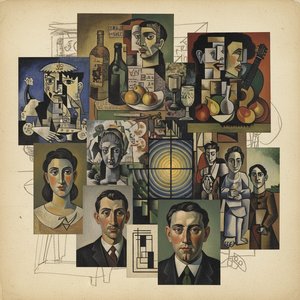
A Dance of Forms: Unveiling Picasso’s ‘Figures on a Beach’
Pablo Picasso's *Figures on a Beach* is more than just a depiction of two figures by the sea; it’s a pivotal work illustrating his groundbreaking journey into Cubism. This oil painting, brimming with dynamic energy and innovative perspective, captures a fleeting moment – perhaps a dance, a playful interaction, or an intimate embrace – rendered through the fragmented lens that would define much of 20th-century art. The artwork invites us to reconsider how we perceive form, space, and the human figure itself.
Deconstructing Reality: Style & Technique
The painting exemplifies Picasso’s Proto-Cubist phase, a crucial stepping stone towards fully realized Cubism. Notice how the figures aren't presented with traditional anatomical accuracy. Instead, they are constructed from geometric shapes – planes and angles that overlap and intersect. This fracturing of form isn’t about inaccuracy; it’s about presenting multiple viewpoints simultaneously, offering a more complete, albeit unconventional, understanding of the subject. The warm palette of oranges and browns dominates, contrasting beautifully with the cool blues suggesting the sea and sky. Picasso's brushwork appears fluid yet deliberate, creating texture and depth within the fragmented composition. He masterfully balances abstraction with recognizable human forms, maintaining an emotional resonance despite the deconstruction.
Historical Currents: Context & Influences
Created during a period of radical artistic experimentation (around 1904-1905), *Figures on a Beach* reflects Picasso’s response to several key influences. He was moving away from the sentimental naturalism of his earlier work and engaging with the burgeoning avant-garde movements in Paris. The influence of Paul Cézanne, whose emphasis on geometric structure profoundly impacted Picasso, is evident here. Simultaneously, African sculpture – particularly its simplified forms and expressive power – played a role in shaping Picasso’s aesthetic. This period also saw the rise of Fauvism, with its bold use of color, though Picasso quickly diverged towards a more analytical approach to form.
Beyond the Surface: Symbolism & Interpretation
While not overtly symbolic, *Figures on a Beach* evokes a sense of intimacy and perhaps melancholy. The intertwined figures suggest connection, but their fragmented forms also hint at a certain instability or impermanence. The beach itself can be interpreted as a liminal space – a boundary between land and sea, representing transition and the passage of time. The ambiguity inherent in the Cubist style encourages viewers to project their own emotions and interpretations onto the artwork, making it a deeply personal experience.
Emotional Resonance & Lasting Impact
*Figures on a Beach* is not simply an intellectual exercise; it’s a powerfully emotive work. The dynamic composition and distorted forms create a sense of movement and energy, while the warm color palette evokes feelings of warmth and sensuality. This painting represents a pivotal moment in art history – a bold departure from traditional representation that paved the way for countless artistic innovations. It remains a compelling example of Picasso’s genius and his enduring influence on modern art.
- Cubism: A revolutionary art movement characterized by fragmented forms, multiple perspectives, and geometric abstraction.
- Proto-Cubism: The transitional phase leading to Cubism, marked by experiments in geometrizing form and reducing color palettes.
- Avant-Garde: Refers to innovative or experimental concepts and works, particularly in the arts.
Discover the power of owning a piece of art history. High-quality reproductions of Picasso’s ‘Figures on a Beach’ are available, allowing you to bring this iconic work into your home or office.



 Preview
 Αγοράστε την αναπαραγωγή
 Αποστολή
 Κοινοποίηση
 Λεπτομέρειες

 Λήψη
Λήψη
 Παρόμοια έργα
 Ακτινογραφία
 Παρουσίαση

 Περισσότερα λεπτομέρεια






































 Η επιλογή με γυαλί είναι διαθέσιμη μόνο για μεγέθη κάτω από 110 εκ.