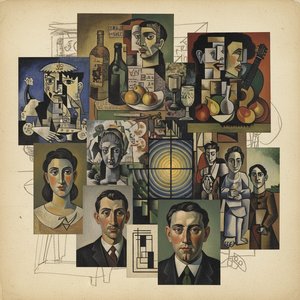
Overview of "Three Dancers" by Pablo Picasso
“Three Dancers” (Les Trois Danseuses), created in June 1925 by the renowned Spanish artist Pablo Picasso, is a captivating oil on canvas artwork measuring 37 x 32 cm. This piece exemplifies Picasso's exploration of Surrealism and reflects a period of personal turmoil and artistic experimentation. The painting depicts three dancers engaged in a frenetic performance within an undefined space, showcasing Picasso’s signature fragmented style and emotional depth.
Style and Technique: A Dive into Surrealism
“Three Dancers” is firmly rooted in the Surrealist movement, which emerged as a reaction to the rationalism of the early 20th century. Surrealists sought to unlock the power of the subconscious mind through art, often employing dreamlike imagery and unexpected juxtapositions. Picasso’s approach here is characterized by distorted figures, angular forms, and a sense of unsettling dynamism. The dancers are not rendered realistically; instead, they are deconstructed into geometric shapes and planes, reflecting Picasso's earlier Cubist explorations while embracing the emotional intensity of Surrealism.
The technique employed in "Three Dancers" is notable for its bold brushstrokes and vibrant color palette. While the overall tone leans towards darker hues, flashes of bright colors punctuate the composition, adding to the painting’s unsettling energy. Picasso's use of oil paint allows for rich textures and layering, further enhancing the sense of movement and emotional depth.
Historical Context: Love, Loss, and Artistic Evolution
The creation of "Three Dancers" was deeply intertwined with Picasso's personal life during a tumultuous period. He had recently traveled to Monte Carlo with his wife, Olga Khokhlova, and became entangled in a complex love triangle involving André Breton’s wife, Gala, and poet Paul Éluard. This emotional turmoil profoundly influenced the painting's subject matter and atmosphere.
The artwork also reflects Picasso's evolving artistic style. While he had already pioneered Cubism, "Three Dancers" demonstrates his embrace of Surrealist principles, moving away from purely intellectual exploration towards a more emotionally charged expression. The painting can be seen as a bridge between his earlier and later works, showcasing his continuous experimentation and innovation.
Symbolism and Emotional Impact: A Dance with Darkness
“Three Dancers” is rich in symbolism, reflecting themes of love, loss, betrayal, and the fleeting nature of human relationships. The distorted figures of the dancers suggest a sense of unease and psychological fragmentation. Some art historians interpret the painting as a visual representation of Picasso's personal struggles with infidelity and heartbreak.
The overall emotional impact of "Three Dancers" is one of intense energy and unsettling beauty. The painting evokes a feeling of frenetic movement, almost as if the dancers are trapped in an endless cycle of desire and despair. Despite its dark subject matter, the artwork possesses a captivating quality that draws viewers into Picasso's world of complex emotions and artistic innovation.
Why Acquire a Reproduction?
- A Touch of Masterpiece: Bring the iconic style of Pablo Picasso into your home or office with a high-quality reproduction.
- Conversation Starter: This striking artwork is sure to spark conversation and admiration from guests.
- Investment in Art Appreciation: Owning a reproduction allows you to engage with a significant work of art history, fostering a deeper appreciation for Picasso's genius.



 Αγοράστε την αναπαραγωγή
 Αποστολή
 Κοινοποίηση
 Λεπτομέρειες

 Λήψη
Λήψη
 Παρόμοια έργα
 Ακτινογραφία
 Παρουσίαση


 Περισσότερα λεπτομέρεια






































 Η επιλογή με γυαλί είναι διαθέσιμη μόνο για μεγέθη κάτω από 110 εκ.