

Εμφανίζεται: · Συμπεριλαμβανομένου του πλαισίου:
 Προεπισκόπηση σε πραγματική κλίμακα
 Αποστολή
 Κοινοποίηση
 Λεπτομέρειες
 Οδηγός

 Λήψη
Λήψη
 Παρόμοια αντικείμενα συλλογής
 Ακτινογραφία
 Παρουσίαση
 Ερωτήσεις & Απαντήσεις
 Στατιστικά

€ 285
Χειροποίητη Αναπαραγωγή σε Έλαιο
Χειροποίητη ελαιογραφία σε καμβά στο δικό σας μέγεθος και πλαίσιο, κατά παραγγελία από τους καλλιτέχνες μας. ( Μετάβαση σε Εκτυπώσεις Μετάβαση σε Ψηφιακή Αποτέλεσμα)
Διαστάσεις
·Πρότυπο
κατόπιν παραγγελίας
CM
INCH
Επιλέξτε από τις προκαθορισμένες διαστάσεις μας που διατηρούν τις αρχικές αναλογίες του έργου τέχνης.
Φόρτωση μεγεθών...

πλάτος
ύψος
Πληκτρολογήστε το πλάτος και το ύψος που επιθυμείτε, ώστε να ταιριάζουν στο κάδሮ ή στον τοίχο σας. Ε เนื่องจาก πρόκειται για χειροποίητη ζωγραφική, σε περίπτωση διαστάσεων με διαφορετικό σχήμα, ο καλλιτέχνης μπορεί να ζωγραφίσει λίγο παραπάνω γύρω από το έργο ή να αφαιρέσει ένα μέρος — η επιλογή είναι δική σας. Σας στέλνουμε ένα ψηφιακό mockup για έγκριση πριν ξεκινήσει η δημιουργία του έργου. Η εικόνα που εμφανίζεται σε αυτή τη σελίδα δεν δείχνει το τελικό αποτέλεσμα — μόνο το mockup το αναδεικνύει.
 Διαβάστε περισσότερα
Ολοκλήρωση
·
Λευκό €1

Αντιστροφή με θολό φινίρισμα €1

Εκτεταμένη περιφέρεια €1

P118B €10

P118H €10

P118W €10

P438Z €10

P508JH €12

P508YH €12

P805H €10

P805Z €10

P919BZ €10

P919G €10

P919XJ €10

P959ZH €10

P968JZ €12

W106C €8

W218G €10

W218JH €8

W218Y €10

W307PJ €10

W316G €10

W316PJ €8

W316Y €10

W398PJ €8

W4111J €10

W500HY €15

W500JH €15

W692G €12

W849H €8

W940BG €15

W953PJ €8

H24-GOLD €30

H24-SILVER €30

H36-GOLD €45

H36-SILVER €45
Αποστέλλεται σε προστατευτικό σωλήνα, έτοιμο για το δικό σας κάδρονια.
Πρόσθετες υπηρεσίες
προαιρετικόΤι περιλαμβάνουν τα επιπλέον στοιχεία;
Παραδείγματα όσων μπορούν να αλλάξουν: Αντικατάσταση του προσώπου με φωτογραφία του πελάτη· Προσθήκη κατοικιδίου (π.χ. αντικατάσταση γάτας με σκύλο)· Ενσωμάτωση κρυφού μηνύματος στο φόντο· Αλλαγή τοπίου ή στοιχείων στο φόντο.
Μετά την παραγγελία, η ομάδα του TopImpressionists.com θα στείλει email στον πελάτη για οδηγίες και θα παρέχει μια προεπισκόπηση (mockup)
Μετά την παραγγελία, η ομάδα του TopImpressionists.com θα στείλει email στον πελάτη για οδηγίες και θα παρέχει μια προεπισκόπηση (mockup)
Παγκόσμια Αποστολή () σε 3-4 εβδομάδες αντί για τις συνήθεις 5 εβδομάδες. (7 Νοέμβριος). Χωρίς συμβιβασμούς στην ποιότητα.
Βερνίκι Προστασίας
Πληροφορίες έργου
Λεπτομέρειες Χάραξης σε Πλακέτα Χαλκού
This elegant plaque features the artist's name and the title of the artwork, finely engraved for a timeless presentation.
It is made from bronze with a refined, elegant finish. The text is precisely laser-engraved for a sharp and permanent result. Measuring 9x2 cm, the plaque is compact yet easy to read. It's built to be durable and scratch-resistant, offering a professional, museum-quality look. Mounting is simple thanks to the included adhesive backing.
Λεπτομέρειες Διαφανούς Ακρυλικής Πλακίδας
The plaque includes essential engraved details such as the artist's name, the title of the artwork, the date it was created, the type of media used-like oil on canvas or watercolor-a brief description of the piece, and a QR code that links to the complete artwork information.
It is crafted from clear acrylic, offering a sleek, modern appearance. The text is UV-engraved in black to ensure strong visual contrast. With a size of 10x15 cm, it ensures optimal readability. It comes equipped with two metal hooks for secure wall mounting. The plaque is designed to be weather-resistant, making it suitable for various environments, and it includes interactive features that work seamlessly with smartphone scanning.
Λεπτομέρειες Πλακίδας Ακρυλικού Μαύρου Χρώματος
This elegant plaque includes engraved information such as the artist's name, the title of the artwork, the date it was created, the type of media used (like oil on canvas or watercolor), a short description of the artwork, and a QR code for quick access to more information.
The plaque itself is made from refined black acrylic with a premium finish. The text is laser-engraved in white for high contrast and readability. Its size is 10x15 cm, designed to be easy to read. It comes with two metal hooks for professional mounting. The design is sleek and fits any interior style. It is also weather-resistant and durable, with built-in digital integration for mobile compatibility.
Η επιλογή με γυαλί είναι διαθέσιμη μόνο για μεγέθη κάτω από 110 εκ.
 Η επιλογή με γυαλί είναι διαθέσιμη μόνο για μεγέθη κάτω από 110 εκ.
- Δωρεάν γρήγορη διεθνής αποστολή
- Κάμβας από Λινό Υψηλής Ποιότητας
- Πλήρης ασφάλιση μεταφοράς
- Εγγύηση επιστροφής δασμών και φόρων εισαγωγής
- Εγγύηση Απόλυτης Ομοιότητας Χρωμάτων
- Πολιτική Επιστροφής 100 Ημερών (Μόνο σε περίπτωση ελαττωμάτων)
- Εγγύηση επιστροφής 100% των χρημάτων
- Προσφορά για πολλαπλές παραγγελίες


Περιγραφή Συλλεκτικού Αντικειμένου
Explore Walter Ufer’s ‘Sleep,’ a poignant oil painting of Native American women in Taos. Discover realism, rich detail & cultural symbolism – a unique 20th-century artwork.
Βιογραφικό Καλλιτέχνη
Ο Walter Ufer (1876-1936) ήταν Αμερικανός καλλιτέχνης Γερμανικής γέννησης, διάσημος για τα συγκλονιστικά έργα του για τη ζωή των Native Americans στο Taos του New Mexico. Μέλος των 'Taos Ten', γνωστός για το τοπίο και τις σκηνές του.
Σχετικά με το έργο
The Weight of Tradition: An Encounter with Walter Ufer’s “Sleep”
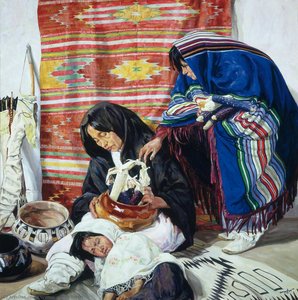
Walter Ufer's "Sleep," painted in 1923, isn’t merely a depiction of three Native American women; it’s an immersion into a world steeped in ritual and profound reverence. The painting immediately draws the viewer in with its rich tapestry of color – predominantly warm reds, oranges, and browns that evoke the earth itself, grounded by cooler blues and greens woven through the textiles and pottery. This palette isn't simply decorative; it speaks to the cultural heritage of the subjects, hinting at a deep connection to the land and ancestral traditions. The composition is carefully orchestrated, centering on the kneeling woman as a focal point, yet subtly inviting us into the periphery of the scene, suggesting an active participation in this sacred space.
Ufer’s masterful technique reveals layers of painstaking detail. He employs a layered oil painting approach, building up texture with deliberate brushstrokes that create a palpable sense of roughness on the clothing – perhaps representing the wear and tear of daily life intertwined with ceremonial garb – while simultaneously rendering the pottery with smooth, almost polished surfaces. This juxtaposition speaks to the duality inherent in Native American culture: the balance between practicality and spirituality, the tangible and the intangible. The lighting, soft and diffused, isn’t dramatic; it's deliberately muted, casting subtle shadows that lend a sense of solemnity and depth to the figures and objects, as if illuminating a secret whispered within a sacred space.
A Window into Taos: Contextualizing Ufer’s Vision
To fully appreciate “Sleep,” it's crucial to understand its historical context. Painted in 1923, during his time in Taos Pueblo, New Mexico, the artwork represents a pivotal moment in Walter Ufer’s career and his deep engagement with Native American culture. He was part of the "Taos Ten," a group of artists who sought to document and celebrate the lives and traditions of the region's indigenous communities. This wasn’t simply an act of observation; it was a deliberate attempt at understanding and portraying these cultures with respect and authenticity, a rare undertaking for American art at the time.
Ufer’s background as a German-born artist profoundly shaped his approach. His training in Europe instilled a meticulous attention to detail and a sophisticated understanding of composition – elements he skillfully translated into his depictions of Native American life. However, it was his immersion within the Taos community that truly informed his work, allowing him to capture not just appearances but also the spirit and essence of these traditions. The painting’s realism is tempered by an underlying sense of mystery, inviting viewers to contemplate the deeper meanings embedded within the scene.
Symbolism Woven into the Fabric
The details within “Sleep” are laden with symbolic significance. The intricately patterned rug serves as a visual anchor, framing the central figures and providing a rich backdrop that speaks to the importance of storytelling and communal life within Native American culture. The pottery, often adorned with geometric designs and natural motifs, represents both artistic skill and spiritual connection – a tangible link to ancestors and the earth. The women themselves, engaged in what appears to be a ritualistic activity, are not simply subjects; they embody generations of tradition, wisdom, and connection to the divine.
The act depicted—kneeling in reverence—suggests healing or a profound spiritual ceremony. The quiet dignity of the figures, coupled with the muted colors and soft lighting, evokes a sense of solemnity and timelessness. It’s an image that transcends mere representation, offering a glimpse into a world governed by ancient beliefs and deeply rooted traditions.
A Legacy of Authenticity: Reproductions and Beyond
Walter Ufer's "Sleep" remains a powerful testament to the beauty and complexity of Native American culture. TopImpressionists offers high-quality, hand-painted reproductions that faithfully capture the painting’s rich detail and evocative atmosphere. These reproductions are more than just images; they are windows into another world—a world of sacred rituals, profound traditions, and enduring wisdom. Investing in a reproduction is an investment in preserving this important piece of American art history and honoring the legacy of Walter Ufer's insightful portrayal.
Ερωτήσεις και Απαντήσεις
Πώς το "Sleep" εξισορροπεί το φως και το σκοτάδι;
Οι καταγεγραμμένες τιμές για το έργο "Sleep" του Ουάλτερ Ουφερ είναι: φωτεινότητα bright, φωταύγεια Gentle Luminance.
Ποια διάθεση εκφράζει το "Sleep" του Ουάλτερ Ουφερ εντός του Contemporary Realism;
Το Melancholic συναίσθημα του έργου "Sleep" συνοδεύει το στυλ της καλλιτεχνικής κίνησης Contemporary Realism.
Ποιος είναι ο δημιουργός του "Sleep" και σε ποιο καλλιτεχνικό ρεύμα ανήκει;
Το έργο "Sleep" δημιουργήθηκε από τον/την Ουάλτερ Ουφερ με το στυλ του/της Contemporary Realism. Ο καλλιτέχνης και το καλλιτεχνικό κίνημα προσδιορίζουν την παράδοση του έργου.
Γρήγορα στοιχεία και κвиζ τέχνης
Σχετικά με τον Ουάλτερ Ουφερ

Ουάλτερ Ουφερ
1876 - 1936, Γερμανία
Βιογραφικό Καλλιτέχνη
Η Ψυχή του Νοτιοδυτικού: Η Ζωή και η Κληρονομιά του Walter Ufer
Ο Walter Ufer αναδεικνύεται ως μια κομβική προσωπικότητα στον Αμερικανικό Ιμπρεσιονισμό, ένας ζωγράφος των οποίων οι πινελιάδες έκαναν κάτι παραπάνω από την απλή καταCapture του φωτός· εκείνες κατάφερναν να αιχμαλωτίσουν τον ίδιο τον παλμό μιας ολόκληρης κουλτούρας. Γεννημένος το 1876 στο Hückes⍵wagen της Γερμανίας, το ταξίδι του Ufer προς τις υψηλές ερήμους του New Mexico προετοιμάστηκε μέσα από μια αυστηρή ευρωπαϊκή εκπαίδευση και μια βαθιά ριζωμένη περιέργεια για την ανθρώπινη κατάσταση. Τα πρώτα του χρόνια διαμορφώθηκαν από τη γερμανικάμερικανική διασπορά στο Louisville του Kentucky, όπου άρχισε να απορροφά τις πλούσιες υφές της κληρονομιάς του. Αυτή η θεμελιώδης περίοδος, σημαδεμένη από μελέτες στη λιθογραφία και την εκτύπωση, του χαρίστησε μια τεχνική ακρίβεια που αργότερα θα του επέτρεπε να περιπλανηθεί στις πολυπλοκότητες του φωτός και της σκιάς με απαράμιλλη δεξιοτεχνία.
Η επιδίωξη της καλλιτεχνικής αριστείας τον οδήγησε σε μια μεταμορφωτική οδύσσεια σε όλη την Ευρώπη. Ως περιπλανώμενος τεχνίτης, ο Ufer βυθίστηκε στις πολυπολιτισμικές καλλιτεχνικές παραδόσεις της ηπείρου, βελτιώνοντας την τεχνική του στις κορυφαίες ακαδημίες του Αμβούργου και της Δρέσδης. Αυτή η περίοδος έντονης πνευματικής και δημιουργικής επέκτασης κορύφωσε την περίοδο του στο Μόναχο, όπου αφιέρωσε τον εαυτό του σε μια εντατική εργασία στο ατελιέ. Όταν τελικά επέστρεψε στις Ηνωμένες Πολιτείες το 1911, μετέφερε μαζί του μια εκλεπτυσμένη ευρωπαϊκή αισθητική, έτοιμη για μια βαθιά συνάντηση με τα άγρια, ηλιολουσμένα τοπία της Αμερικανικής Δύσης.
Ένας Προγνώστης των "Taos Ten"
Το έτος 1914 σηματοδότησε ένα οριστικό σημείο καμπής στη ζωή του Ufer και στην πορεία της αμερικανικής τέχνης. Καθώς περιπλανήθηκε στο Taos Pueblo του New Mexico, βρέθηκε μέρος μιας εξαιρετικής καλλιτεχνικής επανάστασης. Εντασσόμενος στην επιδραστική ομάδα γνωστή ως "Taos Ten," ο Ufer έγινε μια κεντρική μορφή ενός συλλογίματος που επιδίωκε να ξεπεράσει την απλή ζωγραφική τοπίου για να προχωρήσει σε μια πιο αυθεντική, εσωτερική απεικόνιση της ζωής των Native Americans. Σε αντίθεση με πολλούς από τους συνвременούς του, οι οποίοι έβλεπαν τον Νοτιοδυτικό μέσω ενός ρομαντισμένου ή αποικιοκρατικού πρίσματος, ο Ufer προσέγγισε τα θέματά του με βαθιά σεβασμό και μια ματιά προσανατολισμένη στην αξιοπρέπεια της καθημερινής ύπαρξης.
Το έργο του έγινε μια γέφυρα μεταξύ των ευρωπαϊκών ιμπρεσιονιστικών τεχνικών και της ωμή, πνευματικής ενέργειας των ανθρώπων του Pueblo. Δεν ήταν απλώς ένας παρατηρητής, αλλά ένας χρονιστής των τελετουργιών, των τοπίων και των ήσυχων ρυθμών της κοινότητας. Κεντρικό στη δημιουργική αυτή εξέλιξη ήταν η σχέση του με τον Jim Mirabal, έναν Ιндіανο του Taos που λειτούργησε τόσο ως μούσα όσο και ως συνεργός του Ufer. Μέσα από αυτή τη σύνδεση, ο Ufer απέκτησε μια στενή κατανόηση των πολιτισμικών αποχρώσεων που ορίζουν την περιοχή, επιτρέποντάς του να ενσωματώσει στους καμβάδες του ένα αίσθημα ζωντανής αλήθειας που αντήχησε πολύ πέρα από τα σύνορα του New Mexico.
Τεχνική, Συμβολισμός και Ιστορική Σημασία
Το έργο του Ufer χαρακτηρίζεται από έναν μα マスター ovládzenie της χρώματος και μια τολμηρή, εκφραστική εφαρμογή της μπογιάς. Το στυλ του, αν και ριζωμένο στις αρχές του Αμερικανικού Ιμπρεσιονισμού, τάχθηκε συχνά προς μια πιο στιβαρή και υφασματοειδή προσέγγιση που αλλήλουσε τη ζέστη του ηλιακού κύ heat της ερήμου και το βάρος της γης. Χρησιμοποίησε το φως όχι μόνο για να φωτίσει τη μορφή, αλλά για να προκαλέσει συναίσθημα — δημιουργώντας σκηνές όπου η ατμόσφαιρα μοιάζει βαριά από την ιστορία και την παράδοση.
Η ιστορική σημασία του Walter Ufer έγκειται στην ικανότητά του να αναβαίνει τη ζωγραφική είδους σε ένα βαθύ κοινωνικό και πολιτισμικό δήλωμα. Τα επιτεύγματά του περιλαμβάνουν:
- Αυθεντική Αναπαράσταση: Η απομάκρυνση από τα "τοπικά" στερεότυπα της ζωής των Native Americans για την παρουσίαση ενός πιο πολυεπίπεδου και ανθρωποκεντρικού πορτρέτου των ανθρώπων του Taos.
- Καλλιτεχνικός Συνδυασμός: Η επιτυχημένη ένωση της επίσημης ακαδημαϊκής εκπαίδευσης της Γερμανίας με το ζωντανό, ανεξέλεγκτο πνεύμα του Αμερικανικού Νοτιοδυτικού.
- Κληρονομιά των Taos Ten: Ο καθοριστικός ρόλος στην καθιέρωση του Taos ως κορυφαίου προορισμού για τον Αμερικανικό μοντερνισμό και ως ζωτικό κέντρο για την τέχνη που εστιάζει στον ιθαγενή πολιτισμό.
Σήμερα, οι πίνακες του Ufer παραμένουν αιώνια μαρτυρίες μιας περιόδου έντονης πολιτισμικής διασταύρωσης. Η ικανότητά του να υφάνει την τεχνική αυστηρότητα της ευρωπαϊκής εκπαίδευσής του με το πνευματικό βάθος της κουλτούρας Pueblo διασφαλίζει ότι το έργο του συνεχίζει να μαγεύει, προσκαλώντας τους σύγχρονους θεατές να γίνουν μάρτυρες του διαχρονικού πνεύματος της Κοιλάδας Taos μέσα από τα συγκινητικά και κορυφαία μάτια του.
Γρήγορα στοιχεία για τον/την Ουάλτερ Ουφερ
- Artistic Movement Or Style: Ιμπρεσιονισμός Taos
- Artists Or Movements Influenced By This Artist: ['']
- Artists Who Influenced This Artist: ['']
- Date Of Birth: 1876
- Date Of Death: 1936
- Full Name: Walter Ufer
- Nationality: Γερμανο-Αμερικανός
- Notable Artworks:
- Η Κόρη Της
- Οι Χτίστες της Ερήμου
- Μετά από Αυτούς
- Place Of Birth: Hückeswagen, Γερμανία


Ουάλτερ Ουφερ
Sleep
() ·
Συμπεριλαμβανομένου του πλαισίου: · Χειροποίητο με λάδια σε λινό
Σύνολο