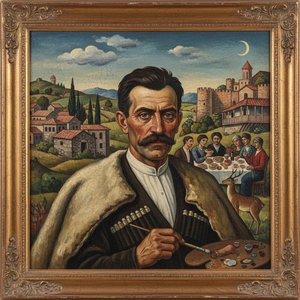
The Quiet Observer of the Don
In the bustling landscape of the Russian Empire, Viktor Abashin found his purpose within the local rhythms of Novocherkassk. He was a man of the brush and the stage, a painter and a graphic artist who moved through the world with a keen eye for the tangible. Though he lacked formal academic training, his talent emerged through a deep, intuitive connection to the land and its produce. He lived and worked in a circle of dedicated local creators, sharing ideas and artistic pursuits with his contemporaries. His life was one of steady observation, finding profound meaning in the simplest of subjects.
His hand was most often guided by the weight and texture of the earth's bounty. He possessed a particular fascination with the vegetables and fruits of the Don region, treating them with a reverence that made their physical presence feel almost illusory. He did not seek to complicate his compositions; instead, he favored a simple, symmetrical arrangement that allowed the viewer to focus entirely on the material reality of the subject. There was a certain honesty in his approach, a refusal to hide behind artifice.
A Life in Color and Form
While his still lifes captured the stillness of the harvest, Abashin found his greatest successes in the expansive reach of the landscape. In these works, he tackled the difficult challenges of composition and color, seeking to capture the essence of a place through light and shadow. His participation in the local art scene was a constant presence, as he contributed his vision to the collective exhibitions of his community. His work can be found in several significant collections, including:
- The Novocherkassk Museum of the History of Don Cossacks
- The Rostov Regional Museum of Fine Arts
- The Starocherkassk Historical and Architectural Museum-Reserve
- The Rostov Regional Museum of Local Lore
His artistic output was marked by a devotion to the specificities of his surroundings. He painted the ripening grain, the quiet banks of a river, and the heavy presence of a melon or a watermelon. These were not mere objects to him, but studies in form and existence. His ability to translate the weight of a fruit or the atmosphere of a meadow into paint defined his contribution to the regional art of his time.
The Legacy of the Local Painter
The passing of Abashin in 1919 marked the end of a life spent translating the visual world into a permanent record. Much of his work remains tucked away in private collections or held within the walls of regional museums, making the surviving pieces even more significant. He was a vital part of the "Circle of Don Artists," a group that helped define the visual identity of the region during a transformative era. His paintings, such as his depictions of winter mornings or the quiet life of a fisherman, remain as direct and unpretentious as the life he led.
Ερωτήσεις και Απαντήσεις
Υπάρχει χρονολόγιο με τα έργα του/της Viktor Abashin;
Μπορείτε να δείτε τη χρονολογία των έργων του/της Viktor Abashin στη σελίδα Χρονολόγιο Έργων, όπου τα έργα είναι ταξινομημένα ανά ημερομηνία δημιουργίας.
Με τι άλλα ονόματα ή ψευδώνυμα είναι γνωστός/η Viktor Abashin;
Ο/Η Viktor Abashin είναι γνωστός/η επίσης ως Victor Abashin, Viktor Fyodorovich Abashin, Wiktor Fjodorowitsch Abaschin, Виктор Фёдорович Абашин.
Σε ποιες καλλιτεχνικές καμπάνιες συμμετείχε ο/η Viktor Abashin;
Η σελίδα Όλα τα Ρευmatά ομαδοποιεί τα έργα του/της Viktor Abashin ανά καλλιτεχνικό κίνημα.
Πού ομαδοποιούνται τα έργα του Viktor Abashin με βάση λέξεις-κλειδιά;
Για να βρείτε έργα του Viktor Abashin με συγκεκριμένο θέμα, επισκεφθείτε τη σελίδα Με Λέξεις-Κλειδιά του καλλιτέχνη, η οποία ομαδοποιεί τα έργα ανά λέξη-κλειδί.