
 Preview
 Send
Send Share
Share
 Details
 Guide
Guide

 Download
 Similars
 X-Ray
X-Ray Diaporama
 Q&A
Q&A Stats
StatsPoppies


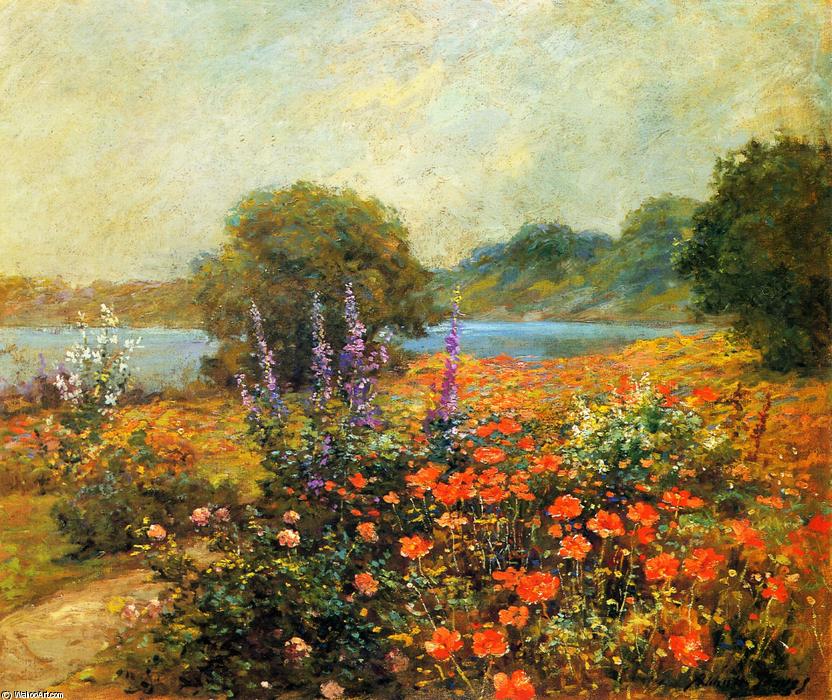
The painting depicts a serene landscape featuring a field brimming with vibrant poppies and purple flowers under the watchful gaze of trees. Two birds soar above, completing this idyllic tableau created by Abbott Fuller Graves in 1905.
 Read More
An American Impressionist master known for vibrant floral still-lifes and garden scenes like Near Kennebunkport, Abbott Fuller Graves captures the fleeting beauty of light and nature in every brushstroke.
Giclée / Art Print
Museum-quality giclée or canvas print with fast production and flexible finish options. ( Buy Hand Made Painting Switch to Digital Image)




P118B $10

P118H $10

P118W $10

P438Z $10

P508JH $12

P508YH $12

P805H $10

P805Z $10

P919BZ $10

P919G $10

P919XJ $10

P959ZH $10

P968JZ $12

W106C $8

W218G $10

W218JH $8

W218Y $10

W307PJ $10

W316G $10

W316PJ $8

W316Y $10

W398PJ $8

W4111J $10

W500HY $15

W500JH $15

W692G $12

W849H $8

W940BG $15

W953PJ $8




Standard
custom
CM
INCH
Pick from our preset sizes that match the artwork's original proportions.
Loading sizes...

width
height
Type the width and the height you need, to fit your frame or your wall. A print can only be cut, never made bigger than the picture, so a size with a different shape loses a part of the image. We send you a digital mockup to approve before we print anything. The picture shown on this page does not show the real cut — only the mockup does.
Worldwide Delivery () in 2 weeks instead of standard 4/5 weeks. (12 November)

Free Worldwide Express Shipping

High-Quality Linen Canvas

Full Shipping Insurance

Customs Tax Refund Guarantee

True Color Matching Guarantee

100-Day Return Policy (Defects Only)

100% Money-Back Guarantee

Bulk Discount Offer
 Glass option is only available in size under 110 CM

Poppies
Giclée / Art Print
Reproduction Size
-


Total Price
$ 70
Georges Seurat: Bridging Science and Beauty
Georges Seurat’s “La Grenouillère” – literally “The Pond” – stands as an emblem of Impressionism's audacious embrace of scientific inquiry. Painted in 1876, this monumental canvas depicts a Parisian café scene brimming with life, yet it’s far from merely capturing a snapshot of everyday existence. Instead, Seurat meticulously constructed his artwork using a revolutionary technique known as Pointillisme, pioneered alongside Paul Signac.
- The Technique: Pointillisme wasn't about blending colors; it was about applying tiny dots of pure pigment onto the canvas surface. These dots, individually colored and strategically positioned, refract light and blend optically in the viewer’s eye—a process meticulously documented by Seurat himself.
- Scientific Foundations: Seurat’s approach drew heavily from Chevreul's Color Theory, which posits that complementary colors stimulate each other, creating vibrancy and enhancing visual perception. He painstakingly calculated the chromatic coordinates of each dot to achieve optimal color harmony.
- Historical Context: Impressionism emerged as a reaction against the academic tradition dominating French art academies. Artists like Seurat sought to liberate painting from rigid conventions, prioritizing subjective experience and capturing fleeting moments of light and atmosphere.
The scene itself is deceptively simple—a café terrace populated by men and women enjoying drinks and conversation. However, beneath the surface lies a profound exploration of color and perception. Seurat’s palette utilizes bold hues – reds, blues, yellows – arranged in discrete patches that shimmer with reflected light. This deliberate fragmentation contributes to an unsettling yet captivating effect; it invites viewers to actively participate in constructing the image.
Symbolism:The pond itself—a recurring motif in Seurat’s oeuvre—represents both physical space and psychological depth. It symbolizes tranquility amidst urban bustle, mirroring the artist's own quest for intellectual clarity and artistic innovation. The figures within the café are rendered with meticulous detail, yet their faces remain largely obscured, emphasizing the importance of emotion and intuition over precise representation.
- Emotional Impact: “La Grenouillère” evokes a sense of immediacy and dynamism—a feeling that captures the vibrant energy of Parisian life. Yet, there’s also an underlying tension created by Seurat's technique; it compels viewers to confront the complexities of visual perception.
“La Grenouillère” remains a cornerstone of Impressionist art history and continues to inspire artists and collectors alike. Its enduring appeal lies not only in its aesthetic beauty but also in its audacious intellectual ambition—a testament to Seurat’s unwavering belief that art could illuminate the mysteries of human consciousness.
Questions & Answers
Can I watch "Poppies" as a full-screen slideshow?
The diaporama of "Poppies" can be watched on the artwork's Diaporama page.
What technique and style characterize "Poppies" by Abbott Fuller Graves?
"Poppies" is made in acrylic on canvas, in the Impressionism style.
Can I use augmented reality to see "Poppies" by Abbott Fuller Graves in my room?
"Poppies" by Abbott Fuller Graves can be previewed on your own wall with the artwork's AR Preview page, using augmented reality on a compatible device.
Related Artworks


Artist Biography
A Life Captured in Light and Bloom
Abbott Fuller Graves was an American painter and illustrator whose brush captured the delicate intersection of nature and light. Born in Weymouth, Massachusetts, his early aspirations leaned toward the structured world of architecture, leading him to attend the Massachusetts Institute of Technology. However, a profound calling toward the ephemeral beauty of the natural world eventually redirected his path. This journey took him far beyond the borders of New England, as he traveled to Paris and Italy to refine his skills. In the vibrant art centers of Europe, Graves immersed himself in the study of floral painting and figure work, absorbing the revolutionary techniques that would later define his signature style.
During his formative years in Paris, Graves studied at the Académie Julian, learning under masters such as Fernand Cormon, Jean- Paul Laurens, and Paul Gervais. This rigorous academic training provided him with a foundation in realism, yet it was the burgeoning influence of European Impressionism that truly ignited his creative spirit. His time in Europe also allowed him to room with Edmund C. Tarbell, fostering connections within a circle of artists who were reshaping American art. Upon returning to Boston, Graves became a teacher at the Cowles Art School, working alongside notable figures like Childe Hassam, a relationship that undoubtedly enriched their mutual artistic development.
The Impressionistic Spirit of New England
As his career matured, Graves found a permanent sanctuary in the coastal town of Kennebunkport, Maine. It was here that his work truly blossomed, as he began to specialize in decorative open-air garden paintings and floral still-lifes. His mastery lay in the ability to blend Impressionistic light with Realistic observation. He did not merely seek to replicate the appearance of a garden; he sought to capture how sunlight filtered through foliage, casting dappled shadows and illuminating blossoms with an ethereal glow. His use of thick brushstrokes and vibrant colors allowed him to translate the textures of roses, lilies, and lush landscapes onto the canvas, creating scenes that felt both alive and deeply serene.
His subject matter often celebrated the rhythms of local life and the splendor of the natural world. While many of his works focused on the intricate beauty of exotic gardens—sometimes reaching as far as Spain and South America—he remained deeply rooted in the American landscape. His paintings frequently featured genre scenes of Kennebunkport, portraying fishermen, farmers, and sea captains, often rendered with a charming, nostalgic quality that led to his work being widely reproduced on postcards and calendars. This ability to elevate everyday coastal life into a symphony of color and light remains his most enduring legacy.
Artistic Legacy and Architectural Vision
Beyond the canvas, Graves possessed a unique vision for the integration of art and living space. In 1905, he applied his architectural sensibilities to design the Abbott Graves House in Kennebunkport. This structure, notable as one of the rare examples of the Prairie School of architecture in Maine, stands as a testament to his multifaceted talent. The house reflects the same harmony between form and nature that characterized his paintings, showcasing a sophisticated understanding of design and space.
In his later years, Graves moved between the creative energy of New York City and the tranquility of the coast. His membership in prestigious organizations such as the National Academy of Design, the Salmagundi Club, and the Allied Artists of America solidified his standing within the American art community. Through his dedication to capturing the fleeting beauty of a petal or the shifting light on a coastal shoreline, Abbott Fuller Graves left behind a body of work that continues to resonate with those who find poetry in the natural world.

Abbott Fuller Graves
1859 - 1936 , United States of America
Quick Facts
- Artistic Movement Or Style: Realism and Impressionism
- Artists Who Influenced This Artist:
- Claude Monet
- Pierre-Auguste Renoir
- Childe Hassam
- Full Name: Abbott Fuller Graves
- Nationality: American
- Notable Artworks:
- Nearing Home
- Eastern Point, Gloucester
- Near Kennebunkport
- Place Of Birth: Weymouth, United States of America
- Date Of Birth: 1859
- Date Of Death: 1936
Related Articles

Capturing the Mist: The Timeless Beauty of British Landscape Impressionism
Explore the ethereal beauty of British Landscape Impressionism. Discover how masters captured light and mist through plein air techniques, offering a profound connection to the English countryside's timeless, atmospheric soul.
Explore artworks organized by themes, styles, and characteristics.


