

Shown: · With its frame:
 Preview
 Send
Send Share
Share
 Details
 Guide
Guide

 Download
 Similars
 X-Ray
X-Ray Diaporama
 Q&A
Q&A Stats
Stats Dutch Golden Age
 1666
1666 121.0 x 146.0 cm
 Academy of Fine Arts Vienna
$ 269
Hand Made Oil Reproduction
Hand-painted oil on canvas in your size and frame, made to order by our artists. ( Switch to Print Switch to Digital Image)
Size
·Standard
custom
CM
INCH
Pick from our preset sizes that match the artwork's original proportions.
Loading sizes...

width
height
Type the width and the height you need, to fit your frame or your wall. This is hand-painted, so for a size with a different shape the artist can paint a bit more around the picture, or cut a bit — you choose. We send you a digital mockup to approve before the painting starts. The picture shown on this page does not show the real result — only the mockup does.
 Read more
Finish
·
White $1

Blurside $1

Extended $1

P118B $10

P118H $10

P118W $10

P438Z $10

P508JH $12

P508YH $12

P805H $10

P805Z $10

P919BZ $10

P919G $10

P919XJ $10

P959ZH $10

P968JZ $12

W106C $8

W218G $10

W218JH $8

W218Y $10

W307PJ $10

W316G $10

W316PJ $8

W316Y $10

W398PJ $8

W4111J $10

W500HY $15

W500JH $15

W692G $12

W849H $8

W940BG $15

W953PJ $8

H24-GOLD $30

H24-SILVER $30

H36-GOLD $45

H36-SILVER $45
Shipped in a protective tube, ready for your own framer.
Above 105 cm the frame is shipped as a kit for a professional framer — read the details.
Extras
optionalWhat do the extras include?
Examples of what can be changed: Replace face with customer photo; Add pet (e.g., replace cat with dog); Include hidden message in background; Change background landscape or elements.
After order, TopImpressionists.com team will email client for instructions and provide a mockup preview
After order, TopImpressionists.com team will email client for instructions and provide a mockup preview
Worldwide Delivery () in 3/4 weeks instead of standard 5 weeks. (30 October). No compromise on quality.
Protective Varnish
Nameplate
Engraved Bronze Plaque Details
This elegant plaque features the artist's name and the title of the artwork, finely engraved for a timeless presentation.
It is made from bronze with a refined, elegant finish. The text is precisely laser-engraved for a sharp and permanent result. Measuring 9x2 cm, the plaque is compact yet easy to read. It's built to be durable and scratch-resistant, offering a professional, museum-quality look. Mounting is simple thanks to the included adhesive backing.
Transparent Acrylic Plaque Details
The plaque includes essential engraved details such as the artist's name, the title of the artwork, the date it was created, the type of media used-like oil on canvas or watercolor-a brief description of the piece, and a QR code that links to the complete artwork information.
It is crafted from clear acrylic, offering a sleek, modern appearance. The text is UV-engraved in black to ensure strong visual contrast. With a size of 10x15 cm, it ensures optimal readability. It comes equipped with two metal hooks for secure wall mounting. The plaque is designed to be weather-resistant, making it suitable for various environments, and it includes interactive features that work seamlessly with smartphone scanning.
Black Acrylic Plaque Details
This elegant plaque includes engraved information such as the artist's name, the title of the artwork, the date it was created, the type of media used (like oil on canvas or watercolor), a short description of the artwork, and a QR code for quick access to more information.
The plaque itself is made from refined black acrylic with a premium finish. The text is laser-engraved in white for high contrast and readability. Its size is 10x15 cm, designed to be easy to read. It comes with two metal hooks for professional mounting. The design is sleek and fits any interior style. It is also weather-resistant and durable, with built-in digital integration for mobile compatibility.
Glass option is only available in size under 110 CM
 Glass option is only available in size under 110 CM
- Free Worldwide Express Shipping
- High-Quality Linen Canvas
- Full Shipping Insurance
- Customs Tax Refund Guarantee
- True Color Matching Guarantee
- 100-Day Return Policy (Defects Only)
- 100% Money-Back Guarantee
- Bulk Discount Offer


Collectible Description
Discover 'The Fishmonger' by Abraham Hendrickz van Beyeren (1666). A stunning Dutch Golden Age oil painting capturing bustling market life & maritime trade. Realistic detail, rich textures & dramatic lighting.
Artist Biography
Discover Abraham Hendricksz. van Beyeren, a Dutch still life painter (1620-1690). Admire his masterful flower & fruit compositions in Leiden, Delft & Amsterdam. See works at Mauritshuis!
About the painting
Quick facts and art quiz
About Abraham Hendricksz. Van Beyeren

Abraham Hendricksz. Van Beyeren
1620 - 1690, Netherlands
Artist Biography
The Master of the Dutch Golden Age Still Life
In the vibrant, prosperous landscape of the seventeenth-century Netherlands, few artists captured the sensory richness of existence as profoundly as Abraham Hendricksz. van Beyeren. Born in The Hague around 1620, van Beyeren emerged during a period of unparalleled artistic flourishing known as the Dutch Golden Age. His life and work were deeply intertwined with the intellectual and commercial pulse of cities like Leiden, Delft, and Amsterdam, where he established himself as a premier chronicler of the material world. While much of his early biography remains shrouded in the soft shadows of history, his artistic lineage suggests a connection to the masters of his era, with some accounts even attributing his foundational training to the legendary Johannes Vermeer. This influence is evident in his sophisticated command of light, a quality that allowed him to transform simple objects into luminous protagonists within his compositions.
The evolution of van Beyron's style serves as a visual chronicle of the shifting aesthetic tides in Dutch art. His early period was characterized by a dramatic, almost theatrical intensity, heavily influenced by the chiaroscuro techniques popularized by Caravaggio. During these formative years, his canvases were defined by deep, moody shadows and sharp, piercing highlights that lent a sense of gravity and emotional weight to his subjects. However, as his career matured, van Beyeren underwent a remarkable stylistic metamorphosis. He gradually moved away from the heavy Baroque tension toward a more serene and luminous palette. His later works embraced softer hues and delicate, precise brushstrokes, reflecting a broader cultural transition from the dramatic grandeur of the early century toward a more contemplative, tranquil aesthetic that celebrated the quiet beauty of the natural world.
Symbolism and the Art of the Banquet
Van Beyeren’s oeuvre is most celebrated for its mastery of the still life, particularly his ability to render textures that seem almost tactile to the viewer. He was a virtuoso of the "banquet" tradition, creating opulent scenes that were far more than mere displays of wealth. Through his meticulous depiction of overflowing platters of fruit, glistening lobsters, and fine glassware, he engaged in a complex dialogue with symbolism. A single piece of ripening fruit or a beautifully crafted timepiece could serve as a memento mori—a poignant reminder of the fleeting nature of life and the inevitability of decay. This tension between the exuberant abundance of the feast and the underlying theme of transience gave his work a profound intellectual depth that resonated with the humanist values of his time.
His technical achievements are perhaps best exemplified in his diverse range of subjects, which included:
- Floral Compositions: Exquisite arrangements where each petal and leaf was rendered with scientific precision, capturing the ephemeral beauty of blooms.
- Maritime and Aquatic Life: Masterful depictions of fish and crustaceans, such as his famous Large Still life with Lobster, which showcased his ability to capture moisture and light reflecting off organic surfaces.
- Luxury Goods: The inclusion of precious metals, fine ceramics, and intricate glassware, demonstrating a profound understanding of how different materials interact with light.
Legacy and Historical Significance
The historical significance of Abraham Hendricksz. van Beyeren lies in his ability to elevate the still life genre from mere decorative craft to a high art form capable of expressing complex philosophical truths. His works continue to reside in some of the world's most prestigious institutions, including the Mauritshuis in The Hague, the Louvre in Paris, and the Metropolitan Museum of Art in New York. By bridging the gap between the dramatic intensity of the early Baroque and the refined elegance of later Dutch traditions, he left an indelible mark on the trajectory of European painting. Today, his canvases remain much more than historical artifacts; they are enduring windows into a lost era of splendor, inviting every generation to pause and admire the quiet, magnificent details of the world around them.
Quick facts about Abraham Hendricksz. Van Beyeren
- Full Name: Abraham Hendricksz. van Beyeren
- Nationality: Dutch
- Date Of Birth: 1620
- Date Of Death: 1690
- Place Of Birth: The Hague, Netherlands
- Notable Artworks:
- Still Life with a Lobster, Fruit, Silver and China Ware
- A blue and white porcelain bowl with fruit
- A chinese porcelain jug, grapes and a peach on a pewter plate with a fobwatch on a draped ledge
- Artistic Movement Or Style: Still Life
- Artists Or Movements Influenced By This Artist: ['Dutch Golden Age']
Explore artworks organized by themes, styles, and characteristics.
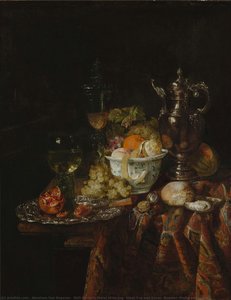


Abraham Hendricksz. Van Beyeren
The Fishmonger
() ·
With its frame: · Hand-painted in oil on linen
Total