


 Preview
 Send
Send Share
Share
 Details
 Guide
Guide

 Download
 Similars
 X-Ray
X-Ray Diaporama
 Stats
StatsLouis Pasteur
 Acrylic On Canvas
- WallArt
- Realist Painting
 1885
1885- 19th Century
 154.0 x 126.0 cm
 Musée d'Orsay
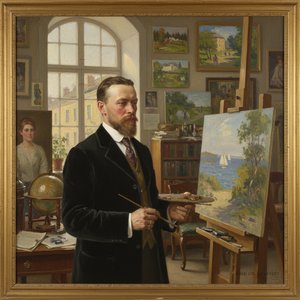
Albert Edelfelt's iconic 1885 portrait of Louis Pasteur captures the scientist’s dedication to science within his laboratory. A masterpiece reflecting the era's advancements and scientific spirit.
 Read More
Explore the realist paintings of Albert Edelfelt (1854-1905), a pioneering Finnish artist celebrated for portraits, landscapes & his influence on Finnish art. Discover works like 'Portrait of Louis Pasteur' and 'Under the Birches'.
Hand Made Oil Reproduction
Hand-painted oil on canvas in your size and frame, made to order by our artists. ( Switch to Print Switch to Digital Image)




P118B $10

P118H $10

P118W $10

P438Z $10

P508JH $12

P508YH $12

P805H $10

P805Z $10

P919BZ $10

P919G $10

P919XJ $10

P959ZH $10

P968JZ $12

W106C $8

W218G $10

W218JH $8

W218Y $10

W307PJ $10

W316G $10

W316PJ $8

W316Y $10

W398PJ $8

W4111J $10

W500HY $15

W500JH $15

W692G $12

W849H $8

W940BG $15

W953PJ $8




Standard
custom
CM
INCH
Pick from our preset sizes that match the artwork's original proportions.
Loading sizes...

width
height
Type the width and the height you need, to fit your frame or your wall. This is hand-painted, so for a size with a different shape the artist can paint a bit more around the picture, or cut a bit — you choose. We send you a digital mockup to approve before the painting starts. The picture shown on this page does not show the real result — only the mockup does.
Examples of what can be changed: Replace face with customer photo; Add pet (e.g., replace cat with dog); Include hidden message in background; Change background landscape or elements.
After order, TopImpressionists.com team will email client for instructions and provide a mockup preview
After order, TopImpressionists.com team will email client for instructions and provide a mockup preview
Worldwide Delivery () in 3/4 weeks instead of standard 5 weeks. (20 October). No compromise on quality.

Free Worldwide Express Shipping

High-Quality Linen Canvas

Full Shipping Insurance

Customs Tax Refund Guarantee

True Color Matching Guarantee

100-Day Return Policy (Defects Only)

100% Money-Back Guarantee

Bulk Discount Offer
 Glass option is only available in size under 110 CM

Louis Pasteur
Reproduction Medium
Reproduction Size
-


Total Price
$ 269
The Genesis of a Masterpiece
Albert Edelfelt’s “Louis Pasteur,” painted in 1885, isn't merely a portrait; it’s a meticulously crafted distillation of an era – the burgeoning age of scientific discovery and the quiet revolution taking place within the laboratories of France. Commissioned during a period of intense intellectual ferment, this oil-on-canvas work transcends simple representation to embody Pasteur’s unwavering commitment to unraveling the mysteries of life and disease. Edelfelt, a Finnish artist deeply influenced by Northern European realism, chose to capture Pasteur not as a celebrated figure in public acclaim, but as a man profoundly engaged in his craft – a scientist immersed in the focused intensity of his laboratory.
The painting’s genesis lies within the context of Pasteur's groundbreaking work. His pioneering research into germ theory, vaccination against rabies and anthrax, and pasteurization were fundamentally reshaping medicine and public health. Edelfelt, keenly aware of this transformative impact, sought to immortalize not just Pasteur’s physical presence but also the spirit of relentless inquiry that defined his legacy. The choice of setting – a meticulously rendered laboratory filled with scientific instruments – immediately establishes this intellectual atmosphere, suggesting a space dedicated to observation, experimentation, and the pursuit of knowledge.
A Symphony of Detail: Technique and Style
Edelfelt’s masterful technique is evident in every brushstroke. He employs a rich, layered impasto—a thick application of paint—that lends texture and depth to the scene. The careful rendering of light and shadow creates a palpable sense of realism, drawing the viewer into Pasteur's world. Notice particularly the subtle gradations of color applied to the various glass bottles and scientific equipment; each element is rendered with painstaking detail, reflecting Edelfelt’s dedication to accuracy. The composition itself is carefully balanced, guiding the eye through the scene – from Pasteur himself, deeply absorbed in his work, to the surrounding apparatus that speaks volumes about his research.
- Color Palette: A muted palette of browns, greens, and blues dominates, reflecting the laboratory’s atmosphere.
- Brushwork: Edelfelt's brushstrokes are visible and deliberate, contributing to the painting's textured surface.
- Lighting: The use of chiaroscuro (strong contrasts between light and dark) emphasizes Pasteur’s figure and highlights the details of his workspace.
Symbolism and the Portrait of a Mind
Beyond its technical brilliance, “Louis Pasteur” is laden with symbolic meaning. The bottles scattered around the laboratory represent the countless experiments and observations that constitute Pasteur's scientific journey. The focused gaze of Pasteur himself embodies his intellectual rigor and unwavering dedication to his work. He’s not a triumphant hero; he’s a man consumed by curiosity, driven by an insatiable desire to understand the natural world. The inclusion of specific instruments—beakers, flasks, and retorts—are not merely decorative elements but rather visual cues that underscore Pasteur's scientific pursuits.
The painting subtly suggests the transformative power of science – a quiet revolution unfolding within the confines of the laboratory, with profound implications for humanity’s future.A Legacy Preserved: Emotional Resonance and Artistic Significance
“Louis Pasteur” is more than just a portrait; it's a testament to the enduring legacy of scientific innovation. It captures not only the likeness of a brilliant mind but also the spirit of inquiry that defines the modern era. The painting’s emotional resonance lies in its portrayal of focused concentration and unwavering dedication—qualities that continue to inspire scientists, artists, and thinkers today. It serves as a poignant reminder of the transformative power of knowledge and the profound impact one individual can have on the world. Reproductions of this iconic work offer a beautiful way to bring this powerful image into your home or office, celebrating both artistic mastery and scientific achievement.
Questions & Answers
Does "Louis Pasteur" by Albert Edelfelt use strong contrasts or soft harmonies?
In "Louis Pasteur", a statement contrast is paired with a strong color unity harmony.
What is the art-historical place of "Louis Pasteur" by Albert Edelfelt?
The art-historical classification of "Louis Pasteur" by Albert Edelfelt is Realist Painting, in the 19th-Century period.
Where can I find a guide to "Louis Pasteur"?
A Guide page is available for "Louis Pasteur" by Albert Edelfelt: a printable factsheet about the artwork, designed for students and classroom use.
Related Artworks


Artist Biography
early life and education
albert gustaf aristides edelfelt, a renowned finnish painter, was born on july 21, 1854, in porvoo, finland. his parents, carl albert edelfelt and alexandra edelfelt (née brandt), were swedish-speaking finns. edelfelt's early life was marked by an innate passion for art, which led him to pursue formal studies at the drawing school of the finnish art society in 1869.artistic journey
edelfelt's artistic journey took him to various esteemed institutions, including:- antwerp academy of art (1873-74), where he honed his skills in history painting.
- école nationale des beaux-arts in paris (1874-78), under the tutelage of jean-léon gérôme, further refining his craft.
- a brief stint at saint petersburg (1881-82) exposed him to diverse artistic influences.
rise to prominence and notable works
edelfelt's breakthrough came with a gold medal at the paris universal exposition of 1889. his notable works include:- portrait of louis pasteur, which earned him the legion of honour in 1886.
- young woman in her boudoir, showcasing his mastery of capturing the essence of femininity.
- under the birches, a poignant representation of finnish landscapes.
legacy and impact
as one of the first finnish artists to achieve international fame, edelfelt significantly contributed to the realist art movement in finland. his influence extended to younger finnish painters, such as akseli gallen-kallela and gunnar berndtson, whom he assisted in their breakthroughs in paris.museum collections and commemoration
edelfelt's works are featured in various museums, including the ateneumin taidemuseo in helsinki. his legacy was commemorated with a €100 albert edelfelt commemorative coin in 2004, celebrating his 150th birth anniversary. key artworks and museum collections: discover more:
Albert Edelfelt
1854 - 1905 , Finland
Quick Facts
- Full Name: Albert Gustaf Aristides Edelfelt
- Nationality: Finnish
- Date Of Birth: 1854
- Date Of Death: 1905
- Place Of Birth: Porvoo, Finland
- Notable Artworks:
- Portrait of Louis Pasteur
- Young woman in her boudoir
- Under the birches
- Girl from Porvoo
- Artistic Movement Or Style: Realist
- Artists Who Influenced This Artist: ['Jean-Léon Gérôme']
- Artists Or Movements Influenced By This Artist:
- Akseli Gallen-Kallela
- Gunnar Berndtson
Related Articles

Anne-Louis Girodet: Bridging Neoclassicism & Romanticism with Emotional Truth
Explore the captivating world of Anne-Louis Girodet, a pivotal figure bridging Neoclassicism & Romanticism. Discover his masterpieces and unique artistic vision with TopImpressionists.

Morris Louis: Pioneering Color Field Painting & Abstract Expressionism's Legacy
Explore the groundbreaking abstract expressionism of Morris Louis, a pioneer of Color Field painting. Discover his innovative techniques, influential series & lasting legacy in post-war American art. Learn more at TopImpressionists.

Albert Charles Lebourg: A Study in Atmospheric Impressionism & Rural France
Explore the serene landscapes of Albert Charles Lebourg, a master of the Rouen School Impressionists. Discover his atmospheric paintings of the Seine and enduring legacy in 19th-century French art.
Albert Edelfelt: A Pioneer of Finnish Realism & International Impressionist Circles
Explore the life & work of Albert Edelfelt, a pioneering Finnish Realist painter who bridged Impressionism & national identity. Discover his masterpieces and lasting influence on art history.

Albert Goodwin: Capturing Victorian Light & Atmosphere – A Study in Landscape Painting
Explore the captivating landscapes of Albert Goodwin (1845-1932), a celebrated Victorian watercolourist influenced by Turner & Ruskin. Discover his techniques, prolific collection, and lasting legacy in British art history.
Explore artworks organized by themes, styles, and characteristics.


