

Shown: · With its frame:
 Preview
 Send
Send Share
Share
 Details
 Guide
Guide

 Download
 Similars
 X-Ray
X-Ray Diaporama
 Q&A
Q&A Stats
Stats
$ 319
Hand Made Oil Reproduction
Hand-painted oil on canvas in your size and frame, made to order by our artists. ( Switch to Print Switch to Digital Image)
Size
·Standard
custom
CM
INCH
Pick from our preset sizes that match the artwork's original proportions.
Loading sizes...

width
height
Type the width and the height you need, to fit your frame or your wall. This is hand-painted, so for a size with a different shape the artist can paint a bit more around the picture, or cut a bit — you choose. We send you a digital mockup to approve before the painting starts. The picture shown on this page does not show the real result — only the mockup does.
 Read more
Finish
·
White $1

Blurside $1

Extended $1

P118B $10

P118H $10

P118W $10

P438Z $10

P508JH $12

P508YH $12

P805H $10

P805Z $10

P919BZ $10

P919G $10

P919XJ $10

P959ZH $10

P968JZ $12

W106C $8

W218G $10

W218JH $8

W218Y $10

W307PJ $10

W316G $10

W316PJ $8

W316Y $10

W398PJ $8

W4111J $10

W500HY $15

W500JH $15

W692G $12

W849H $8

W940BG $15

W953PJ $8

H24-GOLD $30

H24-SILVER $30

H36-GOLD $45

H36-SILVER $45
Shipped in a protective tube, ready for your own framer.
Above 105 cm the frame is shipped as a kit for a professional framer — read the details.
Extras
optionalWhat do the extras include?
Examples of what can be changed: Replace face with customer photo; Add pet (e.g., replace cat with dog); Include hidden message in background; Change background landscape or elements.
After order, TopImpressionists.com team will email client for instructions and provide a mockup preview
After order, TopImpressionists.com team will email client for instructions and provide a mockup preview
Worldwide Delivery () in 3/4 weeks instead of standard 5 weeks. (30 October). No compromise on quality.
Protective Varnish
Nameplate
Engraved Bronze Plaque Details
This elegant plaque features the artist's name and the title of the artwork, finely engraved for a timeless presentation.
It is made from bronze with a refined, elegant finish. The text is precisely laser-engraved for a sharp and permanent result. Measuring 9x2 cm, the plaque is compact yet easy to read. It's built to be durable and scratch-resistant, offering a professional, museum-quality look. Mounting is simple thanks to the included adhesive backing.
Transparent Acrylic Plaque Details
The plaque includes essential engraved details such as the artist's name, the title of the artwork, the date it was created, the type of media used-like oil on canvas or watercolor-a brief description of the piece, and a QR code that links to the complete artwork information.
It is crafted from clear acrylic, offering a sleek, modern appearance. The text is UV-engraved in black to ensure strong visual contrast. With a size of 10x15 cm, it ensures optimal readability. It comes equipped with two metal hooks for secure wall mounting. The plaque is designed to be weather-resistant, making it suitable for various environments, and it includes interactive features that work seamlessly with smartphone scanning.
Black Acrylic Plaque Details
This elegant plaque includes engraved information such as the artist's name, the title of the artwork, the date it was created, the type of media used (like oil on canvas or watercolor), a short description of the artwork, and a QR code for quick access to more information.
The plaque itself is made from refined black acrylic with a premium finish. The text is laser-engraved in white for high contrast and readability. Its size is 10x15 cm, designed to be easy to read. It comes with two metal hooks for professional mounting. The design is sleek and fits any interior style. It is also weather-resistant and durable, with built-in digital integration for mobile compatibility.
Glass option is only available in size under 110 CM
 Glass option is only available in size under 110 CM
- Free Worldwide Express Shipping
- High-Quality Linen Canvas
- Full Shipping Insurance
- Customs Tax Refund Guarantee
- True Color Matching Guarantee
- 100-Day Return Policy (Defects Only)
- 100% Money-Back Guarantee
- Bulk Discount Offer


Collectible Description
Admire "Venice, Before The Campanile Fell" by Albert Goodwin – a serene watercolor capturing Venetian beauty. Impressionistic & Romantic, showcasing timeless charm.
Artist Biography
Albert Goodwin (1845-1932) was a celebrated English watercolourist influenced by Turner & the Pre-Raphaelites. Known for atmospheric landscapes, coastal scenes, and detailed depictions of British life & travels. Explore his prolific collection!
About the painting
Quick facts and art quiz
About Albert Goodwin

Albert Goodwin
2009 - 1932, United Kingdom
Artist Biography
The Ethereal Vision of Albert Goodwin
In the golden twilight of the Victorian era, few artists possessed the ability to capture the fleeting, atmospheric essence of the natural world quite like Albert Goodwin. Born in the picturesque landscapes of County Kent, Goodwin emerged as a master of watercolor, a medium that allowed him to translate the ephemeral qualities of light, mist, and water onto paper with unparalleled sensitivity. His work serves as a profound bridge between the sweeping, romantic grandeur of J.M.W. Turner and the meticulous, symbolic detail characteristic of the Pre-Raphaelite movement. To gaze upon a Goodwin landscape is to step into a dreamscape where the boundaries between reality and poetry become beautifully blurred.
Goodwin’s artistic journey was deeply shaped by his early exposure to the English countryside, yet his spirit was never tethered to a single geography. His travels across Europe and through the more remote corners of Britain provided him with an endless reservoir of inspiration. He possessed a unique talent for capturing the sublime—that specific feeling of awe and slight trepidation one experiences when confronted by the vastness of the sea or the brooding shadows of a mountain range. His technique relied heavily on the delicate layering of washes, creating a luminous depth that suggests a world vibrating with hidden life and spiritual significance.
A Tapestry of Light and Symbolism
The brilliance of Goodwin’s oeuvre lies in his ability to weave narrative and symbolism into seemingly simple landscapes. While many of his contemporaries focused on purely topographical accuracy, Goodwin sought the emotional truth of a scene. His coastal depictions are particularly renowned; he did not merely paint the shore, but rather the way the salt spray catches the setting sun or how the tide retreats to reveal secrets of the sand. This preoccupation with light—often referred to as luminism—allowed him to imbue his works with a sense of divine presence, making his landscapes feel less like mere scenery and more like sacred spaces.
Influenced heavily by the writings of John Ruskin, Goodwin integrated elements of myth and folklore into his compositions. A quiet woodland scene might subtly hint at ancient legends, or a solitary figure on a pier might evoke a sense of profound Victorian melancholy. This layering of meaning ensures that his paintings remain intellectually engaging long after the initial visual impact has faded. His mastery over the watercolor medium allowed for a fluidity of form that mirrored the shifting nature of memory and time itself.
Legacy and Historical Significance
Throughout his prolific career, Albert Goodwin achieved significant recognition within the British art establishment, contributing works to prestigious exhibitions that solidified his place among the great watercolorists of his age. His ability to synthesize the romanticism of the early 19th century with the burgeoning interest in naturalistic detail made him a pivotal figure in the evolution of English landscape painting.
Today, the significance of Goodwin’s work is found in its enduring emotional resonance. He remains a cornerstone for collectors and historians interested in the late Victorian and Edwardian periods, offering a window into a world that valued the contemplative beauty of the natural order. His legacy lives on through:
- The mastery of atmospheric watercolor techniques that continue to inspire landscape artists.
- A profound contribution to the English Romantic tradition, bridging the gap between Turner and modern impressionistic sensibilities.
- The preservation of a specific British aesthetic, capturing the light and mood of a vanishing era with unmatched grace.
In every brushstroke, Goodwin leaves behind a testament to the beauty of the transient, reminding us that even the most fleeting moment of light can be captured and held forever through the power of art.
Quick facts about Albert Goodwin
- Full Name: Albert Goodwin
- Nationality: English
- Date Of Birth: 2009
- Date Of Death: 1932
- Place Of Birth: County Kent, United Kingdom
- Artistic Movement Or Style: Watercolourist, Pre-Raphaelite
- Artists Who Influenced This Artist:
- J.M.W. Turner
- Pre-Raphaelites
Related Artworks


Explore artworks organized by themes, styles, and characteristics.


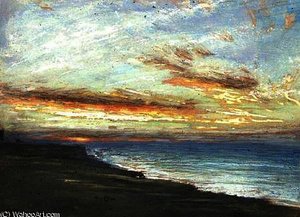


Albert Goodwin
Venice, Before The Campanile Fell
() ·
With its frame: · Hand-painted in oil on linen
Total