


 Preview
 Send
Send Share
Share
 Details
 Guide
Guide

 Download
 Similars
 X-Ray
X-Ray Diaporama
 Stats
StatsFlora Macdonald
 Oil On Canvas
- WallArt
- Rococo Portraiture
 1749
1749 74.0 x 61.0 cm
 The Ashmolean Museum of Art And Archaeology
Admire Allan Ramsay's captivating portrait of Flora Macdonald, a heroine who aided Charles Edward Stuart after the Battle of Culloden. This iconic 1749 oil on canvas showcases her elegance and bravery.
 Read More
Explore Allan Ramsay's (1713-1784) elegant portraits of Scottish society & nobility. Discover his Rococo style, masterful technique & iconic works like Queen Charlotte.
Hand Made Oil Reproduction
Hand-painted oil on canvas in your size and frame, made to order by our artists. ( Switch to Print Switch to Digital Image)




P118B $10

P118H $10

P118W $10

P438Z $10

P508JH $12

P508YH $12

P805H $10

P805Z $10

P919BZ $10

P919G $10

P919XJ $10

P959ZH $10

P968JZ $12

W106C $8

W218G $10

W218JH $8

W218Y $10

W307PJ $10

W316G $10

W316PJ $8

W316Y $10

W398PJ $8

W4111J $10

W500HY $15

W500JH $15

W692G $12

W849H $8

W940BG $15

W953PJ $8




Standard
custom
CM
INCH
Pick from our preset sizes that match the artwork's original proportions.
Loading sizes...

width
height
Type the width and the height you need, to fit your frame or your wall. This is hand-painted, so for a size with a different shape the artist can paint a bit more around the picture, or cut a bit — you choose. We send you a digital mockup to approve before the painting starts. The picture shown on this page does not show the real result — only the mockup does.
Examples of what can be changed: Replace face with customer photo; Add pet (e.g., replace cat with dog); Include hidden message in background; Change background landscape or elements.
After order, TopImpressionists.com team will email client for instructions and provide a mockup preview
After order, TopImpressionists.com team will email client for instructions and provide a mockup preview
Worldwide Delivery () in 3/4 weeks instead of standard 5 weeks. (22 October). No compromise on quality.

Free Worldwide Express Shipping

High-Quality Linen Canvas

Full Shipping Insurance

Customs Tax Refund Guarantee

True Color Matching Guarantee

100-Day Return Policy (Defects Only)

100% Money-Back Guarantee

Bulk Discount Offer
 Glass option is only available in size under 110 CM

Flora Macdonald
Reproduction Medium
Reproduction Size
-


Total Price
$ 269
Flora Macdonald: A Portrait of Courage and Resilience
Allan Ramsay’s “Flora Macdonald,” painted in 1749, is more than just a likeness; it's a potent distillation of Scottish history, embodying the spirit of rebellion and the quiet heroism of an ordinary woman thrust into extraordinary circumstances. Housed within the Ashmolean Museum’s collection in Oxford, this oil on canvas portrait captures a pivotal moment – the clandestine assistance offered to Charles Edward Stuart after the devastating Battle of Culloden, a scene that has resonated through generations.
Ramsay, a master of capturing both aristocratic elegance and subtle emotion, skillfully portrays Flora as a young woman of striking composure. Her fair skin and dark hair are rendered with meticulous detail, styled in an updo indicative of the late 18th century’s fashion trends. The neutral expression on her face—a slight parting of her lips suggesting either a recent utterance or a thoughtful pause—allows the viewer to project their own interpretations onto her demeanor. The carefully chosen attire – a blue dress with a high collar and puffy sleeves, complemented by a vibrant red plaid shawl draped over her shoulder – speaks volumes about her social standing and adds a touch of warmth to the otherwise formal composition.
A Dramatic Narrative in Paint
The painting’s power lies not just in its technical brilliance but also in the narrative it conveys. The red plaid, instantly recognizable as associated with Clan MacDonald, immediately anchors Flora within her Highland heritage and subtly hints at the turbulent events surrounding her. Crucially, she holds a small bouquet of white and pink blooms – flowers often symbolizing purity, remembrance, and even sacrifice – suggesting both her role in protecting the Prince and the poignant cost of his ambition. The placement of her hand resting on what appears to be a chair or bench subtly conveys a sense of weary strength, hinting at the burdens she carried.
The dark background, punctuated by subtle hints of foliage, serves to isolate Flora as the central figure, amplifying her importance within the scene. Ramsay’s use of light is particularly noteworthy; it's soft and diffused, casting gentle shadows that add depth and dimension to the portrait, creating a sense of intimacy and drawing the viewer into Flora’s world.
Historical Context: A Heroine Forged in Rebellion
Flora Macdonald’s story is inextricably linked to the Jacobite rising of 1745. Following Culloden, she risked her life to help Charles Edward Stuart, the exiled heir to the throne, evade capture by government forces. Her bravery and resourcefulness – transporting the Prince disguised as a maidservant across the Highlands – became legendary, cementing her place in Scottish folklore. The painting captures this pivotal moment of defiance against overwhelming odds, transforming a simple Highland woman into a symbol of resistance.
It’s important to note that the portrait's attribution has been debated over time; initially believed to be Flora Macdonald, it is now widely considered to be a generic representation of a lady. However, its enduring popularity and association with the iconic story of her bravery ensure its continued significance within the art historical canon.
Symbolism and Emotional Resonance
Beyond the factual details of the Jacobite uprising, “Flora Macdonald” resonates deeply due to its exploration of themes such as courage, loyalty, and sacrifice. Flora’s quiet dignity and resolute expression speak volumes about her inner strength and unwavering commitment to a cause greater than herself. The painting invites contemplation on the complexities of historical events and the often-unrecognized heroism found in ordinary individuals. It's a powerful reminder that even in times of great upheaval, acts of kindness and bravery can leave an indelible mark on history – and on our collective imagination.
Questions & Answers
What emotional tone accompanies the Rococo Portraiture style of "Flora Macdonald"?
The reflective emotion of "Flora Macdonald" accompanies its Rococo Portraiture style.
Does the copyright of "Flora Macdonald" by Allen Ramsay allow reproductions?
The original "Flora Macdonald" is at The Ashmolean Museum of Art And Archaeology, and the work is in the public domain - its copyright has expired.
How do movement and era meet in "Flora Macdonald" by Allen Ramsay?
In "Flora Macdonald" by Allen Ramsay, the Rococo Portraiture movement meets the Early-Modern era.
Artist Biography
Allan Ramsay: A Life of Elegance and Artistry
Early Life and Training
Born in Edinburgh, Scotland on October 13, 1713, Allan Ramsay emerged as a prominent Scottish portrait-painter whose work captured the elegance and refinement of his era. His artistic journey began at the age of twenty when he travelled to London for studies under the Swedish painter Hans Hysing, followed by instruction at the St. Martin's Lane Academy. This foundational training provided him with a solid base in technique and composition.
Italian Influences & Artistic Development
Ramsay’s artistic development took a significant turn with his travels to Rome and Naples, where he spent three years (1736-1738) working under the tutelage of Francesco Solimena and Imperiali (Francesco Fernandi). These Italian masters profoundly influenced his style, fostering a greater understanding of classical principles and enhancing his skills in capturing likeness and character. He absorbed the prevailing Rococo aesthetic while also developing an appreciation for Neoclassical ideals.
A Flourishing Career & Notable Works
Upon returning to Britain in 1738, Ramsay quickly established a successful career as a portraitist. His ability to portray his subjects with both accuracy and grace soon garnered him a distinguished clientele. Some of his most notable works include:
- Queen Charlotte (1744-1818) with her two eldest sons (Royal Collection, London): A regal depiction showcasing the Queen’s maternal presence.
- Mary Degg, Lady Robert Manners (Scottish National Gallery, Edinburgh): An elegant portrait demonstrating Ramsay's skill in capturing aristocratic beauty.
- Head of Duncan Forbes of Culloden: This early work brought him to the attention of the Duke of Argyll and was later featured on Royal Bank of Scotland banknotes.
Royal Appointment & Peak Achievement
A pivotal moment in Ramsay’s career arrived in 1761 with his appointment as Principal Painter in Ordinary to George III. This prestigious position cemented his status among the art elite and ensured a steady stream of commissions from the royal family and high society. He became *the* portraitist of the Georgian era.
Later Life & Legacy
Ramsay’s later life saw a shift towards literary pursuits, reflecting his broad intellectual interests. However, personal tragedies – an accidental dislocation of his right arm and the passing of his second wife in 1782 – impacted his health and productivity. He died in 1784.
Despite these challenges, Ramsay left behind a lasting legacy as one of Scotland’s most celebrated portrait painters. As Samuel Johnson noted, “I love Ramsay. You will not find a man in whose conversation there is more instruction, more information, and more elegance, than in Ramsay's.” His works continue to be admired for their technical skill, refined aesthetic, and insightful portrayals of 18th-century society.
Historical Significance
Allan Ramsay’s contribution extends beyond his artistic talent. He played a crucial role in shaping the visual culture of Scotland during a period of significant social and political change. His portraits provide valuable insights into the lives, fashions, and values of the Scottish nobility and gentry. His works can be found at locations such as Ayr Town Hall, and the Scottish National Portrait Gallery.

Allen Ramsay
1713 - 1784 , United Kingdom
Quick Facts
- Name: Allan Ramsay
- Movement:
- Rococo
- Neoclassical
- Birth Date: 1713-10-13
- Death Date: 1784
- Birth Place: Edinburgh, United Kingdom
- Nationality: Scottish
- Date Of Birth: 1713
- Date Of Death: 1784
- Influenced By:
- Hans Hysing
- Francesco Solimena
- Imperiali (Francesco Fernandi)
- Notable Works:
- Queen Charlotte with her two eldest sons
- Mary Degg, Lady Robert Manners
- Head of Duncan Forbes of Culloden
- Place Of Birth: Edinburgh, United Kingdom
Related Articles

George Paul Chalmers: Rediscovering the Angus Rembrandt & Scottish Colourist Roots
Explore the captivating world of George Paul Chalmers (1833-1878), a pivotal Scottish painter. Discover his landscapes, portraits & connection to the Aesthetic Movement and Colourists. Learn about this 'Angus Rembrandt's' legacy with TopImpressionists.

Sir John Watson Gordon: A Study in Scottish Landscape Painting & Tonal Impressionism
Explore the captivating portraits of Sir John Watson Gordon, a leading Scottish master. Discover his evolution from neoclassical style to atmospheric Tonalism and influence on 19th-century British art. Learn about his iconic sitters & legacy.

James Giles: Capturing Scottish Life Through the Lens of British Realism
Explore the life & work of James Giles (1801-1870), a master of Scottish landscape painting and favored artist of Queen Victoria. Discover his atmospheric realism & royal commissions.
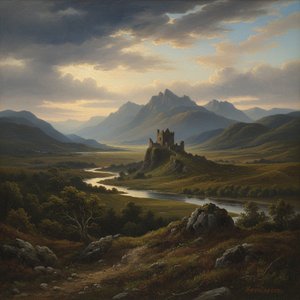
Alexander Nasmyth: Picturing Scotland's Romantic Landscape – Innovation & Identity
Explore the life & art of Alexander Nasmyth, a pivotal figure in Scottish Romantic landscape painting. Discover his iconic works, including portraits of Robert Burns, and learn about his lasting influence on national identity. Fine art reproductions available.

Allen Ramsay: Portraiture, Patronage & Shaping Georgian Identity
Explore the life & work of Allen Ramsay, pivotal portraitist to George III. Discover his Rococo style, influence on Georgian society, and lasting legacy in British art history. Learn about his key works & patronage.
Explore artworks organized by themes, styles, and characteristics.


