


 Preview
 Send
Send Share
Share
 Details
 Guide
Guide

 Download
 Similars
 X-Ray
X-Ray Diaporama
 Stats
StatsRed Coat


Admire Alphonse Mucha’s ‘Red Coat,’ a captivating impressionistic portrait of a scholarly woman. Explore its warm tones, subtle details & Art Nouveau style – a timeless piece.
 Read More
Discover Alphonse Mucha (1860-1939), the Art Nouveau master! Explore his iconic posters, beautiful women & the monumental 'Slav Epic'. A Czech artistic legend.
Giclée / Art Print
Museum-quality giclée or canvas print with fast production and flexible finish options. ( Buy Hand Made Painting Switch to Digital Image)




P118B $10

P118H $10

P118W $10

P438Z $10

P508JH $12

P508YH $12

P805H $10

P805Z $10

P919BZ $10

P919G $10

P919XJ $10

P959ZH $10

P968JZ $12

W106C $8

W218G $10

W218JH $8

W218Y $10

W307PJ $10

W316G $10

W316PJ $8

W316Y $10

W398PJ $8

W4111J $10

W500HY $15

W500JH $15

W692G $12

W849H $8

W940BG $15

W953PJ $8




Standard
custom
CM
INCH
Pick from our preset sizes that match the artwork's original proportions.
Loading sizes...

width
height
Type the width and the height you need, to fit your frame or your wall. A print can only be cut, never made bigger than the picture, so a size with a different shape loses a part of the image. We send you a digital mockup to approve before we print anything. The picture shown on this page does not show the real cut — only the mockup does.
Worldwide Delivery () in 2 weeks instead of standard 4/5 weeks. (21 October)

Free Worldwide Express Shipping

High-Quality Linen Canvas

Full Shipping Insurance

Customs Tax Refund Guarantee

True Color Matching Guarantee

100-Day Return Policy (Defects Only)

100% Money-Back Guarantee

Bulk Discount Offer
 Glass option is only available in size under 110 CM

Red Coat
Giclée / Art Print
Reproduction Size
-


Total Price
$ 70
A Symphony of Crimson and Contemplation
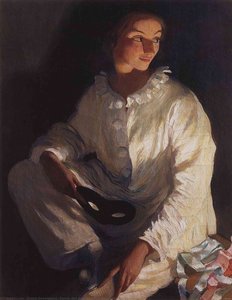
In the heart of the Belle Époque, where the air of Paris hummed with the energy of artistic revolution, Alphonse Mucha captured a moment that transcends time. "The Red Coat," completed in 1902, is far more than a mere portrait; it is a visual distillation of the Art Nouveau spirit, an era defined by its reverence for organic fluidity and luminous grace. As one gazes upon this masterpiece, the eye is immediately arrested by the striking presence of a woman seated in quiet repose, her figure draped in a cloak of such profound scarlet that it seems to pulse with a life of its own. This is not just a study of a subject, but an exploration of how color and form can converge to evoke a sense of deep, scholarly engagement.
The painting serves as a breathtaking example of Mucha’s ability to blend the decorative elegance of his famous posters with a more intimate, impressionistic sensibility. While much of his fame rests upon the sinuous, graphic lines of his lithographs, "The Red Coat" reveals a painterly depth that celebrates texture and light. The technique is characterized by thick, deliberate applications of oil paint, where loose brushstrokes dance across the canvas to create a surface that feels tactile and alive. Rather than pursuing the cold precision of academic realism, Mucha prioritively captures the atmosphere—the way light filters through an unseen window to bathe the subject in a warm, diffused glow, softening the edges of her world and inviting the viewer into her private sanctuary of thought.
Symbolism and the Soul of Art Nouveau
Beyond its aesthetic splendor, the artwork is rich with symbolic resonance, making it a profound choice for collectors who seek depth in their acquisitions. The central figure, absorbed in the act of reading, embodies the intellectual vitality that Mucha often sought to celebrate. The book she holds is not merely an object, but a symbol of knowledge, discovery, and the quiet power of the mind. This theme of intellectual pursuit is beautifully contrasted by the visceral energy of her attire. The red of her coat—a bold, commanding hue—serves as a powerful metaphor for passion, courage, and the very heartbeat of existence. It provides a striking focal point that anchors the composition amidst the more muted, blurred tones of the background.
For the interior designer or the discerning art lover, "The Red Coat" offers an unparalleled emotional landscape. The painting’s palette of deep reds, warm browns, and soft ochres creates a sense of sophisticated warmth, making it an ideal centerpiece for spaces designed for reflection, such as a private library, a study, or a luxurious lounge. The shallow perspective and the way the figure seems to occupy a space just within reach of the viewer create an intimate connection, pulling the observer into her contemplative state. To possess a reproduction of this work is to bring more than just decoration into a room; it is to invite a sense of timeless elegance, a quiet strength, and the enduring beauty of a moment frozen in a flowing, crimson line.
Questions & Answers
Is "Red Coat" by Alphonse Mucha a portrait, landscape or square composition?
"Red Coat" by Alphonse Mucha is a portrait composition. The proportions are worth checking before choosing a print size.
Does "Red Coat" by Alphonse Mucha use strong contrasts or soft harmonies?
In "Red Coat", a balanced contrast is paired with a strong color unity harmony.
Can I examine "Red Coat" in more detail?
The X-Ray page of "Red Coat" by Alphonse Mucha is an interactive viewer that lets you slide through eleven optical layers of the artwork's image, including an X-ray style view.




Artist Biography
Early Life and Education
- Born: July 15, 1860, in Ivanačice, Moravia (now part of the Czech Republic)
- Showed artistic talent from a young age.
- Studied at the Academy of Fine Arts in Prague but became disillusioned with traditional approaches.
- Moved to Paris in 1887 to pursue his own style.
Artistic Style and Notable Works
- Known for distinctive Art Nouveau style characterized by flowing lines, organic forms, and a sense of movement.
- Influenced by artists like Pierre-Auguste Renoir and Gustave Moreau.
- Notable Works:
- The Slavonic Uprising - Showcases blending traditional Czech motifs with modern Art Nouveau elements.
- Salon des Cent
- Paintings inspired by works like The Daughters of Tespio by Gustave Moreau, and La Ribambelle des Gobelins by Piero Dorazio.
- Illustrations based on Young Farmers Breaking Flax by Sir Hubert von Herkomer.
- Frequently featured idealized women in flowing robes surrounded by lush flowers.
Career Highlights and Major Commissions
- Sarah Bernhardt Collaboration: Created posters and designs for the actress Sarah Bernhardt, starting with the poster for Gismonda (1894), which launched his career.
- Universal Exhibition in Paris (1900): His Art Nouveau style gained international recognition at this exhibition. He decorated the Bosnia and Herzegovina Pavilion and collaborated on the Austrian Pavilion.
- Charles Richard Crane Patronage: Received support from Charles Richard Crane, which enabled him to create the monumental series The Slav Epic (1912-30).
- Post-Independence Czechoslovakia: Designed postage stamps, banknotes, and government documents for newly independent Czechoslovakia.
Influences and Legacy
- Influenced by Czech artistic traditions and modern European art movements.
- His unique style paved the way for future generations of artists in Art Nouveau and Secessionism.
- Inspired other artists like Eva Prokopcová.
- Legacy extends beyond his artwork to influence design and aesthetics.
Later Life and Death
- Married Maruska (Marie/Maria) Chytilová in 1906.
- Visited the United States from 1906-1910, where their daughter Jaroslava was born.
- Died on July 14, 1939, in Prague, Czechoslovakia.

Alphonse Mucha
1860 - 1939 , Czech Republic
Quick Facts
- Full Name: Alphonse Maria Mucha
- Nationality: Czech
- Date Of Birth: 1860
- Date Of Death: 1939
- Place Of Birth: Brno, Czech Republic
- Notable Artworks:
- Slavic Uprising
- Salon des Cent
- The Daughters of Tespio
- La Ribambelle des Gobelins
- Young Farmers Breaking Flax
- Artistic Movement Or Style: Art Nouveau
- Artists Who Influenced This Artist:
- Pierre-Auguste Renoir
- Gustave Moreau
- Dante Gabriel Rossetti
- Artists Or Movements Influenced By This Artist: ['Eva Prokopcová']
Related Articles

Modern Soul, Timeless Light: Bringing the Magic of Impressionist Masterpieces into Contemporary Interiors
Discover how to infuse contemporary spaces with the luminous magic of Impressionism. From Monet's light to Renoir's warmth, learn expert tips for styling hand-painted masterpieces and custom art reproductions in your modern home.

Painting with Light: How Impressionist Masterpieces Transform Your Home's Mood
Discover how Impressionist masterpieces transform your home's mood. Explore the luminous beauty of Monet and Renoir through our exquisite, hand-painted oil reproductions designed to bring light, warmth, and timeless elegance to your living space.

Capturing the Soul: The Most Emotionally Moving Impressionist and Post-Impressionist Masterpieces
Discover the profound emotional depth of Impressionist and Post-Impressionist masterpieces. Explore how legends like Monet, Van Gogh, and Gauguin captured light and soul through evocative landscapes and vibrant brushwork for a timeless connection to art history.

Capturing Contemplation: The Most Thoughtful Impressionist Masterpieces
Explore the profound emotional depth of Impressionist and Post-Impressionist masterpieces. From Renoir's tranquil landscapes to Van Gogh's vibrant soul, discover how these legendary artists captured the essence of contemplation through light, color, and texture.

The Elegance of Art Nouveau: Embracing Nature's Fluid Beauty and the Belle Époque Spirit
Discover the enchanting world of Art Nouveau. Explore the organic beauty, flowing lines, and Belle Époque elegance that defined an era of unparalleled craftsmanship and natural inspiration.
Explore artworks organized by themes, styles, and characteristics.


