

Shown: · With its frame:
 Preview
 Send
Send Share
Share
 Details
 Guide
Guide

 Download
 Similars
 X-Ray
X-Ray Diaporama
 Q&A
Q&A Stats
Stats
- 46.0 x 61.0 cm


$ 269
Hand Made Oil Reproduction
Hand-painted oil on canvas in your size and frame, made to order by our artists. ( Switch to Print Switch to Digital Image)
Size
·Standard
custom
CM
INCH
Pick from our preset sizes that match the artwork's original proportions.
Loading sizes...

width
height
Type the width and the height you need, to fit your frame or your wall. This is hand-painted, so for a size with a different shape the artist can paint a bit more around the picture, or cut a bit — you choose. We send you a digital mockup to approve before the painting starts. The picture shown on this page does not show the real result — only the mockup does.
 Read more
Finish
·
White $1

Blurside $1

Extended $1

P118B $10

P118H $10

P118W $10

P438Z $10

P508JH $12

P508YH $12

P805H $10

P805Z $10

P919BZ $10

P919G $10

P919XJ $10

P959ZH $10

P968JZ $12

W106C $8

W218G $10

W218JH $8

W218Y $10

W307PJ $10

W316G $10

W316PJ $8

W316Y $10

W398PJ $8

W4111J $10

W500HY $15

W500JH $15

W692G $12

W849H $8

W940BG $15

W953PJ $8

H24-GOLD $30

H24-SILVER $30

H36-GOLD $45

H36-SILVER $45
Shipped in a protective tube, ready for your own framer.
Above 105 cm the frame is shipped as a kit for a professional framer — read the details.
Extras
optionalWhat do the extras include?
Examples of what can be changed: Replace face with customer photo; Add pet (e.g., replace cat with dog); Include hidden message in background; Change background landscape or elements.
After order, TopImpressionists.com team will email client for instructions and provide a mockup preview
After order, TopImpressionists.com team will email client for instructions and provide a mockup preview
Worldwide Delivery () in 3/4 weeks instead of standard 5 weeks. (5 November). No compromise on quality.
Protective Varnish
Nameplate
Engraved Bronze Plaque Details
This elegant plaque features the artist's name and the title of the artwork, finely engraved for a timeless presentation.
It is made from bronze with a refined, elegant finish. The text is precisely laser-engraved for a sharp and permanent result. Measuring 9x2 cm, the plaque is compact yet easy to read. It's built to be durable and scratch-resistant, offering a professional, museum-quality look. Mounting is simple thanks to the included adhesive backing.
Transparent Acrylic Plaque Details
The plaque includes essential engraved details such as the artist's name, the title of the artwork, the date it was created, the type of media used-like oil on canvas or watercolor-a brief description of the piece, and a QR code that links to the complete artwork information.
It is crafted from clear acrylic, offering a sleek, modern appearance. The text is UV-engraved in black to ensure strong visual contrast. With a size of 10x15 cm, it ensures optimal readability. It comes equipped with two metal hooks for secure wall mounting. The plaque is designed to be weather-resistant, making it suitable for various environments, and it includes interactive features that work seamlessly with smartphone scanning.
Black Acrylic Plaque Details
This elegant plaque includes engraved information such as the artist's name, the title of the artwork, the date it was created, the type of media used (like oil on canvas or watercolor), a short description of the artwork, and a QR code for quick access to more information.
The plaque itself is made from refined black acrylic with a premium finish. The text is laser-engraved in white for high contrast and readability. Its size is 10x15 cm, designed to be easy to read. It comes with two metal hooks for professional mounting. The design is sleek and fits any interior style. It is also weather-resistant and durable, with built-in digital integration for mobile compatibility.
Glass option is only available in size under 110 CM
 Glass option is only available in size under 110 CM
- Free Worldwide Express Shipping
- High-Quality Linen Canvas
- Full Shipping Insurance
- Customs Tax Refund Guarantee
- True Color Matching Guarantee
- 100-Day Return Policy (Defects Only)
- 100% Money-Back Guarantee
- Bulk Discount Offer


Collectible Description
A vibrant abstract study by Amadeo de Souza-Cardoso (1913), featuring dynamic circles and bold blues & reds, reflecting early modernism's innovative spirit. Explore this captivating piece of Portuguese art!
Artist Biography
Discover Amadeo de Souza-Cardoso (1887-1918), a pioneering Portuguese modernist painter. Explore his vibrant, abstract compositions influenced by Cubism & Futurism and lasting artistic legacy.
About the painting
A Dance of Circles: Unveiling the Abstract Vision of Study B
Amadeo de Souza-Cardoso’s “Study B,” painted in 1913, isn't merely a depiction of shapes; it’s an invitation into a vibrant, emotionally charged realm of early modernism. Born in Portugal during a period of intense artistic ferment – a time when the established rules of representation were being boldly challenged – Souza-Cardoso was deeply influenced by the currents flowing through Paris, particularly the burgeoning Cubist and Expressionist movements. This piece captures that spirit with an unrestrained energy, utilizing color and form to evoke a sense of dynamic movement and inner feeling.
The painting immediately draws the eye to its central element: a luminous circle bathed in a warm yellow hue. This isn’t a static focal point; it pulsates with implied motion, as if radiating outward. Surrounding this core are a series of concentric circles – some bold and assertive, others delicate and ethereal – each rendered in a carefully chosen palette of blues, reds, and greens. These aren't simply decorative elements; they function as visual echoes, reinforcing the central circle’s energy while simultaneously creating a complex web of interconnectedness. Souza-Cardoso masterfully employs color not to mimic reality but to express an internal state, a feeling of joyous exploration and creative impulse.
The Seeds of Modernism: Context and Influences
To understand “Study B,” it’s crucial to recognize the artistic landscape of 1913. Portugal was undergoing a period of rapid modernization and cultural change, and Souza-Cardoso was at the forefront of this movement, forging connections with European avant-garde artists like Modigliani and Brancusi. The influence of Cubism is evident in the fragmented forms and multiple perspectives presented within the circles, while the emotional intensity hints at the burgeoning Expressionist style. The painting reflects a desire to move beyond mere imitation of the visible world, embracing instead the subjective experience of perception.
Furthermore, Souza-Cardoso’s background as a caricaturist – a profession demanding keen observation and expressive rendering – undoubtedly informed his approach to abstraction. He was adept at capturing personality and emotion through simplified forms, a skill he translated into his paintings with remarkable effectiveness. The inclusion of the human figure, positioned subtly in the upper left corner, adds another layer of complexity, suggesting a connection between the artist’s inner world and the external reality.
Decoding the Symbolism: Circles and Beyond
The recurring motif of circles is rich with symbolic potential. In many cultures, circles represent wholeness, unity, and eternity – concepts that resonate deeply within Souza-Cardoso's work. The central yellow circle could be interpreted as a representation of the sun, symbolizing life force, creativity, or even spiritual illumination. The surrounding circles might signify interconnectedness, relationships, or perhaps the various facets of consciousness.
Beyond these broader interpretations, the specific color choices contribute to the painting’s emotional impact. The vibrant blues evoke feelings of tranquility and introspection, while the reds suggest passion and energy. The greens represent growth, renewal, and harmony. The interplay of these colors creates a dynamic tension that keeps the viewer engaged and invites them to contemplate the painting's meaning.
A Legacy of Innovation: Souza-Cardoso’s Enduring Vision
Amadeo de Souza-Cardoso’s “Study B” stands as a testament to his pioneering spirit and his profound understanding of modern art. Despite his tragically short life – he died in 1918 at the age of 30 – his work continues to inspire artists and collectors alike. Reproductions of this captivating piece offer a unique opportunity to experience the intensity and innovation of early Portuguese modernism, bringing a touch of vibrant abstraction into any space.
Questions & Answers
What subjects appear in "Study B" by Amadeo de Souza-Cardoso?
The subjects of "Study B" are abstract, geometric, circles, color, modernism, cardoso, composition.
Does "Study B" have an augmented reality preview?
The AR Preview page of "Study B" by Amadeo de Souza-Cardoso uses augmented reality to show the artwork in your own space, on a compatible device.
What is the dominant hue of "Study B" by Amadeo de Souza-Cardoso?
A green to violet spectrum hue runs through "Study B" by Amadeo de Souza-Cardoso.
Quick facts and art quiz
About Amadeo de Souza-Cardoso

Amadeo de Souza-Cardoso
1887 - 1918, Portugal
Artist Biography
A Pioneer of Portuguese Modernism: The Life and Art of Amadeo de Souza-Cardoso
Amadeo de Souza-Cardoso, a name resonating with the vibrant energy of early 20th-century modernism, remains a somewhat enigmatic figure despite his pivotal role in bridging Portuguese art to the international avant-garde. Born on November 14, 1887, in Manhufe, a picturesque parish of Amarante in Portugal, his brief but intensely creative life was marked by a restless spirit and an unwavering dedication to artistic innovation. From humble beginnings rooted in the rural landscapes of his homeland, Souza-Cardoso embarked on a journey that would lead him to the heart of Parisian modernism, where he forged connections with some of the most influential artists of his time – Modigliani, Brancusi, Delaunay, and Gris among them. His early education began with architectural studies in Lisbon, but it was the allure of painting, particularly the expressive power of caricature, that truly captured his imagination and set him on a path toward artistic exploration. This initial foray into art wasn’t merely technical training; it was an awakening to the potential of visual language as a means of commentary and self-expression.Parisian Encounters and Artistic Development
The year 1906 marked a turning point, as Souza-Cardoso relocated to Paris, immersing himself in the city’s thriving artistic milieu. Initially continuing his architectural pursuits, he soon gravitated towards painting, quickly absorbing the radical ideas that were reshaping the art world. The influence of Cubism and Futurism became increasingly apparent in his work around 1910, establishing him as one of Portugal's first true modern painters. However, Souza-Cardoso didn’t simply mimic these movements; he synthesized them with his own unique sensibility, creating a style characterized by bold forms, vibrant colors, and dynamic compositions. His paintings weren’t merely representations of reality but rather explorations of perception, emotion, and the very essence of form itself. Works like *Saut du Lapin* (1911) and *Cabeça* (1913) exemplify this period, showcasing his experimentation with fragmented perspectives and a heightened sense of chromatic intensity. These weren’t chaotic arrangements but carefully balanced structures, revealing a deliberate artistic vision beneath the surface of apparent randomness. He participated in key exhibitions, including the Salon des Indépendants and, crucially, the groundbreaking 1913 Armory Show in New York, bringing his innovative work to an international audience.A Synthesis of Influences: Between Portugal and Paris
Souza-Cardoso’s artistic journey wasn't a complete severance from his Portuguese roots. Despite embracing the avant-garde spirit of Paris, he maintained a strong connection to his homeland, frequently returning to Manhufe. This duality is reflected in his art, where themes and motifs drawn from Portuguese culture – religious processions, rural landscapes, folk traditions – are interwoven with modernist techniques. *Entrada* (1917) and *Pintura* (1917), created during a period of renewed engagement with Portugal, demonstrate this synthesis, showcasing an increasing tendency towards abstraction while retaining a distinctly Portuguese flavor. This ability to reconcile seemingly disparate influences was a hallmark of his artistic genius. He wasn’t simply adopting styles; he was transforming them, imbuing them with his own unique perspective and creating something entirely new. His work became a dialogue between cultures, a testament to the power of art to transcend geographical boundaries.Legacy and Remembrance: A Lasting Impact
Tragically, Amadeo de Souza-Cardoso’s promising career was cut short by his untimely death on October 25, 1918, at the age of just thirty. He succumbed to pneumonia during the Spanish Flu pandemic, leaving behind a relatively small but remarkably impactful body of work. For many years, his contributions were overlooked, overshadowed by more prominent figures in the modernist movement. However, in recent decades, there has been a growing recognition of his significance as a pioneer of Portuguese modernism and an important voice within the broader European avant-garde. Two major retrospectives – one in 1958 and another at the Grand Palais in Paris in 2016 – have helped to reintroduce his work to a wider audience, solidifying his place in art history. Today, his paintings can be found in museums around the world, including the Plymouth City Museum and Art Gallery, alongside works by other notable artists. His legacy continues to inspire contemporary artists, serving as a reminder of the power of artistic innovation and the enduring importance of cultural exchange.Key Characteristics of Souza-Cardoso’s Work
- Innovative Style: A pioneering approach to modern Portuguese art, blending Cubism, Futurism, and his own unique sensibility.
- Vivid Color Palette: Characterized by aggressive and vibrant use of color, creating dynamic and emotionally resonant compositions.
- Dynamic Composition: Often employing fragmented perspectives and seemingly chaotic arrangements that are, in fact, carefully balanced and structured.
- Cultural Synthesis: A unique ability to integrate Portuguese themes and motifs with modernist techniques, creating a dialogue between cultures.
- Early Abstraction: Exploration of abstraction, particularly in his later works, pushing the boundaries of representational art.
Quick facts about Amadeo de Souza-Cardoso
- Full Name: Amadeo de Souza-Cardoso
- Nationality: Portuguese
- Date Of Birth: 1887
- Date Of Death: 1918
- Place Of Birth: Manhelices, Portugal
- Notable Artworks:
- Saut du lapin
- Cabeça
- Entrada
- Pintura
- Artistic Movement Or Style: Cubism, Futurism, Modernism
- Artists Who Influenced This Artist:
- Modigliani
- Brancusi
- Delaunay
Explore artworks organized by themes, styles, and characteristics.




Amadeo de Souza-Cardoso
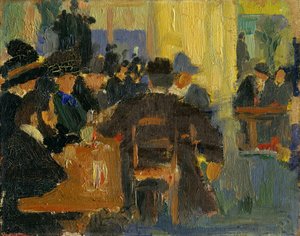
Study B
() ·
With its frame: · Hand-painted in oil on linen
Total