
Shown: · With its frame:
 Preview
 Send
Send Share
Share
 Details
 Guide
Guide

 Download
 Similars
 X-Ray
X-Ray Diaporama
 Q&A
Q&A Stats
Stats
- 81.0 x 61.0 cm


$ 269
Hand Made Oil Reproduction
Hand-painted oil on canvas in your size and frame, made to order by our artists. ( Switch to Print Switch to Digital Image)
Size
·Standard
custom
CM
INCH
Pick from our preset sizes that match the artwork's original proportions.
Loading sizes...

width
height
Type the width and the height you need, to fit your frame or your wall. This is hand-painted, so for a size with a different shape the artist can paint a bit more around the picture, or cut a bit — you choose. We send you a digital mockup to approve before the painting starts. The picture shown on this page does not show the real result — only the mockup does.
 Read more
Finish
·
White $1

Blurside $1

Extended $1

P118B $10

P118H $10

P118W $10

P438Z $10

P508JH $12

P508YH $12

P805H $10

P805Z $10

P919BZ $10

P919G $10

P919XJ $10

P959ZH $10

P968JZ $12

W106C $8

W218G $10

W218JH $8

W218Y $10

W307PJ $10

W316G $10

W316PJ $8

W316Y $10

W398PJ $8

W4111J $10

W500HY $15

W500JH $15

W692G $12

W849H $8

W940BG $15

W953PJ $8

H24-GOLD $30

H24-SILVER $30

H36-GOLD $45

H36-SILVER $45
Shipped in a protective tube, ready for your own framer.
Above 105 cm the frame is shipped as a kit for a professional framer — read the details.
Extras
optionalWhat do the extras include?
Examples of what can be changed: Replace face with customer photo; Add pet (e.g., replace cat with dog); Include hidden message in background; Change background landscape or elements.
After order, TopImpressionists.com team will email client for instructions and provide a mockup preview
After order, TopImpressionists.com team will email client for instructions and provide a mockup preview
Worldwide Delivery () in 3/4 weeks instead of standard 5 weeks. (7 November). No compromise on quality.
Protective Varnish
Nameplate
Engraved Bronze Plaque Details
This elegant plaque features the artist's name and the title of the artwork, finely engraved for a timeless presentation.
It is made from bronze with a refined, elegant finish. The text is precisely laser-engraved for a sharp and permanent result. Measuring 9x2 cm, the plaque is compact yet easy to read. It's built to be durable and scratch-resistant, offering a professional, museum-quality look. Mounting is simple thanks to the included adhesive backing.
Transparent Acrylic Plaque Details
The plaque includes essential engraved details such as the artist's name, the title of the artwork, the date it was created, the type of media used-like oil on canvas or watercolor-a brief description of the piece, and a QR code that links to the complete artwork information.
It is crafted from clear acrylic, offering a sleek, modern appearance. The text is UV-engraved in black to ensure strong visual contrast. With a size of 10x15 cm, it ensures optimal readability. It comes equipped with two metal hooks for secure wall mounting. The plaque is designed to be weather-resistant, making it suitable for various environments, and it includes interactive features that work seamlessly with smartphone scanning.
Black Acrylic Plaque Details
This elegant plaque includes engraved information such as the artist's name, the title of the artwork, the date it was created, the type of media used (like oil on canvas or watercolor), a short description of the artwork, and a QR code for quick access to more information.
The plaque itself is made from refined black acrylic with a premium finish. The text is laser-engraved in white for high contrast and readability. Its size is 10x15 cm, designed to be easy to read. It comes with two metal hooks for professional mounting. The design is sleek and fits any interior style. It is also weather-resistant and durable, with built-in digital integration for mobile compatibility.
Glass option is only available in size under 110 CM
 Glass option is only available in size under 110 CM
- Free Worldwide Express Shipping
- High-Quality Linen Canvas
- Full Shipping Insurance
- Customs Tax Refund Guarantee
- True Color Matching Guarantee
- 100-Day Return Policy (Defects Only)
- 100% Money-Back Guarantee
- Bulk Discount Offer


Collectible Description
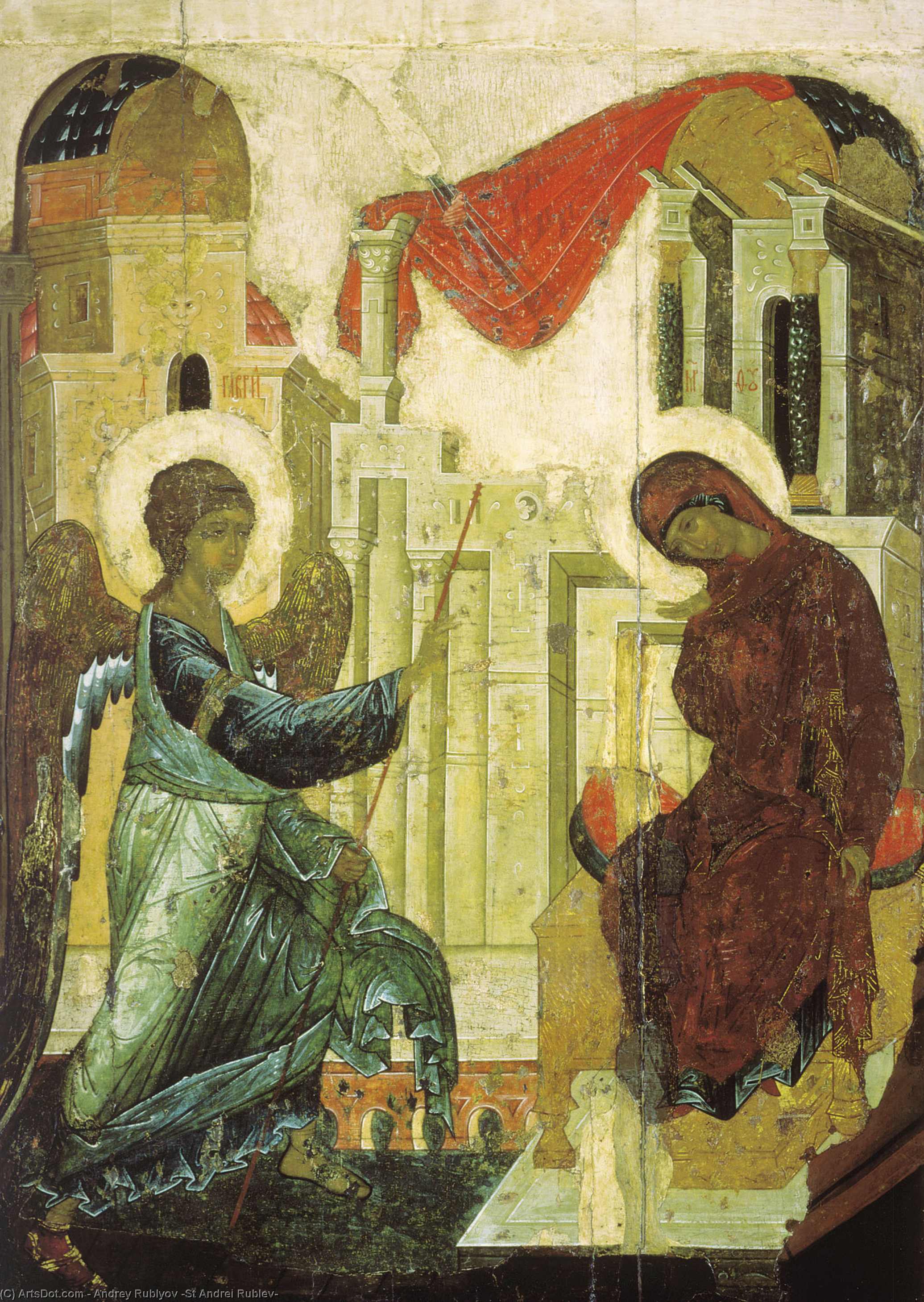
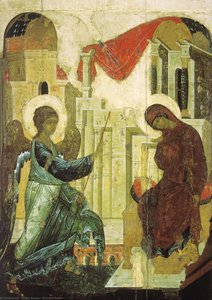
Experience the serene beauty of Andrei Rublev’s 1405 Annunciation icon, a masterpiece of Russian iconography showcasing two angels and human figures in a peaceful setting. Own a piece of art history and immerse yourself in this timeless devotional artwork.
Artist Biography
Andrey Rublyov (c. 1360-1428): A master of Russian icon painting, known for his mystical & emotive works like 'Annunciation' & 'Holy Trinity'. Explore spiritual depth & Byzantine influences.
About the painting
A Window into Faith: Andrei Rublev’s Annunciation
Andrei Rublev's 1405 “Annunciation” is more than just a religious depiction; it’s a profound meditation on faith, humility, and the transformative power of divine revelation. Painted during a pivotal moment in Russian history – a nation wrestling with its identity under Byzantine influence yet forging its own spiritual path – this icon transcends mere representation to become a vessel for deeply felt emotion and theological contemplation. The painting's quiet serenity, achieved through meticulous detail and a masterful understanding of color and form, speaks directly to the viewer’s soul, inviting reflection on themes of grace and obedience.
- The Narrative Unfolds: The scene depicts the pivotal moment when the Archangel Gabriel announces to Mary that she will conceive and bear the Son of God. The angel on the right, seated with folded hands, embodies a posture of reverence and submission, while his counterpart on the left, holding a staff, represents earthly support and guidance.
- A Masterclass in Iconography: Rublev’s technique is characterized by its remarkable restraint and spiritual depth. He employs a limited palette – predominantly blues, reds, and golds – to create a luminous effect, typical of Russian icon painting. The use of *opasny* (halo) around Mary's head further emphasizes her divine status.
The Symbolism of Light and Color
Color in Rublev’s “Annunciation” is not merely decorative; it carries profound symbolic weight. The radiant gold used to depict the angels signifies their heavenly origins, while the blue hues evoke the vastness of God's kingdom. Mary’s red robe symbolizes her virginity and future motherhood – a potent visual shorthand within the iconography tradition. The careful layering of translucent *izol* (encaustic) paint creates an ethereal glow, enhancing the sense of otherworldly beauty and spiritual presence. The architectural elements, particularly the building in the background, are rendered with remarkable precision, grounding the scene in a tangible reality while simultaneously pointing towards the divine.
Historical Context and Artistic Influence
Created during a period of intense religious fervor within Russia, Rublev’s “Annunciation” reflects the profound influence of Byzantine art. However, unlike many Western icon painters, Rublev infused his work with distinctly Russian sensibilities – a sense of humility, devotion, and an unwavering belief in the power of faith. He was likely influenced by Theophanes the Greek, whose innovative approach to iconography paved the way for Rublev’s own groundbreaking style. This painting represents a crucial step in the development of Russian iconographic tradition, establishing key visual motifs that would be adopted and adapted by subsequent generations of artists.
Emotional Impact and Artistic Reproduction
Rublev's "Annunciation" continues to resonate with viewers centuries after its creation. Its quiet power, combined with its exquisite craftsmanship, evokes a sense of awe and reverence. TopImpressionists offers meticulously crafted hand-painted reproductions of this iconic work, allowing you to experience the beauty and spiritual depth of Rublev’s masterpiece in your own home or office. Our skilled artisans employ traditional techniques and high-quality materials to faithfully recreate every detail of the original, ensuring that you receive a timeless piece of art that will inspire and uplift for years to come.
Questions & Answers
What is "Annunciation" about, and what atmosphere does it have?
"Annunciation" by Andrey Rublyov (St Andrei Rublev) depicts annunciation, angels, rublyov, iconography, religious scene, medieval art, russian icon, in an ethereal mood. Subject and atmosphere together describe the work.
In what year was "Annunciation" by Andrey Rublyov (St Andrei Rublev) created?
The creation of "Annunciation" by Andrey Rublyov (St Andrei Rublev) is dated 1405.
What stage of Andrey Rublyov (St Andrei Rublev)'s development does "Annunciation" represent?
"Annunciation" represents the Mature Period of Andrey Rublyov (St Andrei Rublev).
Quick facts and art quiz
About Andrey Rublyov (St Andrei Rublev)

Andrey Rublyov (St Andrei Rublev)
1360 - 1428, Russia
Artist Biography
Andrei Rublev: The Soul of Russian Iconography
Andrei Rublev (c. 1360 – c. 1430) remains one of the most enigmatic and profoundly influential figures in the history of Russian art. More than simply a painter, he embodies a confluence of spiritual devotion, artistic mastery, and the very essence of medieval Russia—a nation grappling with its identity amidst Byzantine influence and nascent national consciousness. While details of his life remain shrouded in mystery, his legacy as the foremost iconographer of his era is undeniable, shaping not only the visual language of Russian Orthodox art but also profoundly impacting subsequent generations of artists.
Little concrete information survives regarding Rublev’s early years. He is believed to have been born in Moscow, though some accounts suggest a possible origin in the Trinity-St. Sergius Lavra Monastery near the city – a location that would deeply inform his artistic development. His apprenticeship under Theophanes the Greek, a renowned Byzantine icon painter who had migrated to Russia, provided him with an invaluable foundation in the techniques and stylistic conventions of the era. However, Rublev quickly transcended mere imitation, imbuing these established forms with a uniquely Russian sensibility – a palpable sense of humility, spiritual depth, and emotional resonance that distinguished his work from its Byzantine predecessors.
- Early Career at the Kremlin: Rublev’s early career is inextricably linked to the Moscow Kremlin. In 1405, he joined forces with Theophanes and Prokhor of Gorodets to decorate the Annunciation Cathedral, a pivotal moment in Russian icon painting. This collaboration exposed Rublev to the highest echelons of power and provided him with invaluable experience working on a grand scale.
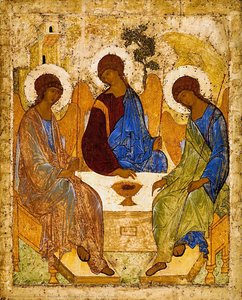
- The Trinity Icon: Arguably Rublev’s most celebrated work, the “Trinity” icon (c. 1420-1428), is a testament to his artistic genius. This masterpiece, now housed in the Tretyakov Gallery in Moscow, departs subtly from traditional Byzantine iconography. The figures of Abraham and Sarah are absent, replaced by a more intimate depiction of the Trinity – God the Father, God the Son, and the Holy Spirit—a shift that has been interpreted as reflecting Rublev’s own spiritual understanding of divine unity.
- Andronikov Monastery: Following his work at the Kremlin, Rublev spent the latter part of his career at the Andronikov Monastery near Moscow. Here, he continued to paint icons and frescoes, including a series of stunning murals in the Savior Cathedral, showcasing his evolving style and deepening spiritual exploration.
The Fusion of Byzantine and Russian Traditions
Rublev’s artistic vision was not born in isolation; it was deeply rooted in both Byzantine traditions and emerging Russian sensibilities. Theophanes' influence is undeniable – the meticulous detail, the rich colors, and the formal structure of his compositions are all hallmarks of Byzantine icon painting. However, Rublev skillfully integrated these elements with a distinctly Russian aesthetic—a profound sense of humility, an emphasis on emotional expression, and a connection to the spiritual life of the monastic community.
- Byzantine Influence: The influence of Byzantine iconography is readily apparent in Rublev’s use of hierarchical composition, his careful rendering of drapery, and his adherence to established iconographic conventions. His work demonstrates a deep understanding of Byzantine artistic principles, reflecting the cultural and religious exchange between Russia and Byzantium.
- Russian Spirituality: Simultaneously, Rublev infused his art with a uniquely Russian spiritual perspective. His figures are not idealized or heroic; they possess a quiet dignity and an aura of profound humility. This emphasis on inner spirituality resonated deeply with the monastic ethos of his time – a period marked by intense religious fervor and a yearning for divine union.
- Novgorodian Iconography: Rublev’s style also shows traces of Novgorodian icon painting, which was known for its expressive faces and emotional intensity. This influence contributed to the psychological depth and emotional resonance that characterize his work.
Symbolism and Spiritual Depth
Rublev's icons are not merely beautiful images; they are imbued with layers of symbolic meaning, reflecting a profound understanding of Christian theology and spiritual practice. His compositions often feature subtle gestures, facial expressions, and spatial arrangements that convey complex theological ideas.
- The Trinity Icon: The “Trinity” icon is particularly rich in symbolism. The three angels represent the Father, Son, and Holy Spirit, while the central figure—a humble peasant—symbolizes humanity’s need for divine grace. The absence of Abraham and Sarah from the composition suggests a shift away from traditional narratives towards a more intimate and personal understanding of God’s relationship with humankind.
- Other Iconographic Elements: Rublev frequently employed symbolic gestures, such as hands clasped in prayer or eyes turned heavenward, to convey spiritual longing and devotion. His use of color—particularly the rich blues and golds—also carries symbolic weight, evoking notions of divinity and transcendence.
Legacy and Historical Significance
Despite his relatively short life, Andrei Rublev left an indelible mark on Russian art and culture. His work profoundly influenced subsequent generations of icon painters, shaping the development of Russian iconography for centuries to come. The Stoglavi Sobor in 1551 officially proclaimed Rublev’s style as a model for church painting, cementing his status as a national artistic hero.
- Tarkovsky's Film: Andrei Tarkovsky’s 1966 film *Andrei Rublev* played a crucial role in reviving interest in the artist’s life and work. The film, though loosely based on historical events, captured the spiritual depth and artistic genius of Rublev, introducing him to a wider audience.
- Saintly Recognition: In 1988, the Russian Orthodox Church canonized Rublev as a saint, recognizing his profound contribution to Russian spirituality and art. His feast day is celebrated on January 29th, commemorating both his death and his enduring legacy.
- Enduring Influence: Today, Andrei Rublev remains one of Russia’s most beloved artists—a symbol of spiritual devotion, artistic mastery, and the enduring power of faith. His icons continue to inspire awe and reverence, offering a glimpse into the soul of medieval Russia and the timeless beauty of Christian iconography.
Quick facts about Andrey Rublyov (St Andrei Rublev)
- Full Name: Andrey Rublyov
- Nationality: Russian
- Date Of Birth: 1360
- Date Of Death: 1428
- Place Of Birth: Moscow, Russia
- Notable Artworks:
- Trinity Icon
- Annunciation Icon
- Artistic Movement Or Style: Russian Icon Painting
- Artists Who Influenced This Artist:
- Theophanes the Greek
- Prokhor of Gorodets
- Artists Or Movements Influenced By This Artist:
- Byzantine Icons
- Russian Orthodox Art
Explore artworks organized by themes, styles, and characteristics.




Andrey Rublyov (St Andrei Rublev)
Annunciation
() ·
With its frame: · Hand-painted in oil on linen
Total