

 Send
Send Share
Share
 Details
 Guide
Guide

 Download
 Similars
 Diaporama
 Q&A
Q&A Stats
StatsErwartung, op. 17

- 36.0 x 28.0 cm


Experience Arnold Schoenberg's groundbreaking 1909 monodrama Erwartung, op. 17, a pivotal work of expressionism captured in this rare music score. Discover the intensity and innovation of this iconic piece and bring its timeless beauty into your space.
 Read More
Explore Arnold Schoenberg's revolutionary music – atonality, twelve-tone technique & influence on 20th-century composers. Discover his legacy at the Schönberg Center.
Giclée / Art Print
Museum-quality giclée or canvas print with fast production and flexible finish options. ( Buy Hand Made Painting Switch to Digital Image)




































Standard
custom
CM
INCH
Pick from our preset sizes that match the artwork's original proportions.
Loading sizes...

width
height
Type the width and the height you need, to fit your frame or your wall. A print can only be cut, never made bigger than the picture, so a size with a different shape loses a part of the image. We send you a digital mockup to approve before we print anything. The picture shown on this page does not show the real cut — only the mockup does.
Worldwide Delivery () in 2 weeks instead of standard 4/5 weeks. (3 November)

Free Worldwide Express Shipping

High-Quality Linen Canvas

Full Shipping Insurance

Customs Tax Refund Guarantee

True Color Matching Guarantee

100-Day Return Policy (Defects Only)

100% Money-Back Guarantee

Bulk Discount Offer
 Glass option is only available in size under 110 CM

Erwartung, op. 17
Giclée / Art Print
Reproduction Size
-


Total Price
$ 70
A Fragment of Anxiety: Schoenberg's "Erwartung" – A Window into Musical Angst
This meticulously crafted hand-painted reproduction offers an unparalleled glimpse into the genesis of Arnold Schoenberg’s groundbreaking monodrama, “Erwartung” (Expectation), composed in 1909. More than just a musical score, it is a tangible embodiment of intense creative struggle and a profound exploration of human emotion – a testament to Schoenberg's revolutionary approach to composition. The image captures the very document upon which this pivotal work was born, revealing the raw, almost frantic energy that fueled its creation.
- The Score as Canvas: The reproduction faithfully replicates the original score, a chaotic yet meticulously organized collection of notes, symbols, and handwritten annotations. Schoenberg’s characteristic use of short scores – a technique designed to capture fleeting moments of heightened emotion – is strikingly evident.
- A Moment Frozen in Time: The inclusion of two clocks within the image adds another layer of significance. These aren't merely decorative elements; they represent the relentless passage of time, a key thematic concern within “Erwartung,” where suspense and anticipation build to unbearable tension.
- Technical Detail: Notice the varying levels of detail – fully notated pitches and rhythms alongside fragmented dynamics and phrasing, reflecting Schoenberg’s initial approach. This reveals the composer's iterative process, constantly refining his vision as he wrestled with translating psychological states into musical form.
The Birth of Atonality: Contextualizing "Erwartung"
"Erwartung," created in Steinakirchen (Lower Austria), marked a radical departure from traditional tonal music. Schoenberg, alongside Alban Berg and Anton Webern, spearheaded the development of atonality – a system where no single note held inherent harmonic significance. This wasn't simply about discarding established rules; it was an attempt to represent the subjective experience of emotion with unprecedented directness. The monodrama’s narrative, centered around a woman’s increasingly paranoid and unsettling wait for a lover, perfectly mirrored this new musical landscape.
Schoenberg himself articulated his intent brilliantly: “I have written something for the theatre: a monodrama. By that I mean a piece in which only one person appears…” This focus on singular experience, amplified by the dramatic tension of the score, is central to understanding "Erwartung’s" enduring power.
Symbolism and Emotional Resonance
The black-and-white aesthetic of the original photograph lends itself powerfully to the drama unfolding within the score. The stark contrast emphasizes the fragmented nature of the musical ideas and the unsettling atmosphere of anticipation. The handwritten annotations, often corrections or fleeting thoughts, contribute to a sense of vulnerability and intellectual struggle – mirroring the protagonist’s descent into paranoia.
The image isn't just a representation of music; it is an invitation to experience the raw emotional core of Schoenberg’s masterpiece. It speaks to themes of anxiety, isolation, and the fragility of human perception—themes that continue to resonate with audiences today.
Specifications
Title: Erwartung, op. 17 Description: As detailed in the artwork information. Size: 36 x 28 cm Date: 1909 Artist: Arnold Schoenberg Birth Year: 1874 Death Year: 1951Questions & Answers
Where should a reproduction of "Erwartung, op. 17" by Arnold Schoenberg be hung?
Format (landscape) and recommended space (office) are the two placement facts recorded for "Erwartung, op. 17" by Arnold Schoenberg.
Are the colors of "Erwartung, op. 17" by Arnold Schoenberg saturated or muted?
"Erwartung, op. 17" by Arnold Schoenberg is recorded with a balanced soft saturation.
What are the author and date of "Erwartung, op. 17"?
The author of "Erwartung, op. 17" is Arnold Schoenberg, and the work is dated 1909.
Artist Biography
early life and musical beginnings
arnold schoenberg, an austrian-american composer, was born on september 13, 1874, in vienna, austria. his early life was marked by a humble beginning, with his father being a shoe-shopkeeper. despite this, schoenberg's innate passion for music led him to largely self-educate himself in the field.- schoenberg explored film music and wrote more tonal music, completing his chamber symphony no. 2 in 1939.
- he satirized fascist tyrants in ode to napoleon (1942), after byron.
- post-war vienna offered him honorary citizenship, but he was ill, as depicted in his string trio (1946).

Arnold Schoenberg
1874 - 1951 , Austria
Quick Facts
- Full Name: Arnold Schoenberg
- Nationality: Austrian-American
- Date Of Birth: 1874
- Date Of Death: 1951
- Place Of Birth: Vienna, Austria
- Notable Artworks:
- Suite, op. 29
- Music Typewriter
- Staffliner
- Artistic Movement Or Style: Twelve-tone technique; Expressionism
- Artists Who Influenced This Artist:
- Johannes Brahms
- Richard Wagner
- Artists Or Movements Influenced By This Artist:
- Anton Webern
- Alban Berg
Related Articles

Expressionist Painting: 10 Masterpieces That Defined a Movement | TopImpressionists
Explore 10 Expressionist paintings that revolutionized art! Discover Munch, Kirchner & Kandinsky's iconic works. Find museum-quality reproductions and vibrant canvas prints to elevate your home decor on TopImpressionists.com.

José Gutiérrez Solana: A Chronicle of Spanish Society Through Expressionist Vision
Explore the captivating world of José Gutiérrez Solana, a pivotal Spanish Expressionist painter. Discover his haunting depictions of early 20th-century Spain, influenced by Goya & El Greco. Learn about his key works and lasting legacy.

August Macke: Expressionist Visions of Harmony & Modern Life
Explore the vibrant Expressionist paintings of August Macke (1887-1914). Discover his key role in Der Blaue Reiter, Fauvist influences, and captivating depictions of modern life. A comprehensive guide for art enthusiasts & collectors.

The Visceral Self: Exploring Emotion & Identity in Expressionist Portraiture
Explore the powerful world of Expressionist portraiture with TopImpressionists. Discover how artists captured raw emotion & identity through bold color and distortion. Expert insights for collectors.
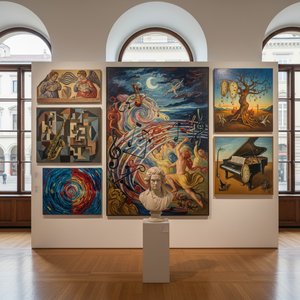
Harmonies on Canvas: Exploring the Visual Representation of Music in Art History
Explore the fascinating history of music's visual representation in art! From ancient symbolism to modern abstraction, discover how artists have captured sound and emotion on canvas. Expert insights & stunning examples.
Explore artworks organized by themes, styles, and characteristics.


