

Shown: · With its frame:
 Preview
 Send
Send Share
Share
 Details
 Guide
Guide

 Download
 Similars
 X-Ray
X-Ray Diaporama
 Q&A
Q&A Stats
Stats

$ 294
Hand Made Oil Reproduction
Hand-painted oil on canvas in your size and frame, made to order by our artists. ( Switch to Print Switch to Digital Image)
Size
·Standard
custom
CM
INCH
Pick from our preset sizes that match the artwork's original proportions.
Loading sizes...

width
height
Type the width and the height you need, to fit your frame or your wall. This is hand-painted, so for a size with a different shape the artist can paint a bit more around the picture, or cut a bit — you choose. We send you a digital mockup to approve before the painting starts. The picture shown on this page does not show the real result — only the mockup does.
 Read more
Finish
·
White $1

Blurside $1

Extended $1

P118B $10

P118H $10

P118W $10

P438Z $10

P508JH $12

P508YH $12

P805H $10

P805Z $10

P919BZ $10

P919G $10

P919XJ $10

P959ZH $10

P968JZ $12

W106C $8

W218G $10

W218JH $8

W218Y $10

W307PJ $10

W316G $10

W316PJ $8

W316Y $10

W398PJ $8

W4111J $10

W500HY $15

W500JH $15

W692G $12

W849H $8

W940BG $15

W953PJ $8

H24-GOLD $30

H24-SILVER $30

H36-GOLD $45

H36-SILVER $45
Shipped in a protective tube, ready for your own framer.
Above 105 cm the frame is shipped as a kit for a professional framer — read the details.
Extras
optionalWhat do the extras include?
Examples of what can be changed: Replace face with customer photo; Add pet (e.g., replace cat with dog); Include hidden message in background; Change background landscape or elements.
After order, TopImpressionists.com team will email client for instructions and provide a mockup preview
After order, TopImpressionists.com team will email client for instructions and provide a mockup preview
Worldwide Delivery () in 3/4 weeks instead of standard 5 weeks. (4 November). No compromise on quality.
Protective Varnish
Nameplate
Engraved Bronze Plaque Details
This elegant plaque features the artist's name and the title of the artwork, finely engraved for a timeless presentation.
It is made from bronze with a refined, elegant finish. The text is precisely laser-engraved for a sharp and permanent result. Measuring 9x2 cm, the plaque is compact yet easy to read. It's built to be durable and scratch-resistant, offering a professional, museum-quality look. Mounting is simple thanks to the included adhesive backing.
Transparent Acrylic Plaque Details
The plaque includes essential engraved details such as the artist's name, the title of the artwork, the date it was created, the type of media used-like oil on canvas or watercolor-a brief description of the piece, and a QR code that links to the complete artwork information.
It is crafted from clear acrylic, offering a sleek, modern appearance. The text is UV-engraved in black to ensure strong visual contrast. With a size of 10x15 cm, it ensures optimal readability. It comes equipped with two metal hooks for secure wall mounting. The plaque is designed to be weather-resistant, making it suitable for various environments, and it includes interactive features that work seamlessly with smartphone scanning.
Black Acrylic Plaque Details
This elegant plaque includes engraved information such as the artist's name, the title of the artwork, the date it was created, the type of media used (like oil on canvas or watercolor), a short description of the artwork, and a QR code for quick access to more information.
The plaque itself is made from refined black acrylic with a premium finish. The text is laser-engraved in white for high contrast and readability. Its size is 10x15 cm, designed to be easy to read. It comes with two metal hooks for professional mounting. The design is sleek and fits any interior style. It is also weather-resistant and durable, with built-in digital integration for mobile compatibility.
Glass option is only available in size under 110 CM
 Glass option is only available in size under 110 CM
- Free Worldwide Express Shipping
- High-Quality Linen Canvas
- Full Shipping Insurance
- Customs Tax Refund Guarantee
- True Color Matching Guarantee
- 100-Day Return Policy (Defects Only)
- 100% Money-Back Guarantee
- Bulk Discount Offer


Collectible Description
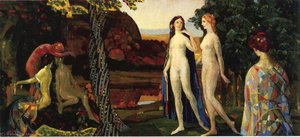
A dramatic scene of chaos and survival unfolds in Arthur B. Davies' The Flood, an expressive 1903 masterpiece capturing the overwhelming power of nature through swirling waters and muted tones for your collection.
Artist Biography
Arthur B. Davies (1862-1928): A key figure in American modernism & the Ashcan School, celebrated for his ethereal paintings and pivotal role in organizing the groundbreaking 1913 Armory Show.
About the painting
A Symphony of Chaos and Survival
In the hauntingly beautiful masterpiece "The Flood," painted in 1903, Arthur B. Davies invites us into a world where the boundaries between nature and myth begin to dissolve. The canvas captures a moment of profound atmospheric tension, presenting a scene that feels less like a mere landscape and more like a visceral, psychological event. At first glance, the viewer is swept up in the swirling, turbulent energy of rising waters that seem to pulse with a life of their own. This is not a static depiction of a disaster, but a living, breathing struggle against an overwhelming elemental force. The composition, dominated by dark, undulating currents and dense, submerged foliage, creates a sense of claustrophobia that pulls the observer directly into the heart of the deluge.
The emotional weight of the piece is anchored by two figures positioned upon a precarious rocky outcrop. Amidst the swirling chaos of the flood, these figures serve as a poignant symbol of human vulnerability and the indom's will to endure. Their presence transforms the painting from a study of natural disaster into a profound meditation on survival and divine judgment. There is an undeniable sense of the biblical in this imagery, reminiscent of the Great Flood, where the earth itself seems to be undergoing a transformative, albeit destructive, purification. For collectors and enthusiasts, this duality—the terrifying power of nature paired with the quiet resilience of life—offers a deep, contemplative resonance that lingers long after the first viewing.
Mastery of Light, Texture, and Symbolism
Technically, "The Flood" showcases Davies’ transition from his early influences in the Hudson River School toward a more experimental, proto-modernist sensibility. The artist employs a somber, muted palette of deep greens, earthy browns, and heavy grays, which imbues the work with a gloomy, oppressive atmosphere. Yet, within this darkness, there is a masterful use of light; subtle reflections dance upon the surface of the water, providing just enough illumination to guide the eye through the thicket of submerged trees and tangled roots. The brushwork is loose and expressive, utilizing a layering technique that builds a rich, tactile texture. One can almost feel the rough grit of the stones and the slick, heavy movement of the inundating tide.
The style leans toward Symbolism and Expressionism, prioritizing emotional truth over photographic accuracy. The organic, swirling lines of the water create a rhythmic, almost hypnotic movement that mirrors the internal turmoil of the subjects. This lack of sharp, defined edges contributes to the dreamlike, ethereal quality for which Davies became renowned. For an interior designer or a curator of fine art reproductions, this piece serves as a commanding focal point. Its ability to evoke both melancholy and awe makes it an ideal selection for spaces designed for reflection, adding a layer of historical depth and sophisticated drama to any curated collection.
Questions & Answers
How can I view "The Flood" by Arthur B. Davies as a slideshow?
A slideshow is available: the Diaporama page of "The Flood" by Arthur B. Davies.
Where does "The Flood" by Arthur B. Davies sit in art history?
"The Flood" by Arthur B. Davies belongs to the Symbolism movement, within the 19th-Century period. Together they give the work its place in art history.
How do contrast and harmony combine in "The Flood"?
The color analysis of "The Flood" by Arthur B. Davies records a gentle contrast and a unified palette harmony.
Quick facts and art quiz
About Arthur B. Davies

Arthur B. Davies
1862 - 1928, United States of America
Artist Biography
A Mystic in the Modern Age: The Life and Art of Arthur B. Davies
Arthur Bowen Davies, born in Utica, New York, in 1862, occupies a uniquely complex position within the narrative of American art. He wasn’t simply *of* his time—the tumultuous era bridging the 19th and 20th centuries—but actively shaped it, serving as both a conduit for European modernism and a champion of distinctly American artistic voices. His journey began with an early fascination for landscape painting, sparked by a touring exhibition that showcased the works of George Inness and the Hudson River School masters. This initial exposure instilled in him a reverence for nature’s beauty and a technical proficiency that would remain hallmarks of his style throughout his career. However, Davies wasn't destined to become merely another practitioner of traditional landscape; he possessed an inner vision, a yearning to express something beyond the purely representational. After studies at the Chicago Academy of Design and the Art Students League in New York, he began to forge a path that blended romantic sensibilities with emerging modernist ideals. His early career involved illustration work, but his true calling lay in painting—in creating worlds imbued with symbolism and emotional resonance.The Ashcan School & The Armory Show: A Catalyst for Change
Davies’s artistic development unfolded against a backdrop of significant social and cultural shifts. He became associated with “The Eight,” a group of artists who challenged the conservative norms of the National Academy of Design in 1908. While often linked to the Ashcan School—a movement known for its gritty depictions of urban life—Davies stood somewhat apart. Where artists like John Sloan focused on the raw realities of city streets, Davies sought refuge in a more ethereal realm. His paintings weren't about documenting the visible world; they were about evoking moods, dreams, and spiritual longings. Nevertheless, his involvement with The Eight demonstrated his commitment to artistic independence and his willingness to challenge established conventions. This spirit of rebellion culminated in his pivotal role as one of the organizers of the 1913 Armory Show—a watershed moment that introduced European modernism (Cubism, Fauvism, Futurism) to a largely unsuspecting American public. The show was met with both outrage and excitement, irrevocably altering the course of American art history. Davies’s contribution wasn't merely logistical; he possessed an exceptional understanding of contemporary artistic trends and a keen eye for talent, making him instrumental in selecting the works exhibited. He understood that art needed to reflect the changing world, even if that meant embracing radical new forms.A Language of Symbolism & Ethereal Visions
Davies’s mature style is characterized by its lyrical quality, delicate brushwork, and evocative use of color. His paintings often feature figures—often women or mythological beings—immersed in dreamlike landscapes. These aren't portraits in the traditional sense; they are archetypal representations of human emotions and spiritual states. Unicorns: Legend, Sea Calm, perhaps his most famous work, exemplifies this approach. The painting depicts a group of ethereal figures frolicking with unicorns on a tranquil shore—a scene that is both enchanting and deeply symbolic. His works frequently explore themes of longing, loss, and the search for transcendence. He wasn’t interested in depicting reality as it *is*, but rather as it *feels*. This emphasis on subjective experience aligns him with Symbolist painters like Odilon Redon and Pierre Puvis de Chavannes, artists who sought to express inner truths through evocative imagery. Davies's palette is often muted and harmonious, creating a sense of atmosphere and mystery. He masterfully employed techniques such as glazing and scumbling to achieve luminous effects and subtle gradations of tone. His art invites contemplation, urging viewers to look beyond the surface and delve into the realm of the imagination.Contradictions & Legacy
The life of Arthur B. Davies was marked by contradictions. While publicly advocating for artistic freedom and innovation, he maintained a relatively conservative personal life—at least, the one presented to the world. The revelation after his death in Florence, Italy, in 1928, that he had lived a double life with two families—Virginia Meriwether Davies, whom he married in 1892, and Edna—shocked the art community. This hidden aspect of his biography adds another layer of complexity to his artistic persona. Despite this personal turmoil, or perhaps because of it, Davies left an indelible mark on American art. He was a pivotal figure in the development of American modernism, bridging the gap between traditional aesthetics and avant-garde experimentation. His influence can be seen in the work of subsequent generations of artists who continued to explore themes of spirituality, symbolism, and emotional expression.- He remains a testament to the power of art to transcend boundaries—both artistic and personal.
- His paintings continue to resonate with viewers seeking beauty, mystery, and a glimpse into the hidden depths of the human soul.
Quick facts about Arthur B. Davies
- Full Name: Arthur Bowen Davies
- Nationality: American
- Date Of Birth: 1862
- Date Of Death: 1928
- Place Of Birth: Utica, United States of America
- Notable Artworks: ['Unicorns: Legend, Sea Calm']
- Artistic Movement Or Style: Modernism, Symbolism
- Artists Who Influenced This Artist:
- George Inness
- Corot
- Millet
- Artists Or Movements Influenced By This Artist:
- American Modernism
- Ashcan School
Explore artworks organized by themes, styles, and characteristics.




Arthur B. Davies
The Flood
() ·
With its frame: · Hand-painted in oil on linen
Total