

 Preview
 Send
Send Share
Share
 Details
 Guide
Guide

 Download
 Similars
 X-Ray
X-Ray Diaporama
 Q&A
Q&A Stats
StatsLittle Walter

- 60.0 x 50.0 cm


Delve into August Macke's Expressionist masterpiece 'Little Walter,' capturing serene harmony amidst modern life with vibrant colors and meticulous detail—a cornerstone of Der Blaue Reiter.
 Read More
A key figure of Der Blaue Reiter, Macke is famed for his vibrant color. Discover the luminous world of this Expressionist master today.
Giclée / Art Print
Museum-quality giclée or canvas print with fast production and flexible finish options. ( Buy Hand Made Painting Switch to Digital Image)




P118B $10

P118H $10

P118W $10

P438Z $10

P508JH $12

P508YH $12

P805H $10

P805Z $10

P919BZ $10

P919G $10

P919XJ $10

P959ZH $10

P968JZ $12

W106C $8

W218G $10

W218JH $8

W218Y $10

W307PJ $10

W316G $10

W316PJ $8

W316Y $10

W398PJ $8

W4111J $10

W500HY $15

W500JH $15

W692G $12

W849H $8

W940BG $15

W953PJ $8




Standard
custom
CM
INCH
Pick from our preset sizes that match the artwork's original proportions.
Loading sizes...

width
height
Type the width and the height you need, to fit your frame or your wall. A print can only be cut, never made bigger than the picture, so a size with a different shape loses a part of the image. We send you a digital mockup to approve before we print anything. The picture shown on this page does not show the real cut — only the mockup does.
Worldwide Delivery () in 2 weeks instead of standard 4/5 weeks. (11 November)

Free Worldwide Express Shipping

High-Quality Linen Canvas

Full Shipping Insurance

Customs Tax Refund Guarantee

True Color Matching Guarantee

100-Day Return Policy (Defects Only)

100% Money-Back Guarantee

Bulk Discount Offer
 Glass option is only available in size under 110 CM

Little Walter
Giclée / Art Print
Reproduction Size
-


Total Price
$ 70
A Symphony of Color and Childhood Innocence
In the vibrant tapestry of early 20th-century German art, few works capture the delicate equilibrium between tranquility and energy quite like August Macke’s “Little Walter.” Painted in 1912, this masterpiece serves as a breathtaking distillation of Impressionistic light married to the burgeoning, raw fervor of Expressionism. The canvas invites the viewer into a pastoral sanctuary, where a woman sits in quiet contemplation beside a potted plant laden with scarlet berries. Her gaze, fixed intently upon two small animals—perhaps rabbits or playful dogs—nestled within the foliage, creates an immediate sense of intimacy and connection to the natural world. A bowl of fruit rests subtly in the composition, acting as a silent symbol of domestic nourishment and the peaceful rhythms of life.
The emotional resonance of the piece lies in its ability to evoke a sense of nostalgic wonder. There is a profound stillness in the subject's focus, yet the painting vibrates with an underlying vitality. For the collector or interior designer, this work offers more than mere decoration; it provides a window into a moment of pure, unadulterated innocence, making it an ideal centerpiece for spaces designed to inspire calm, joy, and reflection.
The Language of Color and Technique
To gaze upon “Little Walter” is to experience the transformative power of color. Macke’s approach aligns closely with Fauvist tendencies, where pigment is not merely used to describe form but serves as the primary vehicle for emotional expression. He deliberately eschewed the subtle, fleeting light effects of the Impressionists in favor of bold, saturated hues. The striking interplay between the warmth of the reds and yellows against the cool, grounding blues creates a rhythmic visual tension that keeps the eye dancing across the canvas.
Executed using tempera on canvas, the artwork possesses a unique luminosity and a matte, velvety texture that enhances its dreamlike quality. Macke’s brushstrokes are loose and remarkably expressive, conveying a sense of spontaneity as if the scene were captured in a single, breathless moment. This technique allows the colors to blend into harmonious tonal relationships, ensuring that while the forms are simplified, the visual impact remains incredibly sophisticated and layered.
A Legacy of the Blue Rider
The historical significance of this work is deeply intertwined with the Der Blaue Reiter (The Blue Rider) movement, a pivotal collective in the history of modern art led by visionaries like Franz Marc and Wassily Kandinsky. Created during an era of intense artistic experimentation, “Little Walter” embodies the group's quest to explore spiritual truths through abstraction and symbolism. Macke’s ability to integrate avant-garde elements—such as simplified shapes and non-naturalistic color—into a recognizable, emotive scene marks him as a master of modernizing the classical pastoral tradition.
For those seeking to adorn a curated collection or a sophisticated interior, this reproduction offers a profound connection to the golden age of German Expressionism. It stands as a testament to a period of immense creativity that was tragically interrupted by the First World War, preserving forever the vibrant, sun-drenched spirit of Macke’s vision.
Questions & Answers
What does "Little Walter" share with the rest of August Macke's output?
"Little Walter" shares with August Macke's other works its German Expressionism style and the recorded themes: fauvist color harmony, modern life reflection, expressionist vision, symbolism tranquility, artistic legacy macke.
Where should a reproduction of "Little Walter" by August Macke be hung?
Format (landscape) and recommended space (living room) are the two placement facts recorded for "Little Walter" by August Macke.
Can I watch "Little Walter" as a full-screen slideshow?
The diaporama of "Little Walter" can be watched on the artwork's Diaporama page.
Artist Biography
Early Life, Family and Training
The story of August Macke begins in the town of Meschede, Germany, where he was born on January 3, 1887. He was the only son born to August Friedrich Hermann Macke, a building contractor and amateur artist, and Maria Florentine. His childhood was shaped by the shifting fortunes of his father’s company, which brought the family to Cologne and later to Bonn. Even as a young boy, the pull of visual expression was evident; he spent his early years sketching and designing sets for school plays, finding a way to translate his surroundings onto paper long before he ever stepped into a formal academy.
His formal education in the arts began in earnest when he arrived at the Düsseldorf Academy, where he studied from 1904 to 1906. Under the guidance of Adolf Maennchen, he learned the discipline of traditional technique, yet his spirit seemed to crave something more expansive. This restlessness led him to seek further knowledge through night classes with Fritz Helmut Ehmke. His hunger for understanding the craft drove him toward Berlin, where he studied under the German painter Lovis Corinth. These years of rigorous training provided the technical foundation upon which he would later build his unique visual language, moving away from the strictures of his early instruction toward a more personal way of seeing.
The Influence of French Modernism
The streets of Paris exerted a powerful pull on the young artist, drawing him away from the traditional structures of his training. During his first visit to the city in 1907, he found himself profoundly moved by the Impressionist painters. He began to emulate their approach, seeking to capture the play of light through subtly dappled colors. This was no passing interest; he returned to Paris frequently between 1907 and 1912, allowing the atmosphere of the French capital to reshape his perception of the canvas.
A transformative moment arrived in 1912 when he encountered Robert Delaunay. This meeting proved to be a revelation, fundamentally altering the direction of his work. He became deeply influenced by Delaunay's chromatic Cubism, a style that focused on the rhythm of color and light. This approach, often associated with Orphism, encouraged him to move toward a more dynamic and non-representational way of seeing. He began to experiment with broken planes of color, seeking to translate the sensation of modern life into a language of pure light and form.
Membership in Der Blaue Reiter
The trajectory of Macke’s life shifted significantly in 1909 when he arrived in Munich. It was there that he encountered Franz Marc, a meeting that would spark a deep and lasting friendship. This connection drew him into a circle of thinkers and creators who sought to move beyond the mere imitation of nature. By 1911, Macke had become a leading member of the influential Expressionist group known as Der Blaue Reiter. He did not merely participate in the movement; he helped to shape its very spirit, contributing to its exhibitions and the spread of its radical ideas.
His place within this avant-garde circle was strengthened by his close ties to other luminaries of the era. He shared a profound bond with Marc and Paul Klee, finding in their company a shared pursuit of the spiritual and the emotive. Even as he moved through the shifting landscapes of modernism, his interactions with figures like Robert Delaunay helped to refine his unique perspective. While others in the group often explored darker or more anxious themes, Macke sought a sense of harmony and beauty. He looked at the world and saw a place of light and joy, even as the political shadows of Europe began to lengthen.
Artistic Technique and Style
Macke sought to capture the inner spirit of a scene rather than the mere surface of things. His brushwork moved away from the objective reproduction of reality, choosing instead to express deep-seated feelings and moods. To achieve this, he frequently distorted both color and form, bending the physical world to suit his emotional needs. His compositions often relied on bold colors and geometric shapes, creating a sense of structure amidst the expressive flux of his subjects. He found a way to weave the dynamism of Italian Futurism into his compositions, imbuing his scenes with a sense of movement and modern energy.
This pursuit of light and color reached a peak during his travels to North Africa. His Tunisian watercolors from 1914 reveal an exceptional command of color, capturing the intense, shifting light of the region. In these works, the pigment seems to pulse with a life of its own, moving beyond simple representation toward a more luminous, spiritual essence. He did not merely paint the landscape; he painted the sensation of being within it.
- Türkisches Café
- Market in Algiers
Key Works and Masterpieces
As his vision matured, Macke began to capture the quiet rhythms of modern life through a lens of intense color. In 1913, he produced Woman in a Green Jacket, a work that radiates a certain vitality through its bold palette and confident brushwork. His interest in the interplay of light and urbanity led him to create Large Bright Shop Window, where he explored the way light filters through glass. He often turned his attention to the simple pleasures of existence, such as in Bathing girls with town in the backgraund, where he sought to portray a sense of idyllic tranquility through simplified forms.
The final period of his life, shaped by his travels to North Africa, brought a new luminosity to his canvases. His time in Tunisia resulted in a series of works that many consider his finest achievements, most notably Türkisches Café. This period also produced Market in Tunis, a work that later fetched $4.1 million (£2.86 million) in a 2000 auction. Even as the shadows of war loomed, he continued to find beauty in intimate settings, such as in The Couple at a Garden Table, which was sold for £2 million at a 1997 Christie's auction.
- 1913: Woman in a Green Jacket
- 1914: Market in Tunis
- 1914: The Couple at a Garden Table
Later Years and Tragic Death
The year 1914 brought a sudden shift in the light that Macke sought to capture. In the spring, he traveled to Tunis, Tunisia, accompanied by Paul Klee and Louis Moilliet. This excursion allowed him to witness a different kind of sun, influencing the luminist approach that would define his final period. He returned to a Europe that was rapidly descending into chaos. As the first month of the Great War passed, the artist found himself drawn into the conflict. Driven by a sense of duty, he volunteered for military service.
The end came with startling speed. In the second month of the First World War, Macke was killed in action at the front in France. He fell near Perthes-lès-Hurlus on 26 September 1914. He was only 27 years old. His death occurred just as his artistic language was reaching a new level of clarity and light. The suddenness of his passing left a void in the avant-garde circles of Germany, cutting short a career that had been defined by a restless, searching spirit.
Legacy and Influence
Though his time in the sun was brief, the impact Macke left upon the major artistic movements of the twentieth century remains profound. He secured his place in history as a significant figure within Expressionism, offering a perspective that often sought harmony where others found only discord. His ability to synthesize the radical ideas of his contemporaries into a personal language ensured that his vision would not be lost to the shadows of the Great War.
The weight of his contribution was formally recognized long after his passing, leading to the establishment of the August Macke Prize in 1959. This honor continues to honor the spirit of his creative inquiry. Even today, his presence is felt in the way contemporary artists continue to explore the deep connections between color and human emotion. He taught that light and hue could speak of the soul's inner state, a lesson that resonates through the decades.
Where to See the Works Today
To walk through the rooms where his spirit remains, one might travel to Bonn, Germany. There, the August-Macke-Haus stands as a dedicated sanctuary, preserving the memory of the man within the very walls where he once lived and worked. It was in this house that he found his studio, a space that allowed his creative energy to flourish before the shadows of war intervened. Nearby, the Kunstmuseum in Bonn also holds his paintings, ensuring that his vision remains accessible to those who seek the light he so carefully captured.
His presence is felt across many borders, carried in the collections of great institutions. In Cologne, the Museum Ludwig houses his works, while the Museum Folkwang in Essen keeps his canvases for the public to observe. One can also find his traces in the Staatsgalerie Moderner Kunst in Munich, where his colors continue to speak from the frames. Even in Zurich, the Kunsthaus Zürich maintains a part of his legacy, holding paintings that reflect his unique way of seeing the world.
- Bathing girls with town in the backgraund (about 1913)
- Woman in a Green Jacket (1913)
- Landscape with Cows and Camel (1914)
- Türkisches Café (1914)

August Macke
1887 - 1914 , Germany
Quick Facts
- Artistic Movement Or Style: Expressionism, Fauvism, Orphism, Cubism
- Artists Or Movements Influenced By This Artist: ['Contemporary artists']
- Artists Who Influenced This Artist:
- Robert Delaunay
- Adolf Maennchen
- Lovis Corinth
- Full Name: August Robert Ludwig Macke
- Nationality: German
- Notable Artworks:
- Woman in a Green Jacket
- Bathing girls with town in the background
- Türkisches Café
- Landscape with Cows and Camel
- Place Of Birth: Meschede, Germany
- Date Of Birth: 1887
- Date Of Death: 1914
Related Articles

August Macke: Expressionist Visions of Harmony & Modern Life
Explore the vibrant Expressionist paintings of August Macke (1887-1914). Discover his key role in Der Blaue Reiter, Fauvist influences, and captivating depictions of modern life. A comprehensive guide for art enthusiasts & collectors.
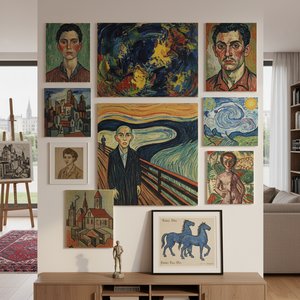
Expressionism's Soul: 10 Masterpieces for Your Home |
Journey into the soul of Expressionism! Explore 10 iconic paintings by Munch, Kirchner, Kandinsky & more. Discover their stories, bold colors & lasting impact. Find museum-quality art reproductions at .

Masterpieces of Light: The Top 25 Pierre-Auguste Renoir Artworks
Explore 25 iconic Pierre-Auguste Renoir masterpieces. Discover the beauty of Impressionism. Explore the full collection online at TopImpressionists.com.

The Raw Emotion of Expressionism: A Deep Dive into its History, Characteristics & Enduring Influence
Explore the raw emotion of Expressionism with TopImpressionists. Discover its history, key artists like Kirchner & Munch, and lasting influence on modern art. Expert insights for collectors & enthusiasts.

German Expressionism's 10 Defining Masterpieces | Art for Your Home
Explore 10 defining German Expressionism masterpieces – from Munch's 'The Scream' to Kandinsky’s abstracts. Discover the artists, stories & bold colors behind this powerful art movement. Find museum-quality reproductions at TopImpressionists.com.
Explore artworks organized by themes, styles, and characteristics.


