Preview
 Send
Send Share
Share
 Details
 Guide
Guide

 Download
 Similars
 X-Ray
X-Ray Diaporama
 Q&A
Q&A Stats
StatsDifference Engine No 1

- 27.0 x 21.0 cm


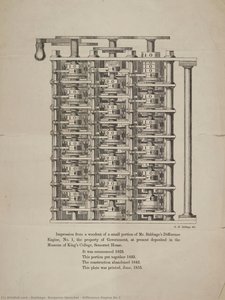
This artwork showcases the detailed craftsmanship of Benjamin Herschel Babbage’s Difference Engine No. 1, capturing its complex gears and wheels in a striking black-and-white drawing created in 1853. Supported by scientific research and historical context.
 Read More
Explore the works of Benjamin Herschel Babbage (1815-1878), an English engineer, scientist & artist known for pen-and-ink expedition sketches of South Australia. Discover his legacy on TopImpressionists!
Giclée / Art Print
Museum-quality giclée or canvas print with fast production and flexible finish options. ( Buy Hand Made Painting Switch to Digital Image)




P118B $10

P118H $10

P118W $10

P438Z $10

P508JH $12

P508YH $12

P805H $10

P805Z $10

P919BZ $10

P919G $10

P919XJ $10

P959ZH $10

P968JZ $12

W106C $8

W218G $10

W218JH $8

W218Y $10

W307PJ $10

W316G $10

W316PJ $8

W316Y $10

W398PJ $8

W4111J $10

W500HY $15

W500JH $15

W692G $12

W849H $8

W940BG $15

W953PJ $8




Standard
custom
CM
INCH
Pick from our preset sizes that match the artwork's original proportions.
Loading sizes...

width
height
Type the width and the height you need, to fit your frame or your wall. A print can only be cut, never made bigger than the picture, so a size with a different shape loses a part of the image. We send you a digital mockup to approve before we print anything. The picture shown on this page does not show the real cut — only the mockup does.
Worldwide Delivery () in 2 weeks instead of standard 4/5 weeks. (8 November)

Free Worldwide Express Shipping

High-Quality Linen Canvas

Full Shipping Insurance

Customs Tax Refund Guarantee

True Color Matching Guarantee

100-Day Return Policy (Defects Only)

100% Money-Back Guarantee

Bulk Discount Offer
 Glass option is only available in size under 110 CM

Difference Engine No 1
Giclée / Art Print
Reproduction Size
-


Total Price
$ 70
Benjamin Herschel Babbage’s Difference Engine No 1: A Vision of Mathematical Precision
The Difference Engine No 1, conceived by the brilliant mind of Benjamin Herschel Babbage (1815–1878), stands as a testament to Victorian ingenuity and a pivotal moment in the history of computing. More than just a machine; it embodies an audacious ambition—to mechanize complex mathematical calculations, transforming them from laborious manual processes into swift, accurate computations driven by gears and levers. This drawing, created in 1853, captures not merely its physical form but also the spirit of scientific inquiry that characterized Babbage’s era.- Subject Matter: The image depicts a detailed elevation of the Difference Engine No 1, showcasing its intricate construction—a sprawling assemblage of gears, wheels, and levers designed to generate tabular logarithms with unprecedented speed and accuracy.
- Style & Technique: Executed in meticulous pen and ink drawing, the artwork reflects Babbage’s fascination with precision engineering. The artist's hand painstakingly renders every component, emphasizing the complexity and elegance of the machine’s design. Notice the careful shading and linework that convey texture and depth, bringing the engine to life on paper.
- Historical Context: Constructed between 1823 and 1842, the Difference Engine No 1 represents a radical departure from traditional methods of mathematical tabulation. Driven by Charles Babbage’s unwavering belief in the transformative potential of machinery—a conviction echoed throughout his prolific scientific output—the project aimed to revolutionize astronomy and navigation.
- Symbolism: Beyond its mechanical function, the Difference Engine symbolizes Babbage's relentless pursuit of knowledge and his determination to overcome obstacles through innovation. It embodies the Victorian ethos of progress and represents a bold assertion that human intellect could be augmented by harnessing the power of technology.
The Science Museum’s Reproduction: Preserving Legacy Through High Fidelity
Today, a stunning reproduction of Babbage's Difference Engine No 1 resides within the Science Museum Group Collection (inv.1862-89). This faithful representation allows visitors to appreciate not only the machine’s remarkable design but also its profound significance as a precursor to modern computers. The meticulous attention to detail—captured in this engraving—mirrors the original craftsmanship and underscores the enduring fascination with Babbage's visionary concept.A Window into Victorian Scientific Thought
The Difference Engine No 1 wasn’t simply about calculating logarithms; it represented a fundamental shift in how mathematicians approached their work. As noted by George Biddel Airy, the Astronomer Royal, “Mr Babbage made the approval of the machine a personal question.” The project faced considerable challenges—funding difficulties and disagreements among collaborators—yet Babbage persevered, driven by an unwavering conviction that his invention would unlock new frontiers in scientific understanding.Beyond Calculation: An Emblematic Representation of Innovation
Ultimately, Benjamin Herschel Babbage’s Difference Engine No 1 transcends its utilitarian purpose. It stands as a symbol of human curiosity and the transformative power of imagination—a reminder that groundbreaking discoveries often emerge from daring experiments and unwavering belief in the possibility of progress. Its image continues to inspire artists and designers alike, capturing the essence of Victorian scientific ambition and cementing Babbage’s place as “the father of the computer.”Questions & Answers
How much light do the colors of "Difference Engine No 1" appear to reflect?
The colors of "Difference Engine No 1" show a bright balance luminance.
How can I view "Difference Engine No 1" by Babbage, Benjamin Herschel as a slideshow?
"Difference Engine No 1" by Babbage, Benjamin Herschel can be viewed as a slideshow on the artwork's Diaporama page.
Are the colors of "Difference Engine No 1" by Babbage, Benjamin Herschel vivid or muted?
"Difference Engine No 1" by Babbage, Benjamin Herschel is recorded with a muted saturation and a balanced intensity.
Artist Biography
Early Life and Family
Benjamin Herschel Babbage (6 August 1815 – 22 October 1878) was an English engineer, scientist, explorer, and politician, best known for his pioneering role in establishing the colony of South Australia. He invariably signed his name “B. Herschel Babbage” and was frequently referred to as “Herschel Babbage.” Born in London, he was the eldest son of Charles Babbage, a renowned mathematician and inventor who is credited with conceiving the concept of a programmable computer—a lineage that profoundly shaped his intellectual trajectory. Georgina Whitmore served as his mother. His uncle on his mother’s side, William Wolryche-Whitmore, an MP in the House of Commons, championed the formation of South Australia and spearheaded the passage of the South Australia Act 1834 into British Parliament, securing governmental backing for Babbage's ambitious endeavors. At eighteen, he enrolled as a pupil at William Chadwell Mylne’s engineering school, honing his skills alongside Brunel on groundbreaking railway projects in Italy and England during the 1840s—collaborations that cemented his reputation as a visionary innovator. He married Laura Jones in Bristol in 1839, forging a family life punctuated by seven children.Career: Engineering Innovation and Exploration
Babbage’s engineering prowess extended far beyond railway planning; he tackled monumental challenges with meticulous precision and unwavering determination. His involvement with Brunel on the Italian and English railways solidified his position as a leader in Victorian engineering, demonstrating an unparalleled grasp of mechanics and structural design. However, it was his contribution to South Australia that truly distinguished him—a project driven by a fervent belief in scientific advancement and colonial expansion. He spearheaded expeditions to chart the region’s geological landscape, meticulously documenting mineral deposits and fostering the burgeoning field of Australian botany. Notably, he utilized photography extensively during these explorations, capturing evocative images of the Outback terrain and flora—images that would later become celebrated at exhibitions like the 1859 South Australian Society of Arts exhibition. Furthermore, Babbage's architectural pursuits included designing buildings for Adelaide City Hall and St Mary’s Cathedral, reflecting his commitment to shaping the physical environment alongside furthering scientific understanding. His work on the Adelaide-Port Railway was particularly noteworthy—the first railway in Australia employing steam propulsion—a testament to his inventive spirit and collaborative leadership.South Australian Expeditions: Geology, Botany, and Photographic Documentation
Babbage’s expeditions into South Australia were characterized by a methodical approach rooted in scientific observation and meticulous record-keeping. Recognizing the importance of comprehensive geological surveys for assessing resource potential and informing settlement planning, he commissioned detailed mapping projects aimed at uncovering hidden mineral deposits—a pursuit that yielded significant discoveries and contributed to bolstering the colony's economic prosperity. Simultaneously, Babbage cultivated an ardent interest in botany, embarking on expeditions to catalog native plant species and documenting their habitats—activities that enriched Australia’s scientific heritage. His photographic endeavors captured the grandeur of the Outback wilderness, preserving visual records of landscapes and flora for posterity. The expedition sketches produced during these explorations were showcased at prominent exhibitions, including the 1859 South Australian Society of Arts exhibition, cementing his legacy as a multifaceted explorer and artist—a figure whose contributions profoundly impacted Australia’s scientific and cultural development.Legacy: A Pioneer in Engineering and Exploration
Benjamin Herschel Babbage's influence extended beyond his immediate accomplishments; he established precedents for future generations of engineers and explorers alike. His unwavering dedication to methodical observation, coupled with his inventive spirit—inherited from his father—served as inspiration for countless individuals pursuing scientific breakthroughs and charting uncharted territories. He remains a symbol of Victorian ingenuity and colonial ambition—a testament to the transformative power of intellectual curiosity and collaborative endeavor. His work is prominently featured on TopImpressionists.com, where his sketches and photographs are meticulously preserved and presented alongside biographical information—a fitting tribute to a man who indelibly shaped Australia’s scientific landscape. Museums recognizing Babbage's contribution include the National Portrait Gallery and the State Library of South Australia.Notable Works
- Pen-and-ink expedition sketches shown at the 1859 South Australian Society of Arts exhibition
- Lake Torrens Expedition (1858)
- Geological and Mineralogical Survey of South Australia
- Adelaide City Hall Design
- St Mary’s Cathedral Design
References
- TopImpressionists.com
- Wikipedia
- National Portrait Gallery
- State Library of South Australia

Babbage, Benjamin Herschel
1815 - 1878 , United Kingdom
Quick Facts
- Full Name: Benjamin Herschel Babbage
- Nationality: English
- Date Of Birth: 1815
- Date Of Death: 1878
- Place Of Birth: London, United Kingdom
- Notable Artworks: ['Pen-and-ink expedition sketches']
- Artistic Movement Or Style: Victorian Era
- Artists Who Influenced This Artist:
- Charles Babbage
- Isambard Kingdom Brunel
- Artists Or Movements Influenced By This Artist: ['Analytical Engine']
Related Articles

Victorian Naturalism: The Art of Capturing Botanical Precision and Raw Wilderness
Explore the profound beauty of Victorian Naturalism. Discover how 19th-century masters captured botanical precision and raw landscapes through meticulous oil painting techniques and scientific observation.
Explore artworks organized by themes, styles, and characteristics.