Send
Send Share
Share
 Details
 Guide
Guide

 Download
 Similars
 Diaporama
 Q&A
Q&A Stats
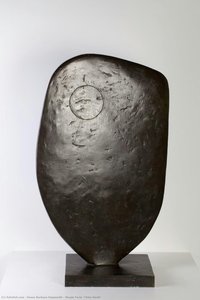
StatsSingle Form (Chûn Quoit)

- 106.0 x 66.0 cm


Admire Barbara Hepworth's 'Single Form (Chûn Quoit)' – a striking bronze sculpture reflecting Neolithic chamber tombs. Explore its history, artistic significance & the artist’s legacy.
 Read More
Explore the modernist sculptures of Dame Barbara Hepworth (1903-1975). A pioneer of abstract art, Hepworth's work – including 'Oval Form' & 'Two Forms' – blends surrealism and abstraction. Discover her legacy at the Hepworth Wakefield.
The artwork displayed on this page is protected by copyright law, which means we cannot legally create or sell an identical reproduction. This protection is enforced under international agreements such as the Berne Convention and by national laws, including those outlined by the U.S. Copyright Law - Title 17.
This method fully complies with copyright regulations because it does not involve copying or duplicating the protected artwork. Instead, it is a creative reinterpretation - a new painting that is influenced by the original but not identical to it.
Giclée / Art Print
Museum-quality giclée or canvas print with fast production and flexible finish options. ( Buy Hand Made Painting Switch to Digital Image)




































Standard
custom
CM
INCH
Pick from our preset sizes that match the artwork's original proportions.
Loading sizes...

width
height
Type the width and the height you need, to fit your frame or your wall. A print can only be cut, never made bigger than the picture, so a size with a different shape loses a part of the image. We send you a digital mockup to approve before we print anything. The picture shown on this page does not show the real cut — only the mockup does.
Worldwide Delivery () in 2 weeks instead of standard 4/5 weeks. (7 November)

Free Worldwide Express Shipping

High-Quality Linen Canvas

Full Shipping Insurance

Customs Tax Refund Guarantee

True Color Matching Guarantee

100-Day Return Policy (Defects Only)

100% Money-Back Guarantee

Bulk Discount Offer
 Glass option is only available in size under 110 CM

Single Form (Chûn Quoit)
Giclée / Art Print
Reproduction Size
-


Total Price
$ 70
Single Form (Chûn Quoit): A Meditation on Neolithic Echoes
Barbara Hepworth’s “Single Form (Chûn Quoit),” crafted in 1961, isn't merely a sculpture; it’s an invitation to contemplate the enduring resonance of ancient ritual and the fundamental geometry of human experience. This remarkable piece, rendered in textured plaster and presented on a subtly shaded wooden base, embodies Hepworth’s signature style – a masterful blend of abstraction and deeply rooted connection to the natural world. The work immediately draws the eye with its deceptively simple form: a broad, gently curving plane punctuated by a single, precisely incised circle. Yet, within this apparent stillness lies a profound complexity, hinting at layers of meaning derived from both the artist’s personal vision and the evocative power of prehistoric sites.
The title itself offers a crucial key to understanding the sculpture's genesis. “Chûn Quoit” refers to a specific type of Neolithic chamber tomb found in Cornwall – megalithic structures built as sacred spaces, often associated with ancestor veneration and rites of passage. Hepworth’s choice of this name suggests an intentional dialogue between the modern world and the ancient past. The smooth, almost polished surface of the plaster evokes the cool, grey stone of these prehistoric monuments, while the incised circle acts as a visual echo – a subtle reminder of the circularity of life, death, and rebirth, a motif frequently explored in Neolithic art.
The Sculptor’s Process: A Dialogue with Material
Hepworth's approach to sculpture was deeply rooted in a tactile engagement with her materials. She rarely worked from detailed drawings or preparatory sketches, preferring instead to begin with a block of stone or wood and allow the form to emerge through a process of intuitive manipulation. “Single Form (Chûn Quoit)” exemplifies this method perfectly. The plaster was likely sculpted directly from a rough block, guided by Hepworth’s sensitivity to its inherent qualities. The subtle variations in texture – the slight undulations, the delicate scoring – are not accidental; they represent the artist's deliberate interaction with the material, imbuing it with her own energy and vision.
Interestingly, the sculpture was created during a period of intense personal reflection for Hepworth. Following the death of Dag Hammarskjöld, Secretary-General of the United Nations, she sought to create a work that honored his memory while simultaneously exploring themes of human connection and timelessness. The circular incision, mirroring the shape of a tomb entrance, can be interpreted as a symbolic portal – a gateway between the earthly realm and something beyond.
A Legacy of Form and Space
“Single Form (Chûn Quoit)” is more than just an object; it’s a carefully considered arrangement of form and space. The sculpture's placement within its environment—whether in a museum, a private collection, or even as part of an interior design scheme—significantly impacts its overall effect. The subtle contrast between the smooth surface of the plaster and the warm tones of the wooden base creates a visual tension that draws the eye inward, inviting contemplation. The work’s inherent simplicity belies its profound emotional resonance, making it a timeless addition to any setting.
Hepworth's influence extends far beyond her own lifetime. Her pioneering approach to abstraction and her deep respect for the natural world continue to inspire artists today. Reproductions of “Single Form (Chûn Quoit)” offer a remarkable opportunity to bring this powerful work into your home or office, allowing you to experience its beauty and complexity firsthand.
Technical Details & Historical Context
The sculpture is crafted from plaster, painted in a muted brown hue, and presented on a walnut base. It measures 106 cm (height) x 66.5 cm (width) x 45 cm (depth). Created in 1961, it’s part of a series of works Hepworth produced during this period, exploring themes of memory, ritual, and the relationship between humanity and the landscape. The work was commissioned as a memorial to Dag Hammarskjöld, Secretary-General of the United Nations, reflecting Hepworth's commitment to social justice and her belief in the importance of human connection.
Further research reveals that this piece is closely related to another sculpture from the same year, “Single Form (September),” which also features a circular indentation. Both works were created during a period of intense personal reflection for Hepworth following Hammarskjöld’s death and are considered key examples of her mature style.
Questions & Answers
Is "Single Form (Chûn Quoit)" by Barbara Hepworth a light or a dark artwork?
"Single Form (Chûn Quoit)" is deep_shadow overall, and its luminance is dark.
How can I get a print of "Single Form (Chûn Quoit)" by Barbara Hepworth?
"Single Form (Chûn Quoit)" is available as a fine art print on cotton canvas or archival canvas paper. Orders are placed on its Fine Art Print page, in the size of your choice.
What is the recommended use of a print of "Single Form (Chûn Quoit)"?
The recommended use of a print of "Single Form (Chûn Quoit)" is reflective.
Artist Biography
early life and education
dame barbara hepworth, a renowned english artist and sculptor, was born on january 10, 1903, in wakefield, yorkshire. she attended the leeds school of art from 1920 and later won a county scholarship to study at the royal college of art (rca) in london from 1921 until she was awarded the diploma in 1924.artistic career
- dame barbara hepworth's work exemplifies modernism, particularly modern sculpture. she was one of the few female artists to achieve international prominence.
- in 1933, she co-founded the unit one art movement with ben nicholson, paul nash, and others, seeking to unite surrealism and abstraction in british art.
- hepworth's early work was characterized by abstraction and her involvement with the paris-based art movement, abstraction-création.
notable works and exhibitions
- oval form (trezion), a bronze sculpture, is part of the kimbell art museum collection in fort worth, united states. (view on TopImpressionists)
- two forms, a sculpture, is exhibited at the hepworth wakefield in wakefield, united kingdom. (view on TopImpressionists)
- totem, a marble sculpture, is also part of the collection at the hepworth wakefield. (view on TopImpressionists)
legacy and museum collections
barbara hepworth's work is widely recognized, with her sculptures and paintings forming part of various museum collections worldwide. the hepworth wakefield, named after the artist, houses numerous masterpieces from renowned artists, including hepworth's own works. (discover more about the hepworth wakefield on TopImpressionists)conclusion
dame barbara hepworth's pioneering work in modern british sculpture has left an indelible mark on the art world. her legacy continues to inspire artists and art enthusiasts alike, with her works remaining a testament to her innovative spirit and artistic genius. more about barbara hepworth on wikipedia
Barbara Hepworth
1903 - 1975 , United Kingdom
Quick Facts
- Full Name: Barbara Hepworth
- Nationality: British
- Date Of Birth: 1903
- Date Of Death: 1975
- Place Of Birth: Wakefield, United Kingdom
- Notable Artworks:
- Oval Form (Trezion)
- Two Forms
- Totem
- Artistic Movement Or Style: Modernism, Abstraction
- Artists Who Influenced This Artist:
- Henry Moore
- Ben Nicholson
- Artists Or Movements Influenced By This Artist:
- Abstraction-Création
- Unit One
Related Articles

The Eternal Glow of Bronze: A Guide to Sculpting with Light, Strength, and Timeless Artistry
Explore the profound beauty of bronze sculpture. From the ancient lost-wax technique to the interplay of light and patina, discover how this enduring alloy captures human emotion and history through masterful artistry and strength.
Explore artworks organized by themes, styles, and characteristics.