Send
Send Share
Share
 Details
 Guide
Guide

 Download
 Similars
 Diaporama
 Q&A
Q&A Stats
StatsTwo Forms


 Read More
The artwork displayed on this page is protected by copyright law, which means we cannot legally create or sell an identical reproduction. This protection is enforced under international agreements such as the Berne Convention and by national laws, including those outlined by the U.S. Copyright Law - Title 17.
This method fully complies with copyright regulations because it does not involve copying or duplicating the protected artwork. Instead, it is a creative reinterpretation - a new painting that is influenced by the original but not identical to it.
Giclée / Art Print
Museum-quality giclée or canvas print with fast production and flexible finish options. ( Buy Hand Made Painting Switch to Digital Image)




































Standard
custom
CM
INCH
Pick from our preset sizes that match the artwork's original proportions.
Loading sizes...

width
height
Type the width and the height you need, to fit your frame or your wall. A print can only be cut, never made bigger than the picture, so a size with a different shape loses a part of the image. We send you a digital mockup to approve before we print anything. The picture shown on this page does not show the real cut — only the mockup does.
Worldwide Delivery () in 2 weeks instead of standard 4/5 weeks. (7 November)

Free Worldwide Express Shipping

High-Quality Linen Canvas

Full Shipping Insurance

Customs Tax Refund Guarantee

True Color Matching Guarantee

100-Day Return Policy (Defects Only)

100% Money-Back Guarantee

Bulk Discount Offer
 Glass option is only available in size under 110 CM

Two Forms
Giclée / Art Print
Reproduction Size
-


Total Price
$ 70
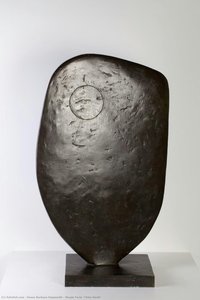
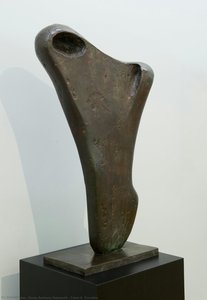
Barbara Hepworth’s “Two Forms”: A Testament to Minimalism and Organic Geometry
Barbara Hepworth (1903 – 1975), a British sculptor whose career spanned decades of artistic innovation, remains an enduring figure in the history of modern art. Her work embodies a profound exploration of form and space, prioritizing simplicity and conveying a deep connection to the natural world—qualities powerfully realized in “Two Forms,” created in 1937.
The sculpture itself is deceptively straightforward. Constructed from concrete – a material Hepworth favored for its solidity and ability to capture subtle tonal variations – it presents two interlocking forms that ascend vertically, separated by a shallow concave curve. These shapes aren’t representational; they eschew recognizable imagery in favor of pure geometric abstraction. Instead, Hepworth sought to distill the essence of form itself, mirroring the principles championed by the Unit One movement she co-founded alongside fellow artists Ben Nicholson and Paul Nash.
Hepworth's approach aligns closely with the broader aesthetic currents of the time. The Unit One group rejected academic conventions and embraced a radical simplification of artistic expression, influenced heavily by Surrealism’s exploration of subconscious imagery and Dada’s rejection of traditional artistic hierarchies. However, unlike Surrealists who often employed dreamlike juxtapositions, Hepworth focused on achieving visual harmony through precise geometric relationships—a deliberate counterpoint to the prevailing anxieties surrounding societal upheaval.
The curve between the two forms is particularly significant. It isn't merely a structural element; it embodies an organic principle – mirroring the contours of rock formations and suggesting a dynamic interplay between opposing forces. Hepworth herself described her sculptures as “attempts to capture the feeling of stone,” reflecting her fascination with geological textures and shapes. This sensitivity to natural forms distinguishes “Two Forms” from purely intellectual exercises in abstraction.
“Two Forms” continues to resonate today, serving as a cornerstone of minimalist sculpture and demonstrating Hepworth’s unwavering commitment to exploring fundamental visual concepts. Its quiet elegance speaks volumes about the artist's belief that beauty resides in restraint and that art can communicate profound emotional truths without resorting to overt symbolism.
- Material: Concrete
- Dimensions: Unknown (likely relatively small)
- Location: Currently housed in a private collection.
Questions & Answers
How is "Two Forms" recommended to be printed - what size, what orientation?
A print of "Two Forms" by Barbara Hepworth is recommended at a medium size in portrait orientation.
What underlying hue runs through "Two Forms" by Barbara Hepworth?
A golden yellow range hue runs through "Two Forms" by Barbara Hepworth.
When and with what materials was "Two Forms" made?
"Two Forms" was created in 1937 using the sculpture bronze technique. Material and date describe how and when the original was made.
Artist Biography
early life and education
dame barbara hepworth, a renowned english artist and sculptor, was born on january 10, 1903, in wakefield, yorkshire. she attended the leeds school of art from 1920 and later won a county scholarship to study at the royal college of art (rca) in london from 1921 until she was awarded the diploma in 1924.artistic career
- dame barbara hepworth's work exemplifies modernism, particularly modern sculpture. she was one of the few female artists to achieve international prominence.
- in 1933, she co-founded the unit one art movement with ben nicholson, paul nash, and others, seeking to unite surrealism and abstraction in british art.
- hepworth's early work was characterized by abstraction and her involvement with the paris-based art movement, abstraction-création.
notable works and exhibitions
- oval form (trezion), a bronze sculpture, is part of the kimbell art museum collection in fort worth, united states. (view on TopImpressionists)
- two forms, a sculpture, is exhibited at the hepworth wakefield in wakefield, united kingdom. (view on TopImpressionists)
- totem, a marble sculpture, is also part of the collection at the hepworth wakefield. (view on TopImpressionists)
legacy and museum collections
barbara hepworth's work is widely recognized, with her sculptures and paintings forming part of various museum collections worldwide. the hepworth wakefield, named after the artist, houses numerous masterpieces from renowned artists, including hepworth's own works. (discover more about the hepworth wakefield on TopImpressionists)conclusion
dame barbara hepworth's pioneering work in modern british sculpture has left an indelible mark on the art world. her legacy continues to inspire artists and art enthusiasts alike, with her works remaining a testament to her innovative spirit and artistic genius. more about barbara hepworth on wikipedia
Barbara Hepworth
1903 - 1975 , United Kingdom
Quick Facts
- Full Name: Barbara Hepworth
- Nationality: British
- Date Of Birth: 1903
- Date Of Death: 1975
- Place Of Birth: Wakefield, United Kingdom
- Notable Artworks:
- Oval Form (Trezion)
- Two Forms
- Totem
- Artistic Movement Or Style: Modernism, Abstraction
- Artists Who Influenced This Artist:
- Henry Moore
- Ben Nicholson
- Artists Or Movements Influenced By This Artist:
- Abstraction-Création
- Unit One
Related Articles

The Soul of Color: A Journey into the Emotional Resonance of Lyrical Abstraction
Embark on a cultural journey through Lyrical Abstraction. Explore how masters like Kandinsky used color and motion to translate emotion into visual poetry. Discover the profound beauty of abstract expressionism and learn to curate emotional resonance in your own art collection.
Explore artworks organized by themes, styles, and characteristics.