Preview
 Send
Send Share
Share
 Details
 Guide
Guide

 Download
 Similars
 X-Ray
X-Ray Diaporama
 Stats
StatsThe sentry

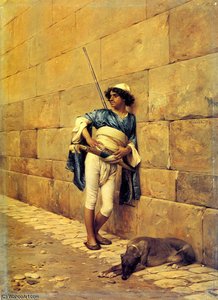
The painting depicts a man holding a firearm alongside a dog, positioned near a brick wall. Two additional figures are present, and a bowl rests on the ground. Influenced by Jean-Léon Gérôme's style, Bargue’s course of drawing established itself as a cornerstone for classical realism.
 Read More
Explore the influential drawings of Charles Bargue, a French artist known for his classical realism & the groundbreaking ‘Bargue Drawing Course.’ Discover orientalist scenes & impact on Picasso & Van Gogh.
Giclée / Art Print
Museum-quality giclée or canvas print with fast production and flexible finish options. ( Buy Hand Made Painting Switch to Digital Image)




P118B $10

P118H $10

P118W $10

P438Z $10

P508JH $12

P508YH $12

P805H $10

P805Z $10

P919BZ $10

P919G $10

P919XJ $10

P959ZH $10

P968JZ $12

W106C $8

W218G $10

W218JH $8

W218Y $10

W307PJ $10

W316G $10

W316PJ $8

W316Y $10

W398PJ $8

W4111J $10

W500HY $15

W500JH $15

W692G $12

W849H $8

W940BG $15

W953PJ $8




Standard
custom
CM
INCH
Pick from our preset sizes that match the artwork's original proportions.
Loading sizes...

width
height
Type the width and the height you need, to fit your frame or your wall. A print can only be cut, never made bigger than the picture, so a size with a different shape loses a part of the image. We send you a digital mockup to approve before we print anything. The picture shown on this page does not show the real cut — only the mockup does.
Worldwide Delivery () in 2 weeks instead of standard 4/5 weeks. (22 October)

Free Worldwide Express Shipping

High-Quality Linen Canvas

Full Shipping Insurance

Customs Tax Refund Guarantee

True Color Matching Guarantee

100-Day Return Policy (Defects Only)

100% Money-Back Guarantee

Bulk Discount Offer
 Glass option is only available in size under 110 CM

The sentry
Giclée / Art Print
Reproduction Size
-


Total Price
$ 70
Charles Bargue: The Architect of Drawing
Charles Bargue (1826 – 1883), a French painter and lithographer, stands as an almost singular figure in the history of art education. He wasn’t merely concerned with replicating visual appearances; he sought to instill within aspiring artists a profound understanding of disegno—the Italian term for drawing—a discipline considered foundational to artistic creativity. Bargue's legacy isn’t found solely in his celebrated Cours de dessin, published between 1866 and 1871 alongside Jean-Léon Gérôme, but rather in its enduring influence on generations of artists who followed.
The Cours de dessin itself was a revolutionary undertaking. Rather than beginning with simple sketches or copying photographs, it commenced with plaster casts—replicas of classical sculptures—designed to familiarize students with form and proportion. Subsequent stages involved studying master drawings from antiquity and Renaissance Italy, meticulously analyzing their compositional strategies and tonal values. Finally, the course culminated in drawing from live models, encouraging students to translate observation into expressive representation.
Bargue’s approach wasn't simply pedagogical; it was deeply rooted in humanist ideals. He believed that disegno cultivated not only technical skill but also intellectual rigor and aesthetic sensitivity. His meticulous attention to detail—evident in his lithographs—reflected a conviction that art should strive for accuracy while simultaneously conveying emotion. The Cours de dessin became a cornerstone of artistic training, shaping the styles of artists as diverse as Pablo Picasso and Vincent van Gogh.
Picasso and Van Gogh famously copied Bargue’s entire set of 197 lithographs in 1880/81, demonstrating the enduring power of Bargue's method. They weren’t merely reproducing images; they were engaging in a deliberate process of intellectual emulation—analyzing Bargue’s prints to deepen their understanding of drawing technique and compositional principles.
Bargue’s influence extends beyond individual artists. His Cours de dessin established a paradigm for art education that prioritized observation, analysis, and expressive representation. It continues to inspire academies and ateliers worldwide, fostering a tradition of classical realism that champions both accuracy and artistic vision. Bargue's contribution to the visual arts is undeniable—he fundamentally reshaped how artists approached their craft and cemented disegno’s place as an indispensable element of artistic development.
Questions & Answers
What does "The sentry" by Charles Bargue depict?
The themes present in "The sentry" by Charles Bargue include military, guard duty, dog companion, brick wall texture, drawing course, lithography print, classical art. Together they summarize the artwork's subject matter.
What feeling do the colors of "The sentry" by Charles Bargue create?
"The sentry" by Charles Bargue combines an earthy palette with a calm tone.
Which period of Charles Bargue's career does "The sentry" belong to?
Within Charles Bargue's career, "The sentry" falls in the Mature Period. The phase helps compare it with the artist's other works.
Artist Biography
A Life Dedicated to the Art of Drawing
Charles Bargue, a name perhaps less celebrated than his contemporaries yet profoundly influential in the annals of art education, was a French painter and lithographer born in Paris in 1826. His life, though marked by personal struggles, became inextricably linked with a revolutionary approach to artistic training—an approach that continues to shape classical realism today. While biographical details remain somewhat sparse, Bargue’s early career likely began within the family tradition of lithography before he found himself working for Adolphe Goupil & Cie., a prestigious Parisian printmaking firm in 1858. It was during his time at Goupil that a pivotal artistic partnership blossomed with Jean-Léon Gérôme, a leading academic painter and a key figure in the Orientalist movement. This collaboration would ultimately define Bargue’s legacy, though not necessarily through paintings of his own hand but rather through an unprecedented pedagogical undertaking.The Cours de Dessin: A Foundation for Generations
Bargue's most enduring contribution is undoubtedly the *Cours de dessin*, a comprehensive drawing course conceived in close collaboration with Gérôme and published between 1866 and 1871. This was not merely a textbook; it was a meticulously structured program designed to guide students from the fundamentals of copying plaster casts, through the study of master drawings, and ultimately towards drawing from life. The course comprised 197 lithographs—individual sheets intended for reproduction and practice—and represented a systematic dismantling of artistic skill into manageable steps. The brilliance lay in its accessibility; it democratized academic training, providing aspiring artists with a pathway to mastery previously reserved for those within the established art institutions. It was a method built on repetition, observation, and an unwavering commitment to anatomical accuracy. The *Cours* wasn’t simply about replicating forms but understanding their underlying structure—the very bones and muscles that gave them life.Orientalist Influences and Artistic Style
Though best known for his pedagogical work, Bargue was a skilled painter in his own right. His artistic style reflects the influence of Gérôme, particularly evident in his fascination with Orientalist scenes and historical genre painting. He travelled extensively through North Africa and the Balkans, meticulously documenting local people and customs with remarkable detail. These journeys informed his paintings, which often depict figures set against exotic backdrops, imbued with a sense of realism and ethnographic precision. His work captures not just appearances but also a palpable atmosphere—the textures of fabrics, the play of light on weathered faces, the weight of cultural traditions. However, Bargue’s output was relatively small; he was known to be a slow and painstaking worker, prioritizing quality over quantity.A Lasting Impact: Van Gogh, Picasso, and Beyond
The impact of the *Cours de dessin* reverberates through art history. Perhaps its most famous disciples were Vincent van Gogh and Pablo Picasso, both of whom rigorously studied Bargue’s plates during their formative years. Van Gogh, in particular, held the course in high esteem, copying the entire set in 1880/81 and revisiting it again in 1890. He saw in Bargue's method a pathway to understanding form and structure—a foundation upon which he would build his own unique artistic vision. Picasso, too, benefited immensely from the course, utilizing its principles to hone his draftsmanship before embarking on his revolutionary explorations of Cubism.- The *Cours de dessin* provided a common language for artists seeking mastery of classical techniques.
- It fostered a generation of artists grounded in anatomical accuracy and observational skills.
- Its influence extends to contemporary ateliers and academies dedicated to classical realism.
Historical Significance and Enduring Legacy
Charles Bargue’s life ended tragically in 1883, succumbing to a stroke and the intensification of long-standing mental health struggles. However, his legacy lives on through the *Cours de dessin*, which remains a cornerstone of classical art education worldwide. The course's enduring popularity is a testament to its effectiveness—a timeless method for unlocking artistic potential. While Gérôme often overshadows Bargue in historical accounts, it’s crucial to recognize Bargue’s pivotal role in codifying and disseminating academic principles. He wasn’t merely a copyist or an assistant; he was a visionary educator who democratized art training and profoundly shaped the course of modern art—a quiet revolutionary whose influence continues to be felt by artists striving for excellence today.
Charles Bargue
1826 - 1883 , France
Quick Facts
- Artistic Movement Or Style: Classical Realism
- Artists Or Movements Influenced By This Artist:
- Pablo Picasso
- Vincent van Gogh
- Artists Who Influenced This Artist: ['Jean-Léon Gérôme']
- Date Of Birth: 1826
- Date Of Death: 1883
- Full Name: Charles Bargue
- Nationality: French
- Notable Artworks:
- Head of young man (study)
- The Albanian sentinel
- A Bashi-Bazouk
- An Eastern Coffeehouse
- Place Of Birth: France
Related Articles

The Raw Truth: A Definitive Guide to the Power and Legacy of Social Realism Art
Explore the profound impact of Social Realism. Discover how masters like Courbet rejected idealism to capture the raw, socio-political truths of the working class through powerful, unvarnished art history and enduring visual critique.

The Timeless Elegance of Academic Classicism: A Journey Through Order, Precision, and the Pursuit of Perfection
Explore the profound beauty of Academic Classicism. Discover how masters used order, precision, and classical ideals to achieve timeless perfection in art history, from Neoclassical portraits to the pursuit of ideal beauty.
Explore artworks organized by themes, styles, and characteristics.