


 Preview
 Send
Send Share
Share
 Details
 Guide
Guide

 Download
 Similars
 X-Ray
X-Ray Diaporama
 Stats
StatsDress


Experience 1860s haute couture fashion with this painting by Charles Frederick Worth, showcasing revolutionary design artistry; discover timeless elegance for your collection.
 Read More
Discover Charles Frederick Worth (1825-1895), the 'father of haute couture'. Explore his innovative designs, luxurious fabrics & influence on 19th-century fashion. View dresses & more!
Hand Made Oil Reproduction
Hand-painted oil on canvas in your size and frame, made to order by our artists. ( Switch to Print Switch to Digital Image)




P118B $10

P118H $10

P118W $10

P438Z $10

P508JH $12

P508YH $12

P805H $10

P805Z $10

P919BZ $10

P919G $10

P919XJ $10

P959ZH $10

P968JZ $12

W106C $8

W218G $10

W218JH $8

W218Y $10

W307PJ $10

W316G $10

W316PJ $8

W316Y $10

W398PJ $8

W4111J $10

W500HY $15

W500JH $15

W692G $12

W849H $8

W940BG $15

W953PJ $8




Standard
custom
CM
INCH
Pick from our preset sizes that match the artwork's original proportions.
Loading sizes...

width
height
Type the width and the height you need, to fit your frame or your wall. This is hand-painted, so for a size with a different shape the artist can paint a bit more around the picture, or cut a bit — you choose. We send you a digital mockup to approve before the painting starts. The picture shown on this page does not show the real result — only the mockup does.
Examples of what can be changed: Replace face with customer photo; Add pet (e.g., replace cat with dog); Include hidden message in background; Change background landscape or elements.
After order, TopImpressionists.com team will email client for instructions and provide a mockup preview
After order, TopImpressionists.com team will email client for instructions and provide a mockup preview
Worldwide Delivery () in 3/4 weeks instead of standard 5 weeks. (23 October). No compromise on quality.

Free Worldwide Express Shipping

High-Quality Linen Canvas

Full Shipping Insurance

Customs Tax Refund Guarantee

True Color Matching Guarantee

100-Day Return Policy (Defects Only)

100% Money-Back Guarantee

Bulk Discount Offer
 Glass option is only available in size under 110 CM

Dress
Reproduction Medium
Reproduction Size
-


Total Price
$ 269
The Genesis of Modern Style: A Glimpse into Haute Couture
To stand before this depiction is to step directly into the vibrant, transformative world of mid-Victorian Paris, a time when fashion ceased to be mere necessity and ascended to the realm of high art. This painting captures more than just a woman in an elaborate gown; it immortalizes a pivotal moment in cultural history—the very birth of haute couture itself. The subject, presented with such careful attention to detail, embodies the revolutionary vision of Charles Frederick Worth. One can almost hear the rustle of silk and the hushed anticipation within his salon as he unveiled these designs, setting a standard that would echo through generations of fashion.
Anatomy of an Era: Dress and Design
Observe the gown itself—a masterpiece of 1860s silhouette. The high neckline and delicate, ruffled collar speak volumes about the period's ideals of modesty interwoven with opulent display. Worth’s genius lay in his ability to dictate taste; he was not simply following trends, but creating them. The inclusion of the mannequin within the scene is particularly telling, suggesting a process—a moment caught between creation and presentation. It grounds the ethereal beauty of the model in the tangible reality of design, reminding us that every exquisite drape and fold held the mark of an artisan's meticulous hand.
The Legacy of Worth: Artistry Meets Commerce
Charles Frederick Worth himself was more than a dressmaker; he was an impresario. His ability to present garments as designed statements, complete with labels bearing his signature, fundamentally altered the relationship between artist and consumer. This artwork serves as a visual testament to that shift—the moment fashion became intellectual property, wearable art dictated by visionaries like him. For collectors and designers today, this piece offers an unparalleled window into the intersection of fine art patronage and burgeoning industrial design.
Bringing Parisian Elegance Home
Owning a reproduction of this painting is to curate a narrative of enduring elegance for your own space. Whether adorning a formal drawing-room or serving as a sophisticated accent in a modern gallery setting, the rich textures and historical weight captured here lend an air of storied grandeur. It invites contemplation on beauty's ephemeral nature while celebrating the permanence of masterful craftsmanship. It is an heirloom piece that whispers tales of Parisian salons and revolutionary style.
Questions & Answers
Where can I see a preview of "Dress"?
To preview a reproduction of "Dress" by Charles Frederick Worth, open the artwork's Preview page.
Does "Dress" show strong light-dark contrasts?
The contrast level of "Dress" by Charles Frederick Worth is statement.
In what year was "Dress" by Charles Frederick Worth created?
The creation of "Dress" by Charles Frederick Worth is dated 1868.
Artist Biography
The Architect of Haute Couture: Charles Frederick Worth
Charles Frederick Worth, a name synonymous with the birth of haute couture, wasn’t merely a dressmaker; he was an orchestrator of style, a shrewd businessman, and arguably the first fashion designer to achieve celebrity status. Born in Bourne, Lincolnshire, England, on October 13, 1825, his journey from humble beginnings to becoming the arbiter of Parisian elegance is a testament to ambition, innovation, and an innate understanding of the desires of an evolving society. Young Worth initially apprenticed with London textile merchants, absorbing the intricacies of fabric and trade – knowledge that would prove invaluable. However, it was his move to Paris in 1845 that truly ignited his destiny. He found employment at Gagelin-Opigez & Cie, a prestigious establishment where he quickly distinguished himself not only as a skilled salesman but also as a creative force capable of transforming textiles into breathtaking garments. It wasn’t long before Worth persuaded the firm to allow him to establish a dressmaking department, marking his formal entry into the world of fashion design.Revolutionizing Fashion and Establishing a Legacy
In 1858, Worth took a bold step, founding the House of Worth in partnership with Otto Bobergh. This wasn’t simply another atelier; it was a revolutionary concept. Prior to Worth, dressmaking was largely anonymous, garments were often adapted from existing styles or created by nameless seamstresses. Worth changed all that. He boldly presented his designs on live models – a radical departure from the use of wax figures common at the time – allowing clients to envision how the clothes would drape and move on a real body. This theatrical presentation elevated dressmaking to an art form, transforming it from a craft into a spectacle. Furthermore, Worth was the first to sign his creations with a branded label, establishing the designer as the central figure in the creation of a garment, rather than simply the anonymous artisan. His clientele quickly ascended to include European royalty and high society figures, drawn by his innovative designs and impeccable craftsmanship. Empress Eugénie, wife of Napoleon III, became one of his most devoted patrons, solidifying Worth’s position at the pinnacle of Parisian fashion.Aesthetic Principles and Notable Creations
Worth's aesthetic was characterized by a lavish use of opulent fabrics – silks, satins, velvets, and brocades – often adorned with intricate embroidery, lace, and trimmings. He wasn’t afraid to draw inspiration from historical styles, particularly the Renaissance and Rococo periods, but he adapted these influences to suit the sensibilities of his contemporary clientele. His designs emphasized a sculpted silhouette, achieved through innovative construction techniques like boning and padding. The afternoon dress showcased at the Museum of Fine Arts, Boston, exemplifies his mastery of satin design, while the dinner dress held by the Kyoto Costume Institute, with its striking chrysanthemum pattern and voluminous sleeves, demonstrates his flair for dramatic effect. Even simpler designs, such as the dress housed in the Design Museum of Barcelona, reveal a refined elegance and attention to detail that defined his work. He is credited with popularizing several key fashion innovations, including the cage crinoline – a structure designed to hold skirts in an expansive shape – and the bustle, which created fullness at the back of the skirt.Beyond the Gowns: A Lasting Impact
The influence of Charles Frederick Worth extends far beyond the exquisite gowns he created. He fundamentally altered the business of fashion, establishing the concept of seasonal collections and creating a demand for exclusive, designer-made clothing. The House of Worth continued to thrive after his death in 1895, carried on by his sons, Gaston Lucien and Jean Philippe, maintaining its reputation for luxury and innovation well into the 20th century. His legacy can be seen in the collections of museums worldwide, including the Russell-Cotes Art Gallery and Museum in the United Kingdom and the Ingram Collection of Modern British and Contemporary Art in London. Worth’s pioneering spirit paved the way for future generations of designers, establishing the foundations of the modern fashion industry as we know it today. He wasn't just designing clothes; he was crafting an image, a lifestyle, and ultimately, a legend that continues to resonate within the world of haute couture.
Charles Frederick Worth
1825 - 1895 , United Kingdom
Quick Facts
- Full Name: Charles Frederick Worth
- Nationality: English
- Date Of Birth: 1825
- Date Of Death: 1895
- Place Of Birth: Bournemouth, United Kingdom
- Notable Artworks:
- Afternoon dress
- Dinner dress
- Dress
- Artistic Movement Or Style: Haute Couture
- Artists Or Movements Influenced By This Artist: ['Fashion Designers']
Related Articles

Draped Narratives: Fashion as Symbol & Subject in Historical Art
Explore the fascinating history of fashion as a symbol of power & status in art! Discover masterpieces from Gainsborough to Tissot and learn how clothing shaped societal narratives. Find museum-quality reproductions at TopImpressionists.

Cristóbal Balenciaga: Deconstructing Haute Couture's Architectural Legacy
Explore the revolutionary world of Cristóbal Balenciaga, the 'couturier's couturier'. Discover his architectural designs, lasting influence on haute couture, and guide to collecting rare pieces. A connoisseur’s resource.
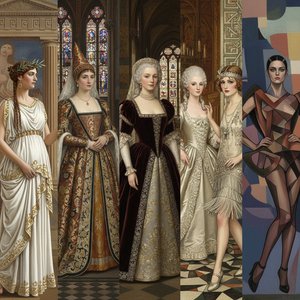
Style Through the Ages: Iconic Artworks That Defined the Evolution of Fashion Design
Explore the breathtaking intersection of fine art and high fashion. Discover how iconic masterpieces from Art Deco to Impressionism have shaped the world of luxury couture and timeless design in this curated visual journey.

Gianfranco Ferré: Deconstructing Haute Couture – A Legacy of Architectural Form
Explore the revolutionary world of Gianfranco Ferré, 'the architect of fashion.' Discover his architectural approach to haute couture, iconic Dior designs, and lasting influence on luxury style. A deep dive for collectors & enthusiasts.

Crimson Threads of Narrative: Exploring Symbolism & Representation in Artworks Featuring the Red Dress
Explore the rich symbolism of the red dress in art history! From ancient power displays to iconic portraits like Cézanne’s 'Madame Cezanne', discover the cultural and artistic significance behind this captivating color. Expert analysis & insights.
Explore artworks organized by themes, styles, and characteristics.


