Preview
 Send
Send Share
Share
 Details
 Guide
Guide

 Download
 Similars
 X-Ray
X-Ray Diaporama
 Q&A
Q&A Stats
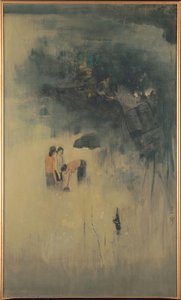
StatsBali Beach

- 63.0 x 50.0 cm


A vibrant Nanyang modernist scene featuring two women relaxing on a tropical shore by Cheong Soo Pieng, capturing the essence of Southeast Asian life through colorful, stylized forms that invite you to explore his legacy.
 Read More
Cheong Soo Pieng (1917-1983) was a pioneering Singaporean artist of the Nanyang style, known for his modernist oil paintings & watercolors depicting Southeast Asian life, particularly stylized figures and scenes. A key figure in 20th-century art.
The artwork displayed on this page is protected by copyright law, which means we cannot legally create or sell an identical reproduction. This protection is enforced under international agreements such as the Berne Convention and by national laws, including those outlined by the U.S. Copyright Law - Title 17.
This method fully complies with copyright regulations because it does not involve copying or duplicating the protected artwork. Instead, it is a creative reinterpretation - a new painting that is influenced by the original but not identical to it.
Giclée / Art Print
Museum-quality giclée or canvas print with fast production and flexible finish options. ( Buy Hand Made Painting Switch to Digital Image)




P118B $10

P118H $10

P118W $10

P438Z $10

P508JH $12

P508YH $12

P805H $10

P805Z $10

P919BZ $10

P919G $10

P919XJ $10

P959ZH $10

P968JZ $12

W106C $8

W218G $10

W218JH $8

W218Y $10

W307PJ $10

W316G $10

W316PJ $8

W316Y $10

W398PJ $8

W4111J $10

W500HY $15

W500JH $15

W692G $12

W849H $8

W940BG $15

W953PJ $8




Standard
custom
CM
INCH
Pick from our preset sizes that match the artwork's original proportions.
Loading sizes...

width
height
Type the width and the height you need, to fit your frame or your wall. A print can only be cut, never made bigger than the picture, so a size with a different shape loses a part of the image. We send you a digital mockup to approve before we print anything. The picture shown on this page does not show the real cut — only the mockup does.
Worldwide Delivery () in 2 weeks instead of standard 4/5 weeks. (2 November)

Free Worldwide Express Shipping

High-Quality Linen Canvas

Full Shipping Insurance

Customs Tax Refund Guarantee

True Color Matching Guarantee

100-Day Return Policy (Defects Only)

100% Money-Back Guarantee

Bulk Discount Offer
 Glass option is only available in size under 110 CM

Bali Beach
Giclée / Art Print
Reproduction Size
-


Total Price
$ 70
A Moment of Tropical Stillness
The sun warms the shore as two women rest amidst the scattered remnants of a tropical afternoon. One figure lies prone, her head finding a soft place upon the lap of her companion, who sits upright watching the world drift by. Around them, the scene is punctuated by the bright yellow of fallen bananas and the quiet presence of birds fluttering near the edge of the frame. A simple bowl rests on the lower right, grounding the composition in the everyday reality of the coast. There is a sense of heavy, midday heat that slows every movement.
The colors are bold and saturated, pulling the eye toward the rhythmic shapes of the figures. Thick black contours define their forms, lending a structural weight to their limbs that feels both grounded and ethereal. The landscape itself seems fragmented into geometric planes, mirroring the way light breaks across the sand and sea. It is a scene where the boundaries between the human form and the natural environment begin to blur.
The Spirit of Nanyang Modernism
This work emerges from a period of profound artistic transformation in Southeast Asia. The artist brings the structural lessons of Cubism and the dreamlike qualities of Surrealism to the shores of the Malay Peninsula and the Indonesian archipelago. By blending these Western influences with the organic essence of the tropics, the painting captures a specific regional identity. The figures possess elongated limbs and almond-shaped eyes, a stylistic choice that lends them a graceful, almost mythic quality.
The technique relies on a masterful command of line and light to transform a simple beach setting into something much larger. Through the use of fragmented shapes and intense color, the heat and movement of the shore are made palpable. The painting does not merely record a landscape; it captures the very pulse of life in this sun-drenched corner of the world. Every brushstroke carries the weight of a specific cultural context, where the mundane beauty of a beach afternoon is elevated through a modern lens.
Questions & Answers
What is a reproduction of "Bali Beach" by Cheong Soo Pieng recommended for?
A reproduction of "Bali Beach" by Cheong Soo Pieng is recommended for cultural. This suggestion follows from the work's subject, mood and colors.
What are the format and size of "Bali Beach"?
"Bali Beach" by Cheong Soo Pieng is proportioned as a landscape work of 63 x 50 cm.
How is "Bali Beach" recommended to be printed - what size, what orientation?
A print of "Bali Beach" by Cheong Soo Pieng is recommended at a small size in landscape orientation.
Related Artworks


Artist Biography
The Architect of Nanyang Modernism
In the vibrant tapestry of twentieth-century Asian art, few threads shine as brightly or as uniquely as those woven by Cheong Soo Pieng. A visionary who bridged the vast distance between the ancient traditions of the East and the avant-garde movements of the West, Cheong stands as a monumental figure in Singaporean art history. Born in 1917 in Amoy, China, his early life was marked by a profound connection to the classical aesthetics of his heritage, yet his spirit was destined for the tropical rhythms of Southeast Asia. His formative education at the Xiamen Academy of Fine Art and later in Shanghai provided him with a rigorous foundation in Chinese ink painting, but it was his move to Singapore in 1946 that would ignite his true artistic revolution.
Cheong did not merely adopt a new landscape; he reimagined it through a lens of modernism. Alongside contemporaries like Chen Wen Hsi, he became a primary architect of the Nanyang style—a movement that sought to capture the soul of the Malay Peninsula and the Indonesian archipelago. This was not a mere imitation of European trends, but a sophisticated fusion. He took the structural lessons of Cubism and the dreamlike qualities of Surrealism and breathed into them the warmth, color, and cultural vitality of Southeast Asian life. His work became a dialogue between the geometric precision of the West and the organic, flowing essence of the tropics.
A Symphony of Form and Local Essence
To gaze upon a Cheong Soo Pieng masterpiece is to witness a masterful command of both line and light. His technique was characterized by an extraordinary ability to use bold, saturated colors and thick black contours to delineate forms that felt both grounded and ethereal. He possessed a signature way of depicting indigenous tribal people, often portraying figures with elongated limbs and almond-shaped eyes—a stylistic choice that lent his subjects a graceful, almost mythic quality. This rhythmic approach to the human figure allowed him to transform everyday scenes into something timeless and iconic.
His subject matter served as a love letter to the regional identity. Through his brush, the mundane became magnificent:
- The Rhythms of Labor: He captured the communal spirit of Weaver and the industriousness of fishermen hauling nets or farmers tending to rice paddies.
- Cultural Heritage: Works like Kayan Musician celebrate the traditional musical performances that define the region's cultural heartbeat.
- Tropical Serenity: In pieces such as Bali Beach, he invited viewers into a world of relaxation and sun-drenched landscapes, using fragmented geometric shapes to mirror the heat and movement of the shore.
- The Beauty of the Ordinary: Even in his more intimate studies, such as Drying Salted Fish or his various still lifes, there is an unwavering dedication to the palpable essence of human experience within a specific cultural context.
Legacy and the Enduring Spirit of Innovation
As his career progressed, Cheong’s experimentation knew no bounds. He was never content with staying within the safety of oil or watercolor; he fearlessly pushed the limits of his medium by exploring metal reliefs, lacquer, Masonite, and mixed media. This relentless pursuit of innovation ensured that his work remained dynamic, evolving from the figurative clarity of his early Nanyang years toward more complex, layered, and abstract compositions. His later works, such as Abstract Composition, demonstrate a profound depth where texture and color take center stage, reflecting a mature artist grappling with the very essence of spatial relationships.
Cheong Soo Pieng passed away in 1983, but his influence remains an indelible part of the global art canon. He did more than create paintings; he helped forge a visual identity for a region in transition. By rejecting rigid European academic conventions in favor of a style that honored local textures and rhythms, he gave Southeast Asia a modern voice. Today, his works reside in prestigious collections such as the National Gallery Singapore, serving as a permanent testament to a man who saw the beauty in the fragmented, the strength in the stylized, and the eternal in the everyday.

Cheong Soo Pieng
1917 - 1983
Quick Facts
- Full Name: Cheong Soo Pieng
- Nationality: Singaporean
- Date Of Birth: 1917
- Date Of Death: 1983
- Place Of Birth: Xiamen
- Notable Artworks:
- Still Life
- Drying Salted Fish
- Abstract Composition
- Artistic Movement Or Style: Nanyang Style
- Artists Who Influenced This Artist: ['Cubism']
- Artists Or Movements Influenced By This Artist: ['Modernism']
Related Articles

Tropical Splendor: Capturing Sunlight and Lush Landscapes in Impressionist Art
Embark on a visual journey through tropical Impressionism. Discover how masters like Gauguin captured sunlight and lush landscapes. Explore premium, hand-painted oil reproductions of iconic works, curated for the true art lover at TopImpressionists.com.

Sun, Sand, and Soul: 10 Stunning Artworks That Capture the Beach
Immerse yourself in the serene beauty of the coast through 10 iconic seascape paintings. From Impressionist waves to modern coastal masterpieces, explore the stories behind these timeless ocean-inspired artworks. Find museum-quality reproductions at TopImpressionists.com. Explore the full collection online.

Nature Unbound: The Top 25 Masterpieces by Victorian Explorer Marianne North
Embark on a global journey through the vibrant botanical world of Marianne North. Explore 25 iconic Victorian landscapes and lush floral masterpieces, perfect for fine art collectors and decor inspiration. Discover all masterpieces on TopImpressionists.com.
Explore artworks organized by themes, styles, and characteristics.