Preview
 Send
Send Share
Share
 Details
 Guide
Guide

 Download
 Similars
 X-Ray
X-Ray Diaporama
 Q&A
Q&A Stats
StatsThe Rose (IV)


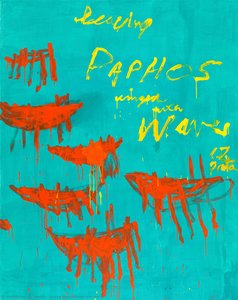
Experience Cy Twombly’s vibrant abstract expressionist masterpiece, "The Rose (IV)," a dynamic study in color and form featuring three expressive rose blooms alongside poetic inscriptions from Rilke. Discover this iconic 2008 artwork and bring its beauty into your space.
 Read More
Explore Cy Twombly's (1928-2011) captivating art: abstract expressionism, calligraphic paintings & poetic themes. Influenced Basquiat & Kiefer with his unique style.
The artwork displayed on this page is protected by copyright law, which means we cannot legally create or sell an identical reproduction. This protection is enforced under international agreements such as the Berne Convention and by national laws, including those outlined by the U.S. Copyright Law - Title 17.
This method fully complies with copyright regulations because it does not involve copying or duplicating the protected artwork. Instead, it is a creative reinterpretation - a new painting that is influenced by the original but not identical to it.
Giclée / Art Print
Museum-quality giclée or canvas print with fast production and flexible finish options. ( Buy Hand Made Painting Switch to Digital Image)




P118B $10

P118H $10

P118W $10

P438Z $10

P508JH $12

P508YH $12

P805H $10

P805Z $10

P919BZ $10

P919G $10

P919XJ $10

P959ZH $10

P968JZ $12

W106C $8

W218G $10

W218JH $8

W218Y $10

W307PJ $10

W316G $10

W316PJ $8

W316Y $10

W398PJ $8

W4111J $10

W500HY $15

W500JH $15

W692G $12

W849H $8

W940BG $15

W953PJ $8




Standard
custom
CM
INCH
Pick from our preset sizes that match the artwork's original proportions.
Loading sizes...

width
height
Type the width and the height you need, to fit your frame or your wall. A print can only be cut, never made bigger than the picture, so a size with a different shape loses a part of the image. We send you a digital mockup to approve before we print anything. The picture shown on this page does not show the real cut — only the mockup does.
Worldwide Delivery () in 2 weeks instead of standard 4/5 weeks. (30 October)

Free Worldwide Express Shipping

High-Quality Linen Canvas

Full Shipping Insurance

Customs Tax Refund Guarantee

True Color Matching Guarantee

100-Day Return Policy (Defects Only)

100% Money-Back Guarantee

Bulk Discount Offer
 Glass option is only available in size under 110 CM

The Rose (IV)
Giclée / Art Print
Reproduction Size
-


Total Price
$ 70
The Rose (IV) by Cy Twombly: A Symphony of Color and Poetic Echoes
- Subject: The painting "The Rose (IV)" by Cy Twombly is an arresting exploration of the rose motif, rendered through a vibrant and dynamic abstract expressionist style. It’s not merely a depiction of a flower; it's an invocation of beauty, passion, and the transient nature of existence, deeply rooted in historical and literary references.
- Style: As a quintessential example of Cy Twombly’s mature work, "The Rose (IV)" exemplifies Abstract Expressionism, characterized by its raw emotion, spontaneous application of paint, and deliberate disregard for traditional representational forms. The piece leans heavily into the gestural qualities of the movement, prioritizing feeling and intuition over precise depiction.
Technique and Materials: A Textured Dialogue
- Medium: Twombly masterfully employs acrylic on plywood, a combination that yields a remarkably textured surface. The application of paint is deliberately loose and expressive, creating a sense of movement and energy within the composition.
- Brushwork & Inscriptions: Bold brushstrokes dominate the canvas, punctuated by carefully considered inscriptions – fragments from Rilke’s “The Roses” cycle. These aren't merely decorative; they are integral to the artwork's meaning, layering intellectual and emotional depth. The varying colors—deep reds, purples, blues—are applied with a tactile quality, inviting close observation of the paint itself.
Symbolism and Historical Context: Echoes of Antiquity and Poetry
- The Rose Motif: The recurring rose in Twombly’s oeuvre is far more than a floral subject; it represents beauty, passion, and the ephemeral nature of life – themes explored extensively throughout Western art history.
- Rilke's Influence: The inscriptions taken from Rilke’s poetry are crucial to understanding the work. Rilke’s exploration of loss, memory, and the cyclical nature of beauty resonates deeply within Twombly’s artistic vision, creating a powerful dialogue between painting and poetry. The piece reflects a deliberate engagement with classical traditions, mirroring the artist's fascination with ancient Mediterranean history and mythology.
Emotional Impact and Artistic Legacy
- Dynamic Composition: "The Rose (IV)" possesses a palpable energy, driven by its vibrant colors and dynamic composition. The overlapping blooms create a sense of depth and movement, drawing the viewer into the heart of the artwork.
- A Testament to Innovation: This painting stands as a testament to Cy Twombly’s innovative approach to Abstract Expressionism, demonstrating his ability to synthesize historical references, poetic inspiration, and bold artistic techniques into a singularly compelling work. Its monumental scale and evocative power continue to captivate audiences today.
Questions & Answers
What palette and what feeling does "The Rose (IV)" combine?
In "The Rose (IV)", dark colors accompany a nostalgic feeling.
What is the overall mood of "The Rose (IV)" by Cy Twombly?
The overall mood of "The Rose (IV)" by Cy Twombly is romantic. The mood describes the general atmosphere of the work.
In which year and which movement was "The Rose (IV)" made?
"The Rose (IV)" by Cy Twombly is dated 2008 and belongs to Abstract Expressionism Abstract Expressionism.
Artist Biography
A Life Etched in Line and Color
Edwin Parker Twombly Jr., known to the world as Cy Twombly, was a singular force in 20th and 21st-century art—an American painter, sculptor, and photographer whose work defied easy categorization. Born on April 25, 1928, in Lexington, Virginia, his artistic journey began with a foundation steeped in classical education and a restless spirit that propelled him across continents. Early studies under Pierre Daura at Washington and Lee University were followed by formative experiences at the Arts Students League of New York and Black Mountain College, where he encountered pivotal figures like Robert Rauschenberg, John Cage, and Merce Cunningham. These encounters fostered an environment of experimentation and interdisciplinary exploration that would profoundly shape his artistic vision. However, it was a 1952 voyage to Italy and North Africa with Rauschenberg—funded by a grant from the Virginia Museum of Fine Arts—that proved truly transformative. Immersed in ancient ruins, vibrant cultures, and the weight of history, Twombly discovered a wellspring of inspiration that would define his aesthetic for decades to come.The Evolution of an Enigmatic Style
Twombly’s artistic style was not born fully formed; it evolved through a series of explorations and refinements. His early works, such as the *North African Sketchbooks* (1953), already hinted at his unique blend of abstract forms and poetic references. These weren't mere travel journals but rather investigations into the essence of place—a distillation of light, texture, and memory. Throughout the 1960s, Twombly’s style began to coalesce around a distinctive vocabulary of scribbled lines, gestural marks, and fragmented words on expansive canvases. Works like the *Ferragosto* series (1961) and *The Italians* (1961) exemplify this period—paintings that seem to exist between calligraphy and chaos, evoking both ancient inscriptions and the immediacy of graffiti. He wasn’t interested in replicating reality but rather in capturing a sense of feeling, memory, and the passage of time. This approach challenged conventional notions of painting, moving away from representation towards a more subjective and emotionally resonant form of expression. Cold Stream* (1966), with its swirling loops and bold text, is a powerful example of this evocative style.Influences and Artistic Lineage
While fiercely independent, Twombly’s work wasn't created in a vacuum. He drew inspiration from a diverse range of sources—from the raw energy of Jean Dubuffet and Alberto Giacometti to the poetic sensibilities of Stéphane Mallarmé, Rainer Maria Rilke, and John Keats. Classical mythology and history also played a significant role, providing him with a rich tapestry of themes and symbols to explore. His paintings often allude to ancient narratives, subtly weaving together fragments of stories and legends. Twombly’s influence on subsequent generations of artists is undeniable. He paved the way for painters like Jean-Michel Basquiat, Anselm Kiefer, Francesco Clemente, and Julian Schnabel, who embraced a similar spirit of experimentation and emotional intensity. His willingness to break down traditional boundaries and explore new forms of expression resonated deeply with artists seeking to challenge the status quo. He demonstrated that painting could be more than just representation; it could be a vehicle for conveying complex emotions, ideas, and experiences.Major Achievements and Lasting Legacy
Throughout his career, Twombly received numerous accolades, including the Golden Lion award at the Venice Biennale in 2001 and being named a Chevalier of the Légion d'Honneur in 2010. His work is represented in major museum collections worldwide, including the Menil Collection in Houston, the Tate Modern in London, and New York’s Museum of Modern Art. A particularly significant achievement was his commission to create a ceiling piece for the Musée du Louvre in Paris—a testament to his international recognition and artistic stature. Three studies from the Temeraire* (1998-99), now held by the Art Gallery of New South Wales, exemplifies his later style – large scale works that are both delicate and powerful. Twombly’s enigmatic style continues to fascinate art enthusiasts and scholars alike. His paintings invite viewers to engage in a dialogue—to decipher the hidden meanings within the layers of paint and scribbled lines. He passed away on July 5, 2011, in Rome after a long battle with cancer, leaving behind a legacy that will continue to inspire and challenge artists for generations to come. A plaque in Santa Maria in Vallicella serves as a lasting memorial to his profound contribution to the world of art.Exploring Twombly’s World
Cy Twombly's work is an invitation to contemplate the complexities of human experience—to delve into the realms of memory, history, and emotion. His paintings are not simply objects to be admired but rather portals to another world—a world where lines dance, words whisper, and feelings take shape. Whether it’s the vibrant energy of *Untitled (Peony Blossom Painting)* or the evocative abstraction of *Proteus*, each work offers a unique glimpse into the artist's inner landscape. His influence extends beyond painting, impacting sculpture and photography as well. To truly appreciate Twombly’s genius, one must allow oneself to be swept away by the fluidity of his lines, the richness of his colors, and the depth of his poetic vision.- Explore Cy Twombly's artworks on TopImpressionists.
- Read more about Cy Twombly on Wikipedia.
- Discover the Musée du Louvre’s collection, featuring Twombly’s commissioned work, on TopImpressionists: Musée du Louvre.

Cy Twombly
1928 - 2011 , United States of America
Quick Facts
- Full Name: Edwin Parker Twombly Jr.
- Nationality: American
- Date Of Birth: 1928
- Date Of Death: 2011
- Place Of Birth: Lexington, United States of America
- Notable Artworks:
- Three studies from the temeraire
- Apollo and the artist
- Cold Stream
- Proteus
- Untitled (Peony Blossom Painting)
- Artistic Movement Or Style: Abstract Expressionism, Postmodern
- Artists Who Influenced This Artist:
- Pierre Daura
- Jean Dubuffet
- Alberto Giacometti
- Artists Or Movements Influenced By This Artist:
- Jean-Michel Basquiat
- Anselm Kiefer
- Francesco Clemente
- Julian Schnabel
Related Articles

Beyond Representation: Exploring the Emotional Landscape of Abstract Expressionism
Explore the profound emotional world of Abstract Expressionism with TopImpressionists. Discover key artists like Pollock & Rothko, learn about collecting, and find museum-quality reproductions to inspire your space.

Abstract Expressionism's 10 Defining Masterpieces |
Explore 10 defining Abstract Expressionism masterpieces by Pollock, Rothko & de Kooning. Discover the stories behind these iconic paintings and find museum-quality art reproductions to elevate your home decor on .

Geometric Abstraction's 10 Defining Masterpieces | Art for Your Home - TopImpressionists
Explore 10 defining masterpieces of Geometric Abstraction! Discover Kandinsky, Mondrian & Malevich’s iconic works. Find museum-quality art reproductions and curated decor ideas to elevate your home at TopImpressionists.com.

Cy Twombly: Scribbles of Emotion – Deconstructing Post-War Expressionism Through Calligraphy & Abstraction
Explore the captivating world of Cy Twombly with TopImpressionists. Discover the emotional depth & artistic significance behind his abstract calligraphy. Expert insights for collectors.

Kandinsky's Masterpieces: 25 Paintings That Define Abstract Art | TopImpressionists
Journey through Wassily Kandinsky's 25 most iconic abstract paintings. Explore his revolutionary use of color, form & spiritual expressionism. Find museum-quality Kandinsky reproductions and elevate your home decor with TopImpressionists.com. Discover all masterpieces on TopImpressionists.com!
Explore artworks organized by themes, styles, and characteristics.


![Untitled (Rome [Wall]) (1961)](/media/artworks/images-thumb/02/29/022976d5294bf560184bd33a69805420.jpg)