Preview
 Send
Send Share
Share
 Details
 Guide
Guide

 Download
 Similars
 X-Ray
X-Ray Diaporama
 Stats
StatsPulpit (on the left)
 Acrylic
- WallArt
- Renaissance Sculpture
 1465
1465 137.0 x 280.0 cm
 San Lorenzo
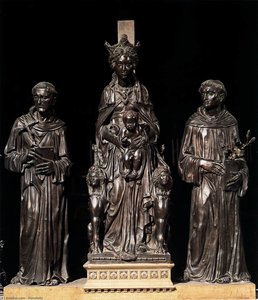
Donatello's 'Pulpit (on the left)' is a stunning marble sculpture showcasing Renaissance artistry & religious themes. A masterpiece by Donatello, it’s a testament to detail and skill.
 Read More
Donatello (1386-1466): Florentine sculptor of the Early Renaissance. Pioneer of freestanding nude sculpture like 'David,' known for expressive realism, classical influence & innovative techniques. Explore his masterpieces and legacy.
Hand Made Oil Reproduction
Hand-painted oil on canvas in your size and frame, made to order by our artists. ( Switch to Print Switch to Digital Image)




P118B $10

P118H $10

P118W $10

P438Z $10

P508JH $12

P508YH $12

P805H $10

P805Z $10

P919BZ $10

P919G $10

P919XJ $10

P959ZH $10

P968JZ $12

W106C $8

W218G $10

W218JH $8

W218Y $10

W307PJ $10

W316G $10

W316PJ $8

W316Y $10

W398PJ $8

W4111J $10

W500HY $15

W500JH $15

W692G $12

W849H $8

W940BG $15

W953PJ $8




Standard
custom
CM
INCH
Pick from our preset sizes that match the artwork's original proportions.
Loading sizes...

width
height
You may enter your own dimensions to fit a specific frame or space. If your selected size does not match the original image's proportions, we will either crop the artwork or extend the painting with additional hand-painted elements. A digital mockup will be sent for your approval before production begins.
Please note that the on-screen preview does not reflect the actual cropping or extension. Only the mockup will accurately show the final composition.
While custom sizes are available, we recommend selecting a dimension from the predefined list to preserve the original proportions.
Examples of what can be changed: Replace face with customer photo; Add pet (e.g., replace cat with dog); Include hidden message in background; Change background landscape or elements.
After order, TopImpressionists.com team will email client for instructions and provide a mockup preview
After order, TopImpressionists.com team will email client for instructions and provide a mockup preview
Worldwide Delivery () in 3/4 weeks instead of standard 5 weeks. (7 October). No compromise on quality.

Free Worldwide Express Shipping

High-Quality Linen Canvas

Full Shipping Insurance

Customs Tax Refund Guarantee

True Color Matching Guarantee

100-Day Return Policy (Defects Only)

100% Money-Back Guarantee

Bulk Discount Offer
 Glass option is only available in size under 110 CM

Pulpit (on the left)
Reproduction Medium
Reproduction Size
-


Total Price
$ 269
The Pulpit’s Silent Sermon: Donatello's Masterpiece of Renaissance Grace
Within the serene confines of San Lorenzo church in Florence resides a sculpture that transcends mere marble; it is a profound meditation on faith, humanity, and the very essence of the Renaissance spirit. Donatello’s “Pulpit (on the left),” crafted in 1465, isn't simply an altar piece – it’s a meticulously realized embodiment of humanist ideals, a testament to the artist’s unparalleled skill, and a window into the soul of a transformative era. The sculpture immediately commands attention with its monumental scale—measuring a substantial 137 x 280 centimeters—yet it never feels overwhelming; rather, it exudes an aura of dignified restraint, inviting quiet contemplation.
Donatello’s genius lies not merely in his technical mastery – the flawless rendering of marble, the exquisite detail of each figure, and the harmonious proportions that define the entire composition – but also in his ability to imbue inanimate stone with a palpable sense of life. The figures depicted are not idealized abstractions; they possess a remarkable degree of realism, capturing subtle nuances of expression and gesture. Notice, for instance, the weary resignation etched on the face of Christ, or the attentive posture of the disciples, seemingly lost in prayer. These aren’t representations of saints elevated to an unattainable perfection; they are human beings grappling with profound questions of faith and mortality.
A Renaissance Dialogue: Form, Faith, and Classical Influence
The “Pulpit” is a quintessential example of Early Renaissance sculpture, deeply rooted in the classical traditions that had been revived during this period. Donatello’s debt to ancient Greek and Roman art is evident in the sculpture's balanced composition, its emphasis on human form, and its use of contrapposto – a technique where the figure’s weight shifts subtly, creating a dynamic sense of movement. However, unlike the static formality of classical sculpture, Donatello infuses his work with a distinctly humanist sensibility, prioritizing emotional expression and psychological depth. The figures are not merely beautiful; they are believable, relatable, and profoundly moving.
The choice of marble itself is significant. It was a material favored by Renaissance artists for its durability, its ability to capture subtle gradations of light and shadow, and its association with purity and spiritual contemplation. Donatello’s skillful manipulation of the stone transforms it into something far more than mere rock; he breathes life into it, imbuing it with an almost ethereal quality. The surface is polished to a breathtaking sheen, reflecting the surrounding light and creating a sense of luminous beauty.
Symbolism and Spiritual Resonance
Beyond its formal qualities, the “Pulpit” is rich in symbolic meaning. The scene depicted—Christ’s agony in the Garden of Gethsemane—is one of the most poignant moments in Christian scripture. It represents not only Christ's suffering but also his humanity, his vulnerability, and his willingness to endure pain for the salvation of humankind. The figures surrounding him – Peter, John, and James – are depicted as ordinary men, caught up in a moment of profound spiritual crisis. Their expressions of doubt, fear, and concern resonate deeply with our own human experience.
The pulpit itself serves as a powerful metaphor for the role of faith in human life. It is a place of instruction, of guidance, and of solace—a space where individuals can connect with the divine and find meaning in their lives. Donatello’s sculpture elevates this humble object to an extraordinary work of art, transforming it into a symbol of hope, compassion, and spiritual grace.
A Legacy Enduring: Art History and Beyond
Donatello's "Pulpit (on the left)" stands as a cornerstone of Renaissance art, influencing generations of artists who followed. Its impact extends far beyond the confines of San Lorenzo church; it has been studied, admired, and imitated by scholars and artists alike for centuries. The sculpture’s enduring appeal lies in its ability to transcend time and culture, speaking to universal themes of faith, humanity, and beauty.
Today, reproductions of this masterpiece continue to inspire awe and wonder. Whether viewed in person or through a high-quality print, the “Pulpit” offers a glimpse into the artistic genius of Donatello and the profound spiritual values that shaped the Renaissance era. It’s a reminder that art can not only reflect our world but also illuminate our souls.
Questions & Answers
What are the dimensions of the original "Pulpit (on the left)" by Donatello?
The recorded dimensions of "Pulpit (on the left)" by Donatello are 137 x 280 cm. Reproductions can be ordered in other sizes while keeping the same proportions.
How does "Pulpit (on the left)" by Donatello connect Renaissance Sculpture to the artist's home country?
"Pulpit (on the left)" connects the Renaissance Sculpture movement with Italy through its creator's birthplace.
What are the reproduction rights of "Pulpit (on the left)" at the San Lorenzo?
The original "Pulpit (on the left)" is at the San Lorenzo, and the work is in the public domain - its copyright has expired.
What is the creation date of "Pulpit (on the left)" by Donatello?
"Pulpit (on the left)" by Donatello was created in 1465.
At what age did Donatello make "Pulpit (on the left)"?
Donatello was 79 years old when creating "Pulpit (on the left)" in 1465. The age is computed from the artist's birth year, 1386.
Who is the artist behind "Pulpit (on the left)"?
"Pulpit (on the left)" was created by Donatello. The information on this page describes Donatello's original work.
What placement suits the format of "Pulpit (on the left)" by Donatello?
The landscape format of "Pulpit (on the left)" by Donatello is recommended for a living room. Format and space together guide the placement of a reproduction.
Artist Biography
early life and career
donato di niccolò di betto bardi, known as donatello, was born in florence, italy around 1386. he studied classical sculpture, which heavily influenced his development of an early renaissance style. this new approach to art and culture would eventually become the hallmark of the florentine renaissance.key works and innovations
donatello's most famous work, david, was the first freestanding nude male sculpture since antiquity. commissioned by the medici family, it showcased his innovative style and technical expertise. other notable works include:- st. louis of toulouse (now in the museum of the basilica di santa croce), which featured a classical frame designed by donatello.
- the sacrifice of isaac, created for the campanile of santa maria del fiore in florence, characterized by strong portrait details.
- crucifix (1425) for santa croce, which portrayed christ in a moment of agony.
artistic style and legacy
donatello's style can be divided into broad phases, beginning with the development of expressiveness and classical monumentality. his work was not immediately accepted by the community but eventually became the most popular, influencing other italian courts and european artists. key art movements:personal life and working style
donatello was known for being amiable and well-liked, but poor at the business side of his career. he tended to accept more commissions than he could handle, often completing works late or handing them over to other sculptors. notable artworks and artists:- leonardo da vinci: annunciation (detail)
- amico aspertini: statua di pan/leone che azzanna un cavallo
- michelangelo buonarroti: tondo pitt
museums and art collections:
- museo della collegiata (empoli, italy): a hidden gem of the renaissance, featuring works by francesco botticini and raffaello botticini.
- the early italian renaissance art movement

Donatello
1386 - 1466 , Italy
Quick Facts
- Full Name: Donatello di Niccolò
- Nationality: Italian
- Date Of Birth: 1386
- Date Of Death: 1466
- Place Of Birth: Florence, Italy
- Notable Artworks:
- David
- St. Louis of Toulouse
- Sacrifice of Isaac
- Crucifix
- Artistic Movement Or Style: Early Renaissance
- Artists Who Influenced This Artist: ['Classical sculpture']
- Artists Or Movements Influenced By This Artist:
- Italian Renaissance
- Early Renaissance
- Florentine Renaissance
Related Articles

The Eternal Beauty of Marble: A Guide to Sculpting Light, Stone, and the Soul of Art History
Explore the sublime artistry of marble sculpture. From Greek antiquity to the masters of light, discover how stone captures the eternal essence of human beauty and emotion through expert craftsmanship and historical mastery.
Explore artworks organized by themes, styles, and characteristics.