


 Preview
 Send
Send Share
Share
 Details
 Guide
Guide

 Download
 Similars
 X-Ray
X-Ray Diaporama
 Stats
StatsL'Espada


Explore Manet’s ‘L’Espada,’ a striking monochromatic etching of a swordsman. Discover its detailed realism, dramatic lighting & 18th-century style – a captivating piece of art history.
 Read More
Manet bridged Realism and Impressionism with Olympia. Discover the revolutionary works of this Parisian master.
Purchase a high-resolution, enhanced digital image, far superior to the online preview.
Each file is meticulously prepared by our in-house specialists using advanced tools and expert manual retouching. We ensure every image has exceptional clarity, precise color accuracy, and fine detail.
The final file is delivered via email within 72 hours, optimized for immediate use in professional, editorial, and print environments. This is the same quality trusted by top-tier design studios, publishers, and galleries.
Digital Image
Download a high-resolution file for personal display, printing, and creative projects. ( Switch to Print Buy Hand Made Painting)
Included in Every Digital Image Order
Expert Digital Delivery, Guaranteed
When you choose TopImpressionists.com, you're not just getting an image - you're receiving a professionally enhanced digital artwork, crafted with precision and backed by a satisfaction guarantee. Here's everything that comes with your order, automatically:

Fast Email Delivery
Your high-resolution digital image file will be emailed to you within 72 hours of ordering - ready for immediate use.

AI-Enhanced Digital File
Your artwork is professionally optimized using advanced AI tools and manual editing, ensuring maximum detail, clarity, and color accuracy.

Free Lifetime Re-Delivery
Accidentally deleted or lost your file? No worries - we'll resend it to you anytime, free of charge.

No Import Fees - Ever
Enjoy your artwork instantly with zero customs, duties, or delivery fees - digital downloads are always tax-free.

Color Accuracy Guarantee
We ensure your digital image reflects the original colors as closely as possible using professional tools and color management.

100-Day Satisfaction Guarantee
If you're not satisfied with your digital image, we'll revise it or refund 100% within 100 days - no questions asked.

100% Money-Back Guarantee
Not satisfied? Get a full refund within 100 days of receiving your digital file - no questions asked.

Bulk Order Discounts
Buy 3 images, save 10% - Buy 5, save 15% - Buy 10+, save 20%. Great for creative projects, galleries, and agencies.
The Enigmatic Figure of L’Espada
Édouard Manet’s L’Espada, a monochromatic etching completed around 1862, isn't merely a portrait; it’s a carefully constructed tableau vivant—a snapshot of Victorian masculinity imbued with an undercurrent of melancholy and subtle defiance. The subject, identified as Victorine Meurent, a model known for her striking beauty and independent spirit, is depicted in a pose that simultaneously evokes the grandeur of a Spanish bullfighter and the vulnerability of a solitary figure. Manet masterfully captures a moment suspended between action and contemplation, inviting the viewer to decipher the narrative hidden within this seemingly simple scene.
A Fusion of Styles and Influences
The etching’s power lies in its deliberate blending of influences. Manet, a restless innovator, drew inspiration from a diverse range of sources—from the dramatic compositions of Francisco Goya's *Tauromaquia* series to the theatrical poses of Renaissance prints depicting figures like Temperance and Justice. He skillfully adapted elements from these disparate traditions, creating a work that feels both historically rooted and strikingly modern. The backdrop, a meticulously rendered scene of a bullring, echoes Goya’s powerful imagery while Victorine's stance subtly references the allegorical figure of Temperance, suggesting restraint and control. The inclusion of other figures in the background—a group of spectators observing the action—adds to the sense of drama and immediacy.
- Goya’s *Tauromaquia*: Provides the setting and overall atmosphere of a bullfight.
- Renaissance Prints: Influenced Victorine's pose, evoking themes of virtue and control.
- Contemporary Parisian Life: Manet captures a specific moment within the bustling urban landscape of 19th-century Paris.
Technique and Emotional Resonance
Manet’s masterful use of etching technique is central to the work's impact. The stark contrasts between light and shadow, achieved through varying pressures on the metal plate, create a dramatic sense of depth and volume. The sharply defined lines delineate the subject’s form, while subtle tonal variations suggest texture—the folds of his cloak, the sheen of his sword, and the rough surface of the bullring wall. The monochromatic palette amplifies the emotional intensity of the scene, lending it a somber and introspective quality. Victorine's direct gaze at the viewer is particularly arresting, inviting us to share in her quiet contemplation.
Symbolism and Victorian Masculinity
Beyond its formal elements, L’Espada offers a poignant commentary on Victorian masculinity. The figure of the “espada,” or bullfighter, traditionally represented strength, courage, and virility, is here presented with an unexpected vulnerability. Victorine's unconventional attire—a pink cape that deviates from the traditional red—and her detached expression suggest a rejection of conventional expectations. The etching subtly critiques the rigid social codes of the era, hinting at the suppressed emotions and desires beneath the surface of Victorian propriety. It’s a portrait not just of a man, but of a complex and layered individual grappling with his own identity within a restrictive society.
Questions & Answers
Is there a guide for "L'Espada" by Édouard Manet?
The Guide page of "L'Espada" by Édouard Manet offers a printable two-sheet factsheet: the artwork with its identity table, a decade band placing it in the artist's lifetime, other works by the artist, the measured color palette, and ready-to-copy citations in four styles.
Where is "L'Espada" suggested to be displayed, considering its palette?
Considering its neutrals colors, "L'Espada" is suggested for a living room.
In which movement and which era is "L'Espada" by Édouard Manet placed?
In "L'Espada" by Édouard Manet, the Realism movement meets the 19th-Century era.
Related Artworks




Artist Biography
The Architect of Modernity
To look at a canvas by Édouard Manet is to witness the precise moment when the polished illusions of the past collapsed under the weight of contemporary reality. He did not seek to decorate the walls of the bourgeoisie; he sought to confront them. While his contemporaries often retreated into mythological safety, Manet forced the viewer to acknowledge the grit and the glare of 19th-century Paris. His work functions as a blunt instrument that dismantled the academic hierarchy of subjects. He stripped away the comfortable distance provided by historical allegory, replacing it with the unsettling directness of a woman staring back from a modern street or a café.
The impact of his technique remains visible in every brushstroke that prioritizes the physical reality of paint over the illusion of depth. He rejected the seamless, invisible finish demanded by the Salon, opting instead for facture—a visible, energetic application of pigment. By using stark contrasts and a flattened pictorial space, he reminded anyone looking at his work that they were observing a constructed image on a flat surface. This was not an error in perspective; it was a deliberate rejection of the window-like transparency that had dominated Western art since the Renaissance.
A Rebellion Rooted in Tradition
Manet’s radicalism was not born from ignorance of the past, but from a deep, analytical study of it. His time spent copying Old Masters in the Louvre provided him with a technical foundation that he would later use to subvert tradition. He drew heavily from the bold compositions and light manipulation found in the works of Caravaggio and Velázquez. From the Spanish masters, he learned how to utilize black as a positive color and how to employ fluid brushwork to suggest form without excessive detail. This was not an imitation of the past, but a dissection of it.
His early life in Paris suggested a path far removed from the studio. Born into a comfortable family, his father initially pushed for a career in the navy or law. After failing his entrance exams for the naval academy, Manet turned toward the arts under the instruction of Thomas Couture. This tension between his bourgeois origins and his revolutionary output created a unique friction in his work. He possessed the social standing to navigate Parisian intellectual circles, yet he used that access to promote an aesthetic that many found vulgar or incompetent.
The Scandal of the Real
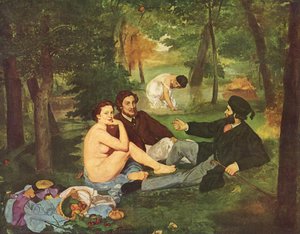
The mid-1860s provided the stage for Manet’s most significant confrontations with the public. The 1863 Salon des Refusés became a site of intense controversy, largely due to his inclusion in the exhibition of rejected works. His painting Le Déjeuner sur l'herbe shocked audiences not merely because of its nudity, but because of its lack of mythological context. The figures were undeniably modern, stripped of the divine or the ancient, leaving only the raw presence of contemporary Parisians. This refusal to idealize his subjects was met with widespread condemnation from critics who found his realism too blunt.
This pattern of provocation continued with Olympia in 1865. By reimagining Titian’s Venus of Urbino through the lens of a contemporary prostitute, Manet stripped away the protective layer of myth. The subject did not invite a gaze of admiration for a goddess; she demanded recognition of a person. This period of his career established the fundamental shift from Realism toward the beginnings of Impressionism. His influence on the movement was structural rather than purely stylistic:
- He championed the use of alla prima painting, or wet-on-wet technique, to capture immediate atmospheric effects.
- He introduced a flattened perspective that challenged the mathematical precision of academic composition.
- He utilized strong, contrasting tones to create a sense of modern, fragmented light.
The Enduring Verdict
Manet’s career was cut short by his death in 1883, yet the trajectory of art had already been irrevocably altered. He acted as the essential bridge between the heavy, grounded themes of Realism and the fleeting, light-focused explorations of the Impressionists. While he never fully adopted the label of an Impressionist and continued to seek recognition from the official Salon, his methods provided the vocabulary for the avant-garde. He proved that the artist's duty was not to provide a beautiful escape, but to document the complexities and contradictions of the era.

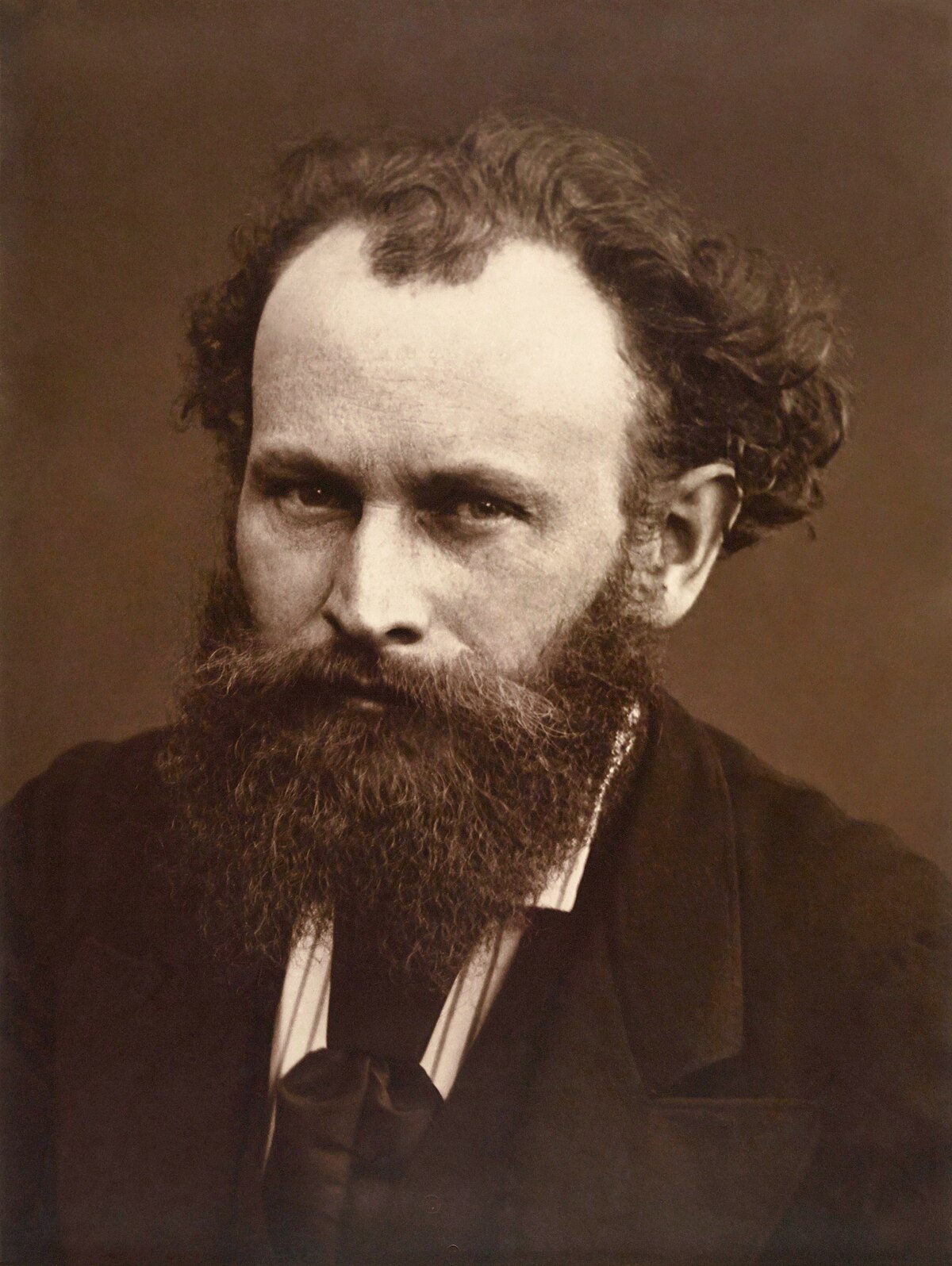
Édouard Manet
1832 - 1883 , France
Quick Facts
- Full Name: Édouard Manet
- Nationality: French
- Date Of Birth: 1832
- Date Of Death: 1883
- Place Of Birth: Paris, France
- Notable Artworks:
- Le Déjeuner sur l'herbe
- Olympia
- A Bar at the Folies-Bergère
- Artistic Movement Or Style: Realism, Impressionism
- Artists Who Influenced This Artist:
- Caravaggio
- Diego Velázquez
- Gustave Courbet
- Artists Or Movements Influenced By This Artist:
- Claude Monet
- Pierre-Auguste Renoir
- Edgar Degas
- Impressionism