


 Preview
 Send
Send Share
Share
 Details
 Guide
Guide

 Download
 Similars
 X-Ray
X-Ray Diaporama
 Stats
StatsJealousy
 Oil On Canvas
- WallArt
- Expressionism
 1895
1895- 19th Century
 48.0 x 58.0 cm
Explore Edvard Munch’s "Jealousy" – a haunting Expressionist masterpiece! Discover its symbolic depth & rich color palette. A captivating artwork for art lovers & collectors.
 Read More
Expressionist pioneer Edvard Munch created the iconic The Scream. Discover his haunting masterpieces of anxiety and emotion today.
Hand Made Oil Reproduction
Hand-painted oil on canvas in your size and frame, made to order by our artists. ( Switch to Print Switch to Digital Image)




P118B $10

P118H $10

P118W $10

P438Z $10

P508JH $12

P508YH $12

P805H $10

P805Z $10

P919BZ $10

P919G $10

P919XJ $10

P959ZH $10

P968JZ $12

W106C $8

W218G $10

W218JH $8

W218Y $10

W307PJ $10

W316G $10

W316PJ $8

W316Y $10

W398PJ $8

W4111J $10

W500HY $15

W500JH $15

W692G $12

W849H $8

W940BG $15

W953PJ $8




Standard
custom
CM
INCH
Pick from our preset sizes that match the artwork's original proportions.
Loading sizes...

width
height
Type the width and the height you need, to fit your frame or your wall. This is hand-painted, so for a size with a different shape the artist can paint a bit more around the picture, or cut a bit — you choose. We send you a digital mockup to approve before the painting starts. The picture shown on this page does not show the real result — only the mockup does.
Examples of what can be changed: Replace face with customer photo; Add pet (e.g., replace cat with dog); Include hidden message in background; Change background landscape or elements.
After order, TopImpressionists.com team will email client for instructions and provide a mockup preview
After order, TopImpressionists.com team will email client for instructions and provide a mockup preview
Worldwide Delivery () in 3/4 weeks instead of standard 5 weeks. (21 October). No compromise on quality.

Free Worldwide Express Shipping

High-Quality Linen Canvas

Full Shipping Insurance

Customs Tax Refund Guarantee

True Color Matching Guarantee

100-Day Return Policy (Defects Only)

100% Money-Back Guarantee

Bulk Discount Offer
 Glass option is only available in size under 110 CM

Jealousy
Reproduction Medium
Reproduction Size
-


Total Price
$ 294
Explore Edvard Munch's "Jealousy": A Masterpiece of Expressionism
Edvard Munch's "Jealousy" (1895) is a captivating work that embodies the essence of Expressionism. This hauntingly atmospheric painting invites viewers into a world of emotional depth and symbolic intrigue, making it a compelling addition to any art collection or sophisticated interior.
Subject and Composition
The artwork presents a dreamlike scene featuring three central figures arranged in a triangular formation. On the left, a dark-cloaked figure holds an umbrella or staff, while the center is dominated by a woman in a vibrant red dress with flowing hair. To the right, another figure with a beard and hooded cloak gazes intently at the viewer. The background includes trees with green foliage and red fruits, adding to the overall composition's richness.
Style and Technique
Munch's distinctive Expressionist style is evident in "Jealousy." The painting emphasizes emotional experience over physical reality, characterized by fluid, somewhat indistinct lines and loosely defined shapes. The use of expressive brushstrokes and a focus on color and form to convey emotion creates a sense of ambiguity and mystery. The rich texture and blending of colors suggest the use of oil paints, adding depth and vitality to the scene.
Historical Context
Created in 1895, "Jealousy" reflects Munch's preoccupation with psychological themes, influenced by his tumultuous childhood and the nihilist philosophy he encountered during his studies. This period marked the beginning of Munch's exploration of deeply-felt themes such as love, anxiety, jealousy, and betrayal, which would later become part of his renowned series "The Frieze of Life."
Symbolism and Emotional Impact
The vivid red dress of the central figure stands out against the more muted background, drawing the viewer's attention. The woman in red could symbolize passion or vitality, while the dark-cloaked figures might represent mystery or contemplation. The trees with red fruits add an element of nature and possibly fertility or temptation. The overall dreamlike quality and emotional intensity of the figures evoke a sense of unease and curiosity, inviting viewers to interpret the scene's meaning.
Why Choose This Reproduction?
"Jealousy" is a powerful and enigmatic piece that adds a touch of drama and sophistication to any space. Its rich color palette and expressive style make it an excellent choice for art lovers, collectors, and interior designers seeking to create a striking focal point. Whether displayed in a modern gallery setting or a cozy living room, this high-quality reproduction captures the essence of Munch's original work, bringing its emotional depth and symbolic richness into your home.
Experience the timeless allure of Edvard Munch's "Jealousy" and elevate your space with a piece that sparks conversation and inspires contemplation.
Questions & Answers
What color leads the composition of "Jealousy" by Edvard Munch?
bronze (#bd7a37) is the leading color of "Jealousy" by Edvard Munch.
Can I see "Jealousy" by Edvard Munch under different lights?
"Jealousy" can be examined layer by layer on the artwork's X-Ray page, a viewer inspired by a conservator's light bench with eleven optical readings of the image.
What emotion does "Jealousy" by Edvard Munch convey?
"Jealousy" by Edvard Munch conveys a melancholic emotional tone.
Artist Biography
A Life Shaped by Loss
Edvard Munch arrived in the world in 1863, born into the stark landscapes of Norway. His early years were defined by a heavy presence of grief that would later find its way onto his canvases. The deaths of his mother and his sister, Sophie, both taken by tuberculosis, left a deep mark on his young mind. These losses created a preoccupation with mortality and the fragility of life that stayed with him forever. He grew up in a household where the shadows of sickness were never far away.
His father, Christian, was a physician who struggled with intense religious devotion and mental instability. This atmosphere of dread and the vivid ghost stories told in his childhood helped shape his later visions. Munch did not merely paint what he saw; he sought to externalize his internal state. He called this approach soul painting. It was a way to translate psychological distress into visual form, using the colors and shapes of his own experience.
The Path to Expressionism
Munch began his formal studies at the Royal School of Art and Design in Kristiania, which is now known as Oslo. During this time, he moved within bohemian circles that challenged the strict rules of academic art. A significant influence was Hans Jæger, a nihilist who encouraged Munch to abandon conventional styles and instead focus on his own subjective emotions. This shift led him toward the development of Expressionism.
Travels through Europe brought new perspectives to his work. In Paris, he encountered the techniques of artists like Paul Gauguin and Vincent van Gogh, particularly their use of color. In Berlin, his connections with figures such as August Strindberg further pushed his investigations into psychological themes. He began to move away from naturalistic representation, opting instead for distorted forms and rhythmic lines that could communicate the tremors of human existence.
Themes and Lasting Impact
Much of his work belongs to a series he called The Frieze of Life, where he explored the recurring cycles of love, fear, death, and anxiety. Some of his most recognized paintings include:
- The Scream: A work from 1893 that uses swirling, fiery landscapes to represent existential dread.
- Madonna: A piece that explores themes of sexuality and mortality.
- The Sick Child: A poignant reminder of the loss of his sister.
- Puberty: An exploration of the physical and psychological changes of youth.
Munch was a highly active printmaker, using techniques like etching, lithography, and woodcut to expand his reach. He possessed over one thousand paintings at the time of his death in 1944. His ability to confront the darker aspects of the human condition helped pave the way for later movements like German Expressionism. Today, much of his legacy is preserved in the Munch Museum in Oslo, where his work continues to speak to the complexities of the human psyche.

Edvard Munch
1863 - 1944 , Sweden
Quick Facts
- Artistic Movement Or Style:
- Expressionism
- Symbolism
- Post-Impressionism
- Artists Or Movements Influenced By This Artist: ['German Expressionism']
- Artists Who Influenced This Artist:
- Paul Gauguin
- Vincent van Gogh
- Toulouse-Lautrec
- Full Name: Edvard Munch
- Nationality: Norwegian
- Notable Artworks:
- The Scream
- Madonna
- The Sick Child
- Puberty
- Place Of Birth: Adelsbruk, Sweden
- Date Of Birth: 1863
- Date Of Death: 1944
Related Articles

Edvard Munch: Anxiety, Modernity & the Dawn of Expressionism
Explore the profound world of Edvard Munch, pioneer of Expressionism. Discover the origins of 'The Scream' & his haunting depictions of anxiety, mortality, and love. Expert analysis & high-quality reproductions at TopImpressionists.
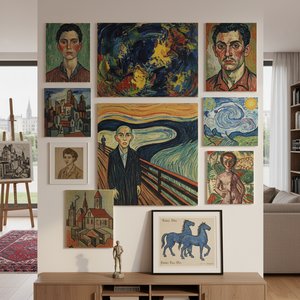
Expressionism's Soul: 10 Masterpieces for Your Home |
Journey into the soul of Expressionism! Explore 10 iconic paintings by Munch, Kirchner, Kandinsky & more. Discover their stories, bold colors & lasting impact. Find museum-quality art reproductions at .

Crimson Threads of Narrative: Exploring Symbolism & Representation in Artworks Featuring the Red Dress
Explore the rich symbolism of the red dress in art history! From ancient power displays to iconic portraits like Cézanne’s 'Madame Cezanne', discover the cultural and artistic significance behind this captivating color. Expert analysis & insights.

Oil on Board Masters: 10 Paintings That Redefined Art | TopImpressionists
Explore 10 legendary 'Oil on Board' masterpieces by Van Gogh, Monet & more! Discover art history, iconic styles like Impressionism, and find museum-quality reproductions to elevate your home decor. Explore the full collection online at TopImpressionists.com.

Edvard Munch's Masterpieces: 25 Iconic Paintings for Art Lovers | TopImpressionists
Explore 25 iconic Edvard Munch paintings, from 'The Scream' to lesser-known masterpieces. Discover the stories behind Expressionism’s most emotional works & find museum-quality art reproductions for your home at TopImpressionists.com.
Explore artworks organized by themes, styles, and characteristics.


