


 Preview
 Send
Send Share
Share
 Details
 Guide
Guide

 Download
 Similars
 X-Ray
X-Ray Diaporama
 Stats
StatsThe Lonely Ones
 Expressionism
 1935
1935 100.0 x 130.0 cm
Explore Edvard Munch’s "The Lonely Ones," a poignant Expressionist masterpiece capturing isolation & emotion. Discover its moody atmosphere & profound human connection. #Munch #Expressionism
 Read More
Expressionist pioneer Edvard Munch created the iconic The Scream. Discover his haunting masterpieces of anxiety and emotion today.
Giclée / Art Print
Museum-quality giclée or canvas print with fast production and flexible finish options. ( Buy Hand Made Painting Switch to Digital Image)




P118B $10

P118H $10

P118W $10

P438Z $10

P508JH $12

P508YH $12

P805H $10

P805Z $10

P919BZ $10

P919G $10

P919XJ $10

P959ZH $10

P968JZ $12

W106C $8

W218G $10

W218JH $8

W218Y $10

W307PJ $10

W316G $10

W316PJ $8

W316Y $10

W398PJ $8

W4111J $10

W500HY $15

W500JH $15

W692G $12

W849H $8

W940BG $15

W953PJ $8




Standard
custom
CM
INCH
Pick from our preset sizes that match the artwork's original proportions.
Loading sizes...

width
height
Type the width and the height you need, to fit your frame or your wall. A print can only be cut, never made bigger than the picture, so a size with a different shape loses a part of the image. We send you a digital mockup to approve before we print anything. The picture shown on this page does not show the real cut — only the mockup does.
Worldwide Delivery () in 2 weeks instead of standard 4/5 weeks. (26 October)

Free Worldwide Express Shipping

High-Quality Linen Canvas

Full Shipping Insurance

Customs Tax Refund Guarantee

True Color Matching Guarantee

100-Day Return Policy (Defects Only)

100% Money-Back Guarantee

Bulk Discount Offer
 Glass option is only available in size under 110 CM

The Lonely Ones
Giclée / Art Print
Reproduction Size
-


Total Price
$ 70
A Silent Dialogue: Unveiling Edvard Munch’s ‘The Lonely Ones’
Edvard Munch's 1935 painting, *The Lonely Ones*, is a deeply affecting work that encapsulates the core tenets of Expressionism. Measuring 100 x 130 cm, this oil on canvas transcends mere representation, offering instead a visceral exploration of human isolation and emotional vulnerability within the vastness of existence. The scene depicts a man and woman standing side-by-side on a balcony, their figures subtly defined against a brooding seascape – yet profoundly disconnected from one another and their surroundings.Expressionist Style & Technical Mastery
Munch’s masterful use of color and brushwork is central to the painting's emotional power. Dominant blues and purples evoke a sense of melancholy and introspection, while warmer tones are reserved for the figures themselves, highlighting their fragile presence. The loose, expressive brushstrokes aren’t concerned with precise detail; rather, they convey feeling – a swirling interiority made visible. This technique is characteristic of Expressionism, a movement that prioritized subjective experience over objective reality. Munch doesn't simply *show* us loneliness; he allows us to *feel* it through the very texture and color of the paint. The simplified forms and abstracted shapes further contribute to this emotional resonance, stripping away extraneous detail to focus on the essential human condition.Historical Context & Artistic Lineage
Created in 1935, *The Lonely Ones* reflects a period of significant social and political upheaval. Munch was part of a generation grappling with anxieties about modernity, industrialization, and the loss of traditional values. He stood alongside other pioneering Expressionists like Vincent van Gogh, Paul Cézanne, and Georges Seurat, all of whom challenged conventional artistic norms in favor of exploring inner psychological states. However, Munch’s work is particularly distinguished by its intensely personal and autobiographical nature. His own life was marked by loss, illness, and mental anguish – experiences that profoundly shaped his artistic vision.Symbolism & Emotional Resonance
The symbolism within *The Lonely Ones* is both subtle and profound. The sea, often a symbol of the unconscious or the infinite, stretches out before the figures, emphasizing their smallness and insignificance in the face of existential questions. The presence of the dog – a recurring motif in Munch’s work – can be interpreted as representing loyalty, companionship, or perhaps even a primal instinct for connection that remains unfulfilled. The balcony itself acts as a liminal space—a threshold between interiority and exteriority, further emphasizing the characters' detachment from both. The painting isn’t about a specific narrative; it’s about a universal feeling – the ache of loneliness, the longing for connection, and the contemplation of life’s inherent solitude.Impact & Legacy
*The Lonely Ones* continues to resonate with audiences today because its themes are timeless and universally relatable. In an increasingly fragmented world, the painting serves as a poignant reminder of our shared human need for belonging and understanding. Its influence can be seen in countless works of contemporary art that explore similar themes of alienation and emotional vulnerability.- For Art Lovers: This piece offers a powerful meditation on the human condition, inviting introspection and empathy.
- For Collectors: *The Lonely Ones* represents a significant example of Munch’s mature style and a cornerstone of Expressionist art.
- For Interior Designers: The painting's moody palette and evocative imagery can add depth and emotional complexity to any space, creating a focal point for contemplation.
Questions & Answers
Is "The Lonely Ones" more bright or more dark overall?
"The Lonely Ones" is bright overall, and its luminance is gentle luminance.
How do movement and era meet in "The Lonely Ones" by Edvard Munch?
"The Lonely Ones" by Edvard Munch is placed in the Expressionism movement, within the 19th-Century era of its creator.
Where can I find artworks similar to "The Lonely Ones" by Edvard Munch?
Works similar to "The Lonely Ones" are listed on the artwork's Similars page.
Artist Biography
A Life Shaped by Loss
Edvard Munch arrived in the world in 1863, born into the stark landscapes of Norway. His early years were defined by a heavy presence of grief that would later find its way onto his canvases. The deaths of his mother and his sister, Sophie, both taken by tuberculosis, left a deep mark on his young mind. These losses created a preoccupation with mortality and the fragility of life that stayed with him forever. He grew up in a household where the shadows of sickness were never far away.
His father, Christian, was a physician who struggled with intense religious devotion and mental instability. This atmosphere of dread and the vivid ghost stories told in his childhood helped shape his later visions. Munch did not merely paint what he saw; he sought to externalize his internal state. He called this approach soul painting. It was a way to translate psychological distress into visual form, using the colors and shapes of his own experience.
The Path to Expressionism
Munch began his formal studies at the Royal School of Art and Design in Kristiania, which is now known as Oslo. During this time, he moved within bohemian circles that challenged the strict rules of academic art. A significant influence was Hans Jæger, a nihilist who encouraged Munch to abandon conventional styles and instead focus on his own subjective emotions. This shift led him toward the development of Expressionism.
Travels through Europe brought new perspectives to his work. In Paris, he encountered the techniques of artists like Paul Gauguin and Vincent van Gogh, particularly their use of color. In Berlin, his connections with figures such as August Strindberg further pushed his investigations into psychological themes. He began to move away from naturalistic representation, opting instead for distorted forms and rhythmic lines that could communicate the tremors of human existence.
Themes and Lasting Impact
Much of his work belongs to a series he called The Frieze of Life, where he explored the recurring cycles of love, fear, death, and anxiety. Some of his most recognized paintings include:
- The Scream: A work from 1893 that uses swirling, fiery landscapes to represent existential dread.
- Madonna: A piece that explores themes of sexuality and mortality.
- The Sick Child: A poignant reminder of the loss of his sister.
- Puberty: An exploration of the physical and psychological changes of youth.
Munch was a highly active printmaker, using techniques like etching, lithography, and woodcut to expand his reach. He possessed over one thousand paintings at the time of his death in 1944. His ability to confront the darker aspects of the human condition helped pave the way for later movements like German Expressionism. Today, much of his legacy is preserved in the Munch Museum in Oslo, where his work continues to speak to the complexities of the human psyche.

Edvard Munch
1863 - 1944 , Sweden
Quick Facts
- Artistic Movement Or Style:
- Expressionism
- Symbolism
- Post-Impressionism
- Artists Or Movements Influenced By This Artist: ['German Expressionism']
- Artists Who Influenced This Artist:
- Paul Gauguin
- Vincent van Gogh
- Toulouse-Lautrec
- Full Name: Edvard Munch
- Nationality: Norwegian
- Notable Artworks:
- The Scream
- Madonna
- The Sick Child
- Puberty
- Place Of Birth: Adelsbruk, Sweden
- Date Of Birth: 1863
- Date Of Death: 1944
Related Articles

Edvard Munch: Anxiety, Modernity & the Dawn of Expressionism
Explore the profound world of Edvard Munch, pioneer of Expressionism. Discover the origins of 'The Scream' & his haunting depictions of anxiety, mortality, and love. Expert analysis & high-quality reproductions at TopImpressionists.

Slate Blue Masterpieces: 10 Iconic Paintings & Timeless Home Decor Ideas
Immerse yourself in the captivating world of slate blue! Explore 10 iconic paintings by Monet, Van Gogh & Renoir. Discover their stories, techniques & find museum-quality art reproductions for your home at .

Romantic Landscapes: 10 Masterpieces for Your Home | TopImpressionists
Journey through 10 Romantic landscape masterpieces by Friedrich, Turner & Cole. Explore emotional art, sublime nature scenes & iconic 19th-century paintings. Find museum-quality reproductions for your home at TopImpressionists.com – discover the full collection online!

Edvard Munch's Masterpieces: 25 Iconic Paintings for Art Lovers | TopImpressionists
Explore 25 iconic Edvard Munch paintings, from 'The Scream' to lesser-known masterpieces. Discover the stories behind Expressionism’s most emotional works & find museum-quality art reproductions for your home at TopImpressionists.com.
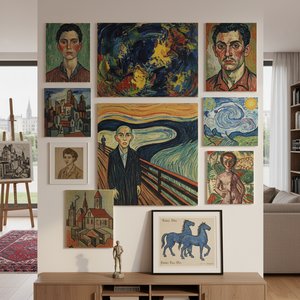
Expressionism's Soul: 10 Masterpieces for Your Home |
Journey into the soul of Expressionism! Explore 10 iconic paintings by Munch, Kirchner, Kandinsky & more. Discover their stories, bold colors & lasting impact. Find museum-quality art reproductions at .
Explore artworks organized by themes, styles, and characteristics.


