Preview
 Send
Send Share
Share
 Details
 Guide
Guide

 Download
 Similars
 X-Ray
X-Ray Diaporama
 Q&A
Q&A Stats
StatsMaking Repairs

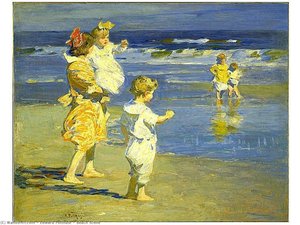
Experience summer leisure with Edward Henry Potthast's "Making Repairs." This Post-Impressionistic beach scene bursts with vibrant color & textured impasto, capturing a charming moment of American life.
 Read More
Discover Edward Henry Potthast (1857-1927), an American Impressionist celebrated for vibrant scenes of leisure, beaches & parks capturing light and joyful moments.
Giclée / Art Print
Museum-quality giclée or canvas print with fast production and flexible finish options. ( Buy Hand Made Painting Switch to Digital Image)




































Standard
custom
CM
INCH
Pick from our preset sizes that match the artwork's original proportions.
Loading sizes...

width
height
Type the width and the height you need, to fit your frame or your wall. A print can only be cut, never made bigger than the picture, so a size with a different shape loses a part of the image. We send you a digital mockup to approve before we print anything. The picture shown on this page does not show the real cut — only the mockup does.
Worldwide Delivery () in 2 weeks instead of standard 4/5 weeks. (10 November)

Free Worldwide Express Shipping

High-Quality Linen Canvas

Full Shipping Insurance

Customs Tax Refund Guarantee

True Color Matching Guarantee

100-Day Return Policy (Defects Only)

100% Money-Back Guarantee

Bulk Discount Offer
 Glass option is only available in size under 110 CM

Making Repairs
Giclée / Art Print
Reproduction Size
-


Total Price
$ 70
A Moment of Leisure: Edward Henry Potthast's "Making Repairs"
Edward Henry Potthast’s “Making Repairs” offers a delightful glimpse into American leisure culture at the turn of the 20th century. This vibrant painting, rendered in a captivating Post-Impressionistic style, transports viewers to a bustling beach scene brimming with life and light. The artwork isn't merely a depiction; it's an evocative capture of a fleeting moment – children playing, adults observing, and a sense of carefree summer joy permeating the air.
Style & Technique: Impasto and Impressionistic Flair
Potthast masterfully employs oil paint on canvas, utilizing a technique characterized by heavy impasto. This thick application of paint creates a palpable three-dimensionality, lending texture and vibrancy to every brushstroke. The style leans heavily into Post-Impressionism, moving beyond the strict realism of earlier Impressionism to emphasize color, emotion, and personal expression. Notice how Potthast uses short, broken lines and organic shapes to build up the scene, prioritizing atmosphere over precise detail. The vibrant hues – particularly the striking dark red umbrella – are strategically placed to draw the eye and create a dynamic composition. The perspective is deliberately shallow, flattening the space and intensifying the immediacy of the beach experience.
Historical Context & Influences
Potthast’s work reflects a period of significant social change in America. As urban centers grew, leisure time became increasingly accessible to more people, leading to a surge in popularity for outdoor activities like visiting beaches and parks. Potthast himself frequently depicted scenes from Central Park and the shores of New England, capturing the essence of American life during this era. His training at the Strobridge Lithography Company and his studies under Thomas Couture (who himself studied with Thomas Couture in Paris) instilled in him a strong foundation in artistic technique while also exposing him to European artistic trends, particularly those associated with the Munich School – known for its emphasis on color and tonal harmony.
Symbolism & Emotional Impact
Beyond its aesthetic appeal, "Making Repairs" carries subtle symbolic weight. The prominent umbrella serves as a visual anchor and represents protection or shelter from the sun's intensity—a comforting presence amidst the lively scene. The children at play embody innocence and joy, evoking feelings of nostalgia and carefree summer days. The overall effect is one of warmth, relaxation, and contentment – an invitation to escape into a world of leisure and simple pleasures. This painting resonates with viewers because it taps into universal desires for connection, recreation, and the beauty of everyday life.
Why Choose a Reproduction?
Bringing "Making Repairs" into your home or office allows you to experience the charm and vibrancy of Potthast's artistry firsthand. A high-quality reproduction captures the rich colors and textured surface of the original painting, providing a stunning visual focal point that will enhance any space. Whether you are an avid art collector or simply seeking inspiration for your interior design project, this piece offers a timeless appeal and a touch of American Impressionistic beauty.
Questions & Answers
How is the color composition of "Making Repairs" by Edward Henry Potthast built?
The color composition of "Making Repairs" by Edward Henry Potthast combines a statement contrast with a discordant palette harmony.
What aliases or alternate names does Edward Henry Potthast have?
Edward Henry Potthast is also known as Edward Potthast.
What colors dominate "Making Repairs" by Edward Henry Potthast?
"Making Repairs" by Edward Henry Potthast uses an earthy palette, with phthalo green (#2f211f) as the dominant color.
Related Artworks


Artist Biography
A Brushstroke of Leisure: The Life and Art of Edward Henry Potthast
Edward Henry Potthast, a name perhaps less immediately recognizable than those of Monet or Renoir, nevertheless occupies a significant and charming niche within the landscape of American Impressionism. Born in Cincinnati, Ohio, on June 10, 1857, Potthast’s journey was one of quiet determination, evolving from humble beginnings as a lithographer to becoming a celebrated painter of leisure and light. His canvases offer a window into a bygone era, capturing the joyful moments of American life at the turn of the twentieth century with a distinctive blend of European training and uniquely American sensibilities. The early years were marked by practical necessity; young Edward was compelled to abandon formal education at sixteen to contribute financially to his family, yet his artistic aspirations remained undimmed. He balanced demanding work with diligent study at the McMicken School of Design, honing skills that would later blossom into a successful career. This period instilled in him not only technical proficiency but also a deep appreciation for the value of perseverance – qualities evident throughout his life and reflected in the enduring appeal of his art.From Munich to Manhattan: The Shaping of an Impressionist Style
Potthast’s artistic education wasn't confined to American shores. He embarked on extended studies abroad, first in Antwerp and then, crucially, at the Royal Academy in Munich. This exposure to European academic traditions, particularly the influence of artists like Carl Marr, initially manifested in works characterized by subdued colors and dramatic contrasts – a far cry from the luminous palettes he would later embrace. However, it was his subsequent sojourn to France, specifically the areas around Fontainebleau, Barbizon, and Gréz, that proved transformative. Here, under the guidance of Robert W. Vonnoh, Potthast encountered the principles of Impressionism firsthand. He began to experiment with broken brushstrokes, a lighter palette, and an emphasis on capturing the fleeting effects of light and atmosphere – elements that would become hallmarks of his mature style. Returning to New York in 1895, he initially supported himself as an illustrator for prominent magazines like *Scribner’s* and *Century*, skills honed during his early lithographic work proving invaluable. This period allowed him to establish connections within the art world and gradually transition towards a full-time career as a fine artist.Capturing the American Spirit: Themes and Techniques
Potthast’s artistic vision centered on portraying scenes of everyday life, particularly those associated with leisure and recreation. He became renowned for his depictions of Central Park, bustling beaches along the New York and New England coasts, and idyllic landscapes filled with families enjoying their free time. Unlike some European Impressionists who focused on grand historical narratives or portraits of high society, Potthast celebrated the ordinary – picnics, boating excursions, children playing by the sea. His paintings radiate a sense of optimism and joy, reflecting the burgeoning prosperity and carefree spirit of the Gilded Age. Technically, his work is characterized by a masterful use of light and color. He employed loose brushwork to create a sense of movement and spontaneity, capturing the shimmering reflections on water, the dappled sunlight filtering through trees, and the vibrant energy of crowds. While clearly influenced by Impressionism, Potthast’s style remained distinctly American, focusing on subjects that resonated with audiences in his own country. He wasn't merely replicating European techniques; he was adapting them to depict a uniquely American experience.Recognition and Legacy: A Lasting Contribution
Throughout his career, Edward Henry Potthast garnered significant recognition within the art establishment. He exhibited regularly at prestigious venues such as the National Academy of Design, the Society of American Artists, and the Salmagundi Club, earning numerous awards and accolades. His election to full membership in the National Academy in 1906 solidified his standing as a leading figure in American art. Today, Potthast’s paintings are held in major museums across the United States, including the Cincinnati Museum of Art, the Brooklyn Museum, and the Virginia Museum of Fine Arts, among others. His work continues to captivate collectors and art enthusiasts alike, with reproductions widely available. Potthast's legacy lies not only in his technical skill but also in his ability to capture a specific moment in American history – an era of optimism, leisure, and burgeoning modernity. He offered a vision of American life that was both accessible and aspirational, celebrating the simple joys of everyday existence. His paintings serve as a poignant reminder of a time when life seemed a little slower, a little brighter, and a little more carefree.Further Exploration
- Explore his works at online databases like TopImpressionists for high-quality reproductions.
- Delve deeper into his life through resources such as Wikipedia and dedicated artist websites.
- Seek out exhibitions featuring American Impressionism to experience Potthast’s paintings in person.

Edward Henry Potthast
1857 - 1927 , United States of America
Quick Facts
- Full Name: Edward Henry Potthast
- Nationality: American
- Date Of Birth: 1857
- Date Of Death: 1927
- Place Of Birth: Cincinnati, United States of America
- Notable Artworks:
- A Happy Group
- Summer Day
- A July Day
- Happy Days
- Artistic Movement Or Style: Impressionism
- Artists Who Influenced This Artist: ['T.S. Noble']
Related Articles

Capturing the Light: A Journey Through the Ethereal Magic of Impressionism and Post-Impressionism
Embark on a cultural journey through the luminous world of Impressionism. Discover the profound beauty of Monet, Van Gogh, and Cézanne through expert art history insights and explore how to bring these timeless masterpieces into your home with museum-quality hand-painted reproductions.

Beyond the Light: Discovering the Soul and Emotional Depth of Post-Impressionism
Embark on a cultural journey through Post-Impressionism. Discover the profound emotional depth of masters like Van Gogh and Cézanne, exploring how they moved beyond light to capture the very soul of human experience through vibrant color and symbolic form.
Explore artworks organized by themes, styles, and characteristics.