

 Preview
 Send
Send Share
Share
 Details
 Guide
Guide

 Download
 Similars
 X-Ray
X-Ray Diaporama
 Q&A
Q&A Stats
Statsuntitled (4498)


A profound sense of mid-century solitude permeates this Edward Hopper masterpiece featuring a contemplative woman bathed in afternoon light, inviting you to explore the quiet beauty of this iconic American Realism painting.
 Read More
A master of American realism, he captured solitude in Nighthawks. Discover his iconic paintings and evocative light and shadow today.
The artwork displayed on this page is protected by copyright law, which means we cannot legally create or sell an identical reproduction. This protection is enforced under international agreements such as the Berne Convention and by national laws, including those outlined by the U.S. Copyright Law - Title 17.
This method fully complies with copyright regulations because it does not involve copying or duplicating the protected artwork. Instead, it is a creative reinterpretation - a new painting that is influenced by the original but not identical to it.
Giclée / Art Print
Museum-quality giclée or canvas print with fast production and flexible finish options. ( Buy Hand Made Painting Switch to Digital Image)




P118B $10

P118H $10

P118W $10

P438Z $10

P508JH $12

P508YH $12

P805H $10

P805Z $10

P919BZ $10

P919G $10

P919XJ $10

P959ZH $10

P968JZ $12

W106C $8

W218G $10

W218JH $8

W218Y $10

W307PJ $10

W316G $10

W316PJ $8

W316Y $10

W398PJ $8

W4111J $10

W500HY $15

W500JH $15

W692G $12

W849H $8

W940BG $15

W953PJ $8




Standard
custom
CM
INCH
Pick from our preset sizes that match the artwork's original proportions.
Loading sizes...

width
height
Type the width and the height you need, to fit your frame or your wall. A print can only be cut, never made bigger than the picture, so a size with a different shape loses a part of the image. We send you a digital mockup to approve before we print anything. The picture shown on this page does not show the real cut — only the mockup does.
Worldwide Delivery () in 2 weeks instead of standard 4/5 weeks. (9 November)

Free Worldwide Express Shipping

High-Quality Linen Canvas

Full Shipping Insurance

Customs Tax Refund Guarantee

True Color Matching Guarantee

100-Day Return Policy (Defects Only)

100% Money-Back Guarantee

Bulk Discount Offer
 Glass option is only available in size under 110 CM

untitled (4498)
Giclée / Art Print
Reproduction Size
-


Total Price
$ 70
A Portrait of Quietude: The Haunting Stillness of Edward Hopper
In the vast canon of American Realism, few works capture the profound ache of modern existence as poignantly as Edward Hopper’s "untitled (4498)". Painted between 1950 and 1952, this masterpiece is far more than a mere observation of an urban corner; it is a distilled essence of mid-century anxiety and aspiration. The canvas presents us with a moment suspended in time, where a solitary woman stands upon the steps of a stately building, her gaze turned inward. As she lingers in the diffused afternoon light, there is a palpable sense that she is contemplating something far beyond the physical confines of the architecture surrounding her. Hopper invites the viewer into this private sanctuary of thought, creating a scene that feels both intensely personal and universally recognizable.
The visual language of the piece is defined by an unsettling stillness, a hallmark of Hopper’s unparalleled ability to render human isolation. Through a masterful execution of technique, he employs a palette of muted, cool blues and greens to weave an atmosphere of gentle melancholy. The architectural backdrop—characterized by classical columns and heavy, shadowed windows—serves as a stoic counterpoint to the woman’s delicate presence. This contrast emphasizes her detachment from the bustling world that exists just out of frame. The light, rendered with meticulous care, casts long, dramatic shadows across the stone steps and softly illuminates interior windows, subtly hinting at the unseen lives unfolding behind closed curtains, forever separated from our view.
Symbolism and the Architecture of Solitude
Beyond its technical brilliance, "untitled (4498)" resonates through its deep layers of symbolism. The woman serves as a universal archetype: the contemplative figure caught in a moment of profound introspection. Her posture—a delicate balance between anticipation and perhaps a quiet disappointment—suggests a soul waiting for a connection that may never arrive. Even the small, seemingly insignificant detail of the hat she holds in her hand carries weight; it acts as a shield against vulnerability or perhaps a remnant of a social identity she has momentarily set aside to face her own solitude. This interplay between the physical objects and the psychological state of the subject is what gives the painting its enduring emotional gravity.
For the discerning collector or interior designer, this work offers more than just aesthetic beauty; it provides a focal point for deep reflection. The painting’s ability to command a room through its quietude makes it an extraordinary choice for spaces designed for contemplation and peace. Whether placed in a modern gallery setting or a sophisticated residential study, the piece brings with it a sense of historical weight and emotional depth. It is a window into the American psyche of the 1950s, capturing the tension between the burgeoning urban landscape and the timeless, solitary nature of the human spirit. To own a high-quality reproduction of this work is to invite a permanent dialogue with one of art history's most evocative explorations of light, shadow, and the beauty found within loneliness.
Questions & Answers
Where should a reproduction of "untitled (4498)" by Edward Hopper be hung?
Format (landscape) and recommended space (lounge) are the two placement facts recorded for "untitled (4498)" by Edward Hopper.
How intense are the colors in "untitled (4498)" by Edward Hopper?
"untitled (4498)" by Edward Hopper shows a monochromatic color intensity.
Is "untitled (4498)" by Edward Hopper in the public domain, and why?
"untitled (4498)" by Edward Hopper is still protected by copyright. Copyright terms are measured from the artist's death, and Edward Hopper died in 1967.


Artist Biography
The Quietude of the American Scene
Edward Hopper was born in Upper Nyack, United States of America. His early years were spent observing the world with a steady eye, a habit that began with childhood sketches meticulously dated and signed. While his parents suggested a practical path in commercial illustration, his focus remained on fine art. He studied at the New York School of Art under William Merritt Chase and Robert Henri. These years taught him the technical skill required to depict the world unvarnished and honest. He did not seek the fleeting brushstrokes of the Impressionists he encountered in Paris. Instead, he developed a way of seeing that favored the stillness of a moment over the movement of a crowd.
His work often centers on the mundane. He looked at houses, diners, offices, and hotel rooms. He stripped away unnecessary details to find the underlying emotional truth of a scene. In House by the Railroad (1925), a simple composition reveals a sense of mystery and isolation. He used light and shadow not merely to describe a room, but to set a mood. The precise rendering of a shadow on a wall or the way light hits a window became his way of communicating the psychological state of his subjects.
Light and the Urban Interior
The way light enters a space is a central character in his paintings. In Nighthawks (1942), the stark fluorescent light of a late-night diner cuts through the darkness of a deserted urban street. The figures inside are physically close but appear lost in their own thoughts, disconnected from one another. This sense of anonymity in a crowded city became a recurring theme. He captured the tension of being alone in a public place, a feeling that resonates in works like Automat and Office in a Small City. He was interested in the way artificial light interacts with the natural darkness of the night.
His wife, Josephine Nivison Hopper, was a constant presence. She was a fellow artist and often served as his model. Her presence is felt in the characterization of many of his female figures. Together, they lived a modest life, often spending summers in New England, which influenced the landscapes he painted. His depictions of the American landscape, both rural and urban, often emphasize a certain starkness or emptiness. Whether it is a roadside gas station in Gas (1940) or a quiet room in a hotel, the subject is always the intersection of a physical place and a private, internal experience.
A Legacy of Observation
Hopper’s influence extends into the visual language of film and literature. His ability to create a sense of psychological tension through composition has been noted by many who study the way stories are told through images. His paintings remain in major museums worldwide, held in collections such as the Whitney Museum of American Art and the Museum of Fine Arts, Boston. He did not aim for grand historical narratives. He found his subject matter in the quiet corners of everyday life, turning a simple window or a passing stranger into a study of the human condition. His work remains a study of the silence that exists between people.

Edward Hopper
1931 - 1967 , United States of America
Quick Facts
- Artistic Movement Or Style: American realism
- Artists Or Movements Influenced By This Artist: ['Pierre Sanford Ross']
- Artists Who Influenced This Artist:
- William Merritt Chase
- Robert Henri
- Edgar Degas
- Édouard Manet
- Full Name: Edward Hopper
- Nationality: American
- Notable Artworks:
- Nighthawks
- Gas
- House by the Railroad
- Automat
- Office in a Small City
- Summertime
- Place Of Birth: Upper Nyack, United States of America
- Date Of Birth: 1931
- Date Of Death: 1967
Related Articles
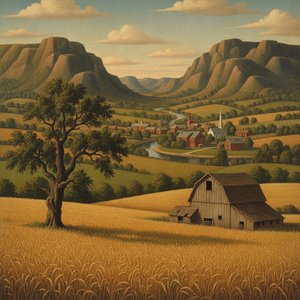
The Soul of the Heartland: A Reflective Journey Through American Regionalism and the Legacy of Grant Wood
Explore the profound beauty of American Regionalism. Discover how Grant Wood captured the resilient soul of the Midwest through masterful oil paintings that celebrate the enduring spirit of the American heartland.

The Unvarnished Truth: A Cultural Journey Through the Soul of American Realism
Explore the profound beauty of American Realism. From the Ashcan School's urban grit to intimate portraits, discover how artists captured the authentic soul of a nation through unvarnished truth and masterful observation.
Explore artworks organized by themes, styles, and characteristics.





