


 Preview
 Send
Send Share
Share
 Details
 Guide
Guide

 Download
 Similars
 X-Ray
X-Ray Diaporama
 Stats
StatsHouse with Shingles
 Oil On Canvas
- WallArt
- Expressionism
 1915
1915- Modern
 110.0 x 140.0 cm
 Leopold Museum
Discover Egon Schiele’s ‘House with Shingles,’ a haunting Expressionist masterpiece. Explore its complex symbolism & bold lines at the Leopold Museum in Vienna. #Schiele #Expressionism #ViennaArt
 Read More
Explore the emotionally charged Expressionist art of Egon Schiele (1890-1918): bold portraits, psychological themes & unique lines. Discover reproductions now!
Hand Made Oil Reproduction
Hand-painted oil on canvas in your size and frame, made to order by our artists. ( Switch to Print Switch to Digital Image)




P118B $10

P118H $10

P118W $10

P438Z $10

P508JH $12

P508YH $12

P805H $10

P805Z $10

P919BZ $10

P919G $10

P919XJ $10

P959ZH $10

P968JZ $12

W106C $8

W218G $10

W218JH $8

W218Y $10

W307PJ $10

W316G $10

W316PJ $8

W316Y $10

W398PJ $8

W4111J $10

W500HY $15

W500JH $15

W692G $12

W849H $8

W940BG $15

W953PJ $8




Standard
custom
CM
INCH
Pick from our preset sizes that match the artwork's original proportions.
Loading sizes...

width
height
Type the width and the height you need, to fit your frame or your wall. This is hand-painted, so for a size with a different shape the artist can paint a bit more around the picture, or cut a bit — you choose. We send you a digital mockup to approve before the painting starts. The picture shown on this page does not show the real result — only the mockup does.
Examples of what can be changed: Replace face with customer photo; Add pet (e.g., replace cat with dog); Include hidden message in background; Change background landscape or elements.
After order, TopImpressionists.com team will email client for instructions and provide a mockup preview
After order, TopImpressionists.com team will email client for instructions and provide a mockup preview
Worldwide Delivery () in 3/4 weeks instead of standard 5 weeks. (18 October). No compromise on quality.

Free Worldwide Express Shipping

High-Quality Linen Canvas

Full Shipping Insurance

Customs Tax Refund Guarantee

True Color Matching Guarantee

100-Day Return Policy (Defects Only)

100% Money-Back Guarantee

Bulk Discount Offer
 Glass option is only available in size under 110 CM

House with Shingles
Reproduction Medium
Reproduction Size
-


Total Price
$ 269
A Window into Austrian Expressionism: Egon Schiele’s ‘House with Shingles’
Egon Schiele's 1915 painting, *House with Shingles*, is a powerful and evocative work that encapsulates the anxieties and intellectual currents of early 20th-century Vienna. Measuring 110 x 140 cm, this oil on canvas resides in the esteemed Leopold Museum, serving as a cornerstone of their collection dedicated to Austrian modern art. The painting isn’t merely a depiction of architecture; it's a psychological landscape rendered with Schiele’s signature intensity and unsettling beauty.Subject & Composition: A Townscape of Disquiet
The artwork presents a stylized, almost claustrophobic view of a town or village dominated by a large building featuring a steeply pitched roof covered in shingles – hence the title. The structure feels both solid and precarious, its brickwork suggesting permanence while its angularity hints at instability. Scattered figures populate the scene, some near the house, others receding into the distance, creating a sense of isolation even within proximity. A striking element is the presence of books strewn across the ground and surfaces; these aren’t casually placed but appear as fragments of discarded knowledge or unrealized potential. The composition is deliberately complex, with overlapping planes and fragmented forms that draw the viewer's eye throughout the canvas, fostering a feeling of unease and contemplation.Style & Technique: Expressionist Mastery
*House with Shingles* exemplifies Schiele’s distinctive Expressionist style. He eschews traditional representational accuracy in favor of conveying inner emotional states. Bold lines, often jagged and angular, define the forms, while a limited palette of earthy tones – browns, ochres, and grays – contributes to the painting's somber mood. Schiele’s brushwork is visible and expressive, adding texture and dynamism to the surface. He deliberately distorts perspective, flattening space and emphasizing the building’s imposing presence. This technique isn’t about creating a realistic depiction but rather about communicating a subjective experience of reality – one filled with tension and psychological weight.Historical Context & Influences
Created in 1915, *House with Shingles* reflects the turbulent atmosphere of pre-World War I Vienna. The city was a hotbed of intellectual and artistic innovation, but also rife with social anxieties and political unrest. Schiele’s work emerged from this context, influenced by the Vienna Workshop and Viennese Art Nouveau, yet pushing beyond their decorative tendencies toward a more raw and emotionally charged aesthetic. He was deeply impacted by Gustav Klimt – initially a mentor – but quickly developed his own unique voice, characterized by its unflinching honesty and psychological depth. His work challenged conventional artistic norms, often courting controversy with its frank depictions of sexuality and the human condition.Symbolism & Emotional Impact: Decoding the Narrative
The symbolism within *House with Shingles* is open to interpretation, adding layers of meaning to the artwork. The house itself can be seen as representing societal structures or the confines of the self. The scattered books suggest a yearning for knowledge and intellectual freedom, but also perhaps a sense of disillusionment or fragmentation. The figures’ isolation speaks to the alienation experienced by many in modern society. Overall, the painting evokes feelings of melancholy, anxiety, and existential questioning. It's not a comforting image; it’s a challenging one that forces viewers to confront uncomfortable truths about themselves and the world around them.Schiele’s Legacy & Collecting Today
Egon Schiele’s brief but prolific career left an indelible mark on modern art. His work continues to resonate with audiences today, inspiring artists and captivating collectors. Alongside masterpieces like *Setting Sun* and *Portrait of the Painter Anton Peschka*, *House with Shingles* stands as a testament to his unique vision and artistic genius. For those seeking to bring a touch of Austrian Expressionism into their homes or collections, a high-quality reproduction of this painting offers a powerful statement piece – a window into a world of intense emotion and intellectual inquiry.Explore More by Egon Schiele
- Setting Sun
- Portrait of the Painter Anton Peschka
- Krumau Town Crescent I
Questions & Answers
What is the art-historical place of "House with Shingles" by Egon Schiele?
Historically, "House with Shingles" is an Expressionism work of the broader Modern era.
How intense are the colors in "House with Shingles" by Egon Schiele?
"House with Shingles" by Egon Schiele shows a balanced color intensity.
What mood and emotion come together in "House with Shingles"?
"House with Shingles" by Egon Schiele conveys a melancholic feeling within an overall dramatic mood.
Artist Biography
A Life Forged in Expression
Born in 1890 in the Austrian town of Tulln an der Donau, Egon Schiele’s life was a tempestuous journey marked by both extraordinary artistic vision and profound personal hardship. His early years were shadowed by illness and loss; his father succumbed to syphilis when Egon was just fourteen, a tragedy that would deeply resonate within his work, fueling an obsession with mortality and the fragility of existence. Raised initially by his mother and then under the somewhat controlling guardianship of his uncle Leopold Czihaczek, Schiele’s childhood lacked conventional stability but fostered a fiercely independent spirit. Even as a boy, he displayed an intense fascination with trains—a motif that subtly reappeared in later paintings—and a burgeoning talent for drawing, though this was initially met with disapproval from his father who saw it as a distraction from more practical pursuits. The early death of his sister Elvira also cast a long shadow over the young artist’s psyche. These formative experiences instilled within him a sensitivity and an emotional rawness that would become hallmarks of his artistic expression, a constant grappling with themes of life, death, and the human condition.
The Crucible of Vienna: Artistic Development
Schiele's formal artistic training began at the Kunstgewerbeschule (School of Arts and Crafts) in Vienna, but he quickly found himself stifled by its conservative approach. He transferred to the Akademie der bildenden Künste (Academy of Fine Arts), only to become further disillusioned with its rigid academic traditions. This dissatisfaction led him to abandon formal training altogether, choosing instead to forge his own path, a testament to his unwavering artistic conviction. The influence of Gustav Klimt was pivotal during these early years; Schiele admired Klimt’s decorative style and exploration of symbolism, even receiving mentorship from the established artist. However, Schiele soon diverged from Klimt's aesthetic, developing a distinctly individual voice characterized by its stark honesty and psychological intensity. He co-founded the Neues Wiener Kunstgruppe (New Viennese Art Group) in 1909, aligning himself with other progressive artists who challenged the prevailing artistic norms. His early works, often unsettling portraits and self-portraits, began to emerge as powerful statements of emotional turmoil, featuring distorted figures and a palpable sense of vulnerability. These paintings were not merely representations of physical form but explorations of the inner landscape—the anxieties, desires, and fears that haunted the human psyche. He sought to depict not what he *saw*, but what he *felt*.
Raw Emotion and Unflinching Truth
Egon Schiele’s art is immediately recognizable for its raw honesty and psychological depth. He fearlessly confronted themes often considered taboo – sexuality, death, anxiety, isolation – with an unflinching gaze. His distinctive style features elongated figures, contorted poses, and expressive lines that convey a sense of unease and emotional intensity. The human form, particularly the nude, became his primary subject, not as an object of idealized beauty but as a vessel for exploring the complexities of human experience. Self-portraits constitute a significant portion of his oeuvre, offering intimate glimpses into his inner world—a world often marked by loneliness and self-doubt. He didn’t shy away from depicting himself in unflattering or vulnerable poses, revealing a profound level of self-awareness and introspection. Beyond self-portraiture, Schiele created numerous portraits of others, capturing their likenesses with an unsettling realism that seemed to penetrate beneath the surface. His landscapes, while less central to his work than his figurative paintings, demonstrate his mastery of form and color, often reflecting the same emotional intensity as his portraits. The use of line is particularly striking in Schiele’s work; it's not merely a tool for defining shape but an expressive force that conveys emotion and psychological tension. Recurring motifs like the *Physalis* plant – symbolizing death and transience with its delicate, papery husk – further underscore this preoccupation with mortality.
A Legacy Cut Short: Achievements & Significance
Despite facing censorship and legal challenges – including a brief imprisonment for allegedly corrupting minors with his art – Schiele gained recognition within Vienna’s avant-garde circles. His work challenged the conventions of the time, provoking both admiration and outrage. By the time of his untimely death during the Spanish flu pandemic in 1918 at the age of twenty-eight, he had established himself as a leading figure in Austrian Expressionism. Significant works such as Self-Portrait with Physalis, Couple Embracing, and Field Landscape (Kreuzberg near Krumau) stand as testaments to his artistic genius. His influence on subsequent generations of artists is undeniable, particularly those interested in exploring psychological themes and challenging conventional artistic norms. Schiele’s bold approach to form and subject matter continues to resonate with audiences today, making him one of the most important and influential figures in early 20th-century art. His paintings are now held in major museum collections worldwide, including the Leopold Museum in Vienna and the Egon Schiele Art Centrum in Český Krumlov, ensuring his artistic legacy endures. He left behind a body of work that is not merely aesthetically compelling but profoundly human—a testament to the power of art to confront the complexities of existence with honesty, courage, and unwavering vision.
- Key Themes: Mortality, sexuality, isolation, psychological turmoil.
- Influences: Gustav Klimt, Viennese Secession, personal trauma.
- Style Characteristics: Elongated figures, contorted poses, expressive lines, raw emotion.

Egon Schiele
1890 - 1918 , Croatia
Quick Facts
- Full Name: Egon Schiele
- Nationality: Austrian
- Date Of Birth: 1890
- Date Of Death: 1918
- Place Of Birth: Vienna, Croatia
- Notable Artworks:
- Self-Portrait with Physalis
- Couple Embracing
- Field Landscape (Kreuzberg)
- Artistic Movement Or Style: Expressionism
- Artists Who Influenced This Artist: ['Gustav Klimt']
- Artists Or Movements Influenced By This Artist: ['Expressionism']
Related Articles
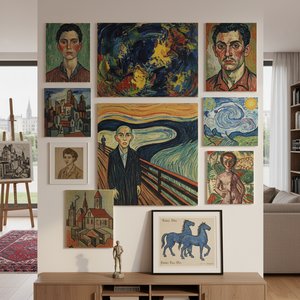
Expressionism's Soul: 10 Masterpieces for Your Home |
Journey into the soul of Expressionism! Explore 10 iconic paintings by Munch, Kirchner, Kandinsky & more. Discover their stories, bold colors & lasting impact. Find museum-quality art reproductions at .

Egon Schiele: Expressionism, Anxiety & the Modern Condition – A Comprehensive Exploration
Explore the emotionally charged world of Egon Schiele (1890-1918). Discover his Expressionist masterpieces, psychological themes, and lasting impact on modern art. A comprehensive guide for collectors & enthusiasts.
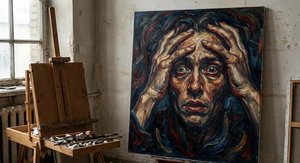
Figurative Expressionism: Emotional Intensity & Subjective Reality in 20th-Century Art
Explore the powerful world of Figurative Expressionism with TopImpressionists. Discover key artists like Kirchner & Beckmann, understand its emotional depth, and learn how to collect this influential 20th-century art movement.

Expressionist Painting: 10 Masterpieces That Defined a Movement | TopImpressionists
Explore 10 Expressionist paintings that revolutionized art! Discover Munch, Kirchner & Kandinsky's iconic works. Find museum-quality reproductions and vibrant canvas prints to elevate your home decor on TopImpressionists.com.

Egon Schiele's Masterpieces: 25 Paintings That Define Expressionism | TopImpressionists
Delve into the haunting world of Egon Schiele with our curated selection of his 25 most iconic Expressionist paintings. Explore the artist's life, technique & emotional depth. Find museum-quality Schiele reproductions and elevate your home decor on TopImpressionists.com.
Explore artworks organized by themes, styles, and characteristics.


