Preview
 Send
Send Share
Share
 Details
 Guide
Guide

 Download
 Similars
 X-Ray
X-Ray Diaporama
 Q&A
Q&A Stats
StatsRemote Girls

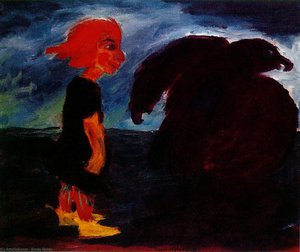
Emil Nolde's 'Remote Girls' captures intimacy and connection through bold colors & gestural brushstrokes. Explore Expressionist artistry at TopImpressionists.
 Read More
Emile Nolde was a key figure in German Expressionism known for The Mocking of Christ. Discover his vibrant and emotive masterpieces today.
Giclée / Art Print
Museum-quality giclée or canvas print with fast production and flexible finish options. ( Buy Hand Made Painting Switch to Digital Image)




































Standard
custom
CM
INCH
Pick from our preset sizes that match the artwork's original proportions.
Loading sizes...

width
height
Type the width and the height you need, to fit your frame or your wall. A print can only be cut, never made bigger than the picture, so a size with a different shape loses a part of the image. We send you a digital mockup to approve before we print anything. The picture shown on this page does not show the real cut — only the mockup does.
Worldwide Delivery () in 2 weeks instead of standard 4/5 weeks. (10 November)

Free Worldwide Express Shipping

High-Quality Linen Canvas

Full Shipping Insurance

Customs Tax Refund Guarantee

True Color Matching Guarantee

100-Day Return Policy (Defects Only)

100% Money-Back Guarantee

Bulk Discount Offer
 Glass option is only available in size under 110 CM

Remote Girls
Giclée / Art Print
Reproduction Size
-


Total Price
$ 70
A Glimpse into Connection: Emil Nolde's "Remote Girls"
This evocative artwork, titled “Remote Girls,” offers a compelling glimpse into the expressive world of German Expressionist painter Emil Nolde. The piece depicts two figures in profile against a vibrant, textured backdrop, inviting viewers to contemplate themes of connection, duality, and perhaps even longing. While seemingly simple in subject matter, "Remote Girls" is rich with artistic nuance and emotional depth, characteristic of Nolde’s unique style.Style and Technique: Expressionism's Bold Embrace
Nolde was a pivotal figure within the German Expressionist movement, particularly associated with the group *Die Brücke* (The Bridge). This artwork exemplifies the core tenets of Expressionism – prioritizing emotional impact over realistic representation. The style leans heavily towards Fauvism as well, evident in the bold and non-naturalistic use of color. Notice how Nolde employs a warm palette dominated by reds, oranges, and yellows, creating an atmosphere of intensity and passion. The technique is characterized by loose, gestural brushstrokes applied with what appears to be watercolor or gouache on paper or canvas. This spontaneous application contributes to the dynamic feel of the piece, suggesting movement and energy within the composition. The visible texture created through layering and blending adds a tactile quality, almost resembling an impasto effect despite the medium used.Historical Context: A Time of Transformation
Created during a period of significant social and political upheaval in Germany (likely between 1910-1930 based on Nolde's typical output), "Remote Girls" reflects the anxieties and emotional turbulence of the era. Expressionism arose as a reaction against the perceived materialism and complacency of bourgeois society, seeking to express inner feelings and experiences rather than simply depicting external reality. Nolde’s work often explored themes of spirituality, nature, and humanity's relationship with the world – all filtered through his intensely personal lens. His later years were marked by controversy due to his involvement with Nazi organizations, a complex chapter in his biography that continues to be studied and debated within art historical circles.Symbolism and Emotional Impact
While not overtly narrative, "Remote Girls" resonates with profound emotional power. The obscured faces of the figures suggest a sense of mystery or introspection. Their proximity yet separation hints at complex relationships – perhaps representing connection amidst isolation, or duality within a single entity. The warm color palette amplifies these feelings, evoking sensations of passion, intensity, and even a touch of melancholy. The flattened perspective further draws attention to the emotional core of the work, prioritizing feeling over spatial accuracy. Ultimately, "Remote Girls" invites viewers to project their own interpretations onto the scene, fostering a deeply personal connection with the artwork's evocative atmosphere.Questions & Answers
Can I use augmented reality to see "Remote Girls" by Emile Nolde in my room?
"Remote Girls" has an augmented reality preview: the artwork's AR Preview page shows it in your own space on a compatible device.
What colors dominate "Remote Girls" by Emile Nolde?
The color identity of "Remote Girls" by Emile Nolde: a dark palette, dominated by phthalo green (#261212).
Is "Remote Girls" by Emile Nolde a light or a dark artwork?
"Remote Girls" by Emile Nolde is recorded as shadow, with a dark luminance.
Artist Biography
The Life and Identity of Emile Nolde
Born Hans Emil Hansen on 7 August 1867, the man who would become known as Emile Nolde grew up near the village of Nolde in the Duchy of Schleswig. His early years were shaped by the rural, agrarian life of his family. He eventually moved away from this path, choosing instead to work as a wood carver and furniture decorator. This tactile, physical labor preceded his shift toward painting and printmaking. He adopted his artistic name as a way to establish a separate identity from his family's expectations.
His presence in the early 20th century was marked by a move toward the internal and the subjective. As one of the first Expressionists, he sought to move beyond the surface of things. He became a member of the Die Brücke group, a collective that looked to break away from academic traditions. His work often focused on the psychological and the primal, using color and form to reach for something deeper than a simple likeness. He was a painter who looked at the world through a lens of intense, personal feeling.
Early Life and Artistic Beginnings
Born Hans Emil Hansen, he grew up on a farm in the Duchy of Schleswig. His parents were Danish and Frisian peasants, and the rhythms of rural life shaped his early years. He eventually realized that the life of a farmer was not his own. He felt a sense of unsuitability for the heavy, repetitive work of the land. Instead of the plow, his hands sought the grain of wood.
He turned to woodcarving as a craft, working with the material in a way that required a steady, tactile connection. This period of manual labor was not a detour but a foundation. He later moved through studies in Karlsruhe and Munich, though the academic constraints of those institutions often felt restrictive. He eventually adopted the name Emil Nolde, a choice that marked a departure from his family's expectations and a step toward his own identity.
Artistic Development and Influences
The way he approached a canvas was shaped by a deep connection to the Post-Impressionist style. He looked toward the work of Paul Gauguin and found a way to move beyond simple representation. This shift allowed him to focus on the inner weight of a subject rather than its outward appearance. His interest in the natural world often manifested in his preoccupation with flowers, a habit that mirrored the influence of Vincent van Gogh. He did not merely paint a garden; he sought the pulse within the petals.
His path was never a straight line. While he found a place among the artists of the Die Brücke group, his interests often pulled him toward different circles. In 1912, he exhibited alongside the members of Wassily Kandinsky's Der Blaue Reiter group. This period of his life was marked by a constant search for a visual language that could hold the intensity of his observations. He moved between the study of color and the study of form, always looking for a way to make the paint speak of something more than the surface of the world.
Membership in the Die Brücke Group
In early 1906, a shift occurred when his work was seen at Arnold’s in Dresden. This encounter led to an invitation to join the Die Brücke group. He remained part of this collective from February 1906 until November 1907. The group itself had been active in Dresden since 1905, seeking to move away from academic traditions through a search for a new pictorial language.
His time with the group was marked by a connection to Post-Impressionist influences. While the members shared a common goal of breaking from established norms, his own path remained distinct. He brought a specific interest in the expressive power of primitive masks and carvings from his native Schleswig-Holstein to the group's shared explorations. This period in Dresden helped define his early approach to color and form before he moved toward a more independent direction.
Technique and Expressive Style
The brushwork reveals a preoccupation with the immediate sensation of color. He was among the first oil painters and watercolorists of the early twentieth century to push the boundaries of how color could be used. His palette often leans into heavy, golden yellows and deep reds. These choices give a certain weight to the surface, making the colors feel present rather than merely decorative. He did not settle for the subtle shifts of light seen in earlier traditions, opting instead for a directness that prioritizes the feeling of a subject over its literal likeness.
Watercolor became a primary medium for him from the 1930s until his death. He found that the medium allowed him to translate his ideas and concepts to the paper much faster than oil painting. This speed is visible in the way he handled the pigment, creating vivid, brooding storm-scapes and brilliant florals. The paint often moves with a sense of urgency, capturing a specific moment of light or weather before it shifts. In his landscapes, the color is not just a layer on top of a shape; it is the substance of the shape itself.
- Autumn Sea (about 1908)
- The Mocking of Christ (1909)
- Masks (about 1906-1907)
Persecution and the Nazi Regime
The relationship between Nolde and the Nazi regime was a complicated one. He was a member of the Nazi Party, yet his own paintings were condemned by the state. His work was deemed “degenerate” by the regime, leading to a direct conflict between his political affiliations and his creative output. This tension resulted in the removal of 1,052 of his works from museums by the Nazi Party.
The restrictions on his practice grew more severe as the years passed. After 1941, he was forbidden to paint. During this period of silence, he turned to other means to keep his vision alive. He created hundreds of watercolors that he kept hidden, often referred to as his "Unpainted Pictures." These works remained out of sight while the official art world turned away from his style.
Notable Works and Artistic Achievements
His brushwork often sought the essence of a subject through a direct application of color. In 1912, he produced Man, Woman and Cat, a work that reflects his interest in the forms of objects and figures. By 1917, his focus turned toward the natural world in Blumengarten (Utenwarf). These pieces show a steady commitment to his specific way of seeing, using thick layers of paint to build up the surface.
As the years passed, his relationship with his medium shifted. From the 1930s until his death, watercolor became his primary way of working, allowing him to move his ideas onto the paper more quickly than with oil. This is evident in the 1930 watercolor Stormy Sea, where the movement of the water is captured through rapid, expressive strokes. Even when he was forbidden from painting in public, he continued to work in private, creating hundreds of hidden watercolors that he called his "Unpainted Pictures."
His later years saw a continued exploration of the human form and the psychological weight of a portrait. In 1937, he created Doppelbildnis, a double portrait that emerged from a series of his watercolor studies. His work remains a record of a man who used color to reach for a specific, internal truth.
- Man, Woman and Cat (1912)
- Blumengarten (Utenwarf) (1917)
- Stormy Sea (1930)
- Doppelbildnis (1937)
Legacy and Historical Impact
The weight of his influence is felt in the way color was allowed to move beyond mere description. By pushing the boundaries of what a canvas could hold, he helped shape the direction of Expressionism. His work moved away from the academic rules of the past, favoring a directness that prioritized the internal state over the external likeness. This shift allowed for a new kind of visual language, one where the application of paint and the choice of hue were used to communicate a raw, unmediated sense of being.
His presence in the early movements of the twentieth century helped establish a precedent for the artist as an individual voice, often at odds with the prevailing political or social climate. Even when his work was removed from public view and labeled as degenerate, he continued to produce art in private. This persistence ensured that his specific approach to color and form would eventually be recognized as a significant contribution to modern art. He left behind a body of work that continues to be studied for its intensity and its refusal to conform to the expectations of his time.
- The Mocking of Christ
- Autumn Sea
- Masks
Where to See His Works Today
Tracing his presence in public collections reveals a scattered but significant trail. In Hanover, the Sprengel Museum holds his watercolor landscape, Stormy Sea. Moving north to Stockholm, Sweden, the Moderna Museet contains Blumengarten (Utenwarf). These pieces offer a way to see how his hand moved across different surfaces and subjects.
The Böttcherstraße Museums in Bremen also house his works, keeping his presence felt within the German landscape. For those looking for a more concentrated view of his life and output, the Nolde Stiftung Seebüll was created in 1956. This foundation remains a central point for his legacy.
- Stormy Sea
- Blumengarten (Utenwarf)

Emile Nolde
1867 - 1956 , Germany
Quick Facts
- Artistic Movement Or Style: German Expressionism
- Artists Or Movements Influenced By This Artist: ['Generations of artists']
- Artists Who Influenced This Artist:
- Vincent van Gogh
- Paul Gauguin
- Full Name: Hans Emil Hansen
- Nationality: German-Danish
- Notable Artworks:
- Masks
- The Mocking of Christ
- Autumn Sea
- Flower Garden (Girl and Washing)
- Dance around the Golden Calf
- Place Of Birth: Nordel, Germany
- Date Of Birth: 1867
- Date Of Death: 1956
Related Articles

The Visceral Canvas: Exploring the Raw Emotion and Historical Power of Abstract Expressionism
Embark on a profound journey through Abstract Expressionism. Discover the raw emotion, historical significance, and visceral power of the New York School's greatest masters in this expert exploration of mid-century modern art history.

Beyond the Brush: The Raw Emotion and Power of Abstract Expressionism
Explore the profound emotional depth of Abstract Expressionism. From the visceral energy of Action Painting to the serene beauty of Color Field, discover the history and mastery behind this transformative movement for the discerning art collector.

The Soul of Color: A Journey into the Emotional Resonance of Lyrical Abstraction
Embark on a cultural journey through Lyrical Abstraction. Explore how masters like Kandinsky used color and motion to translate emotion into visual poetry. Discover the profound beauty of abstract expressionism and learn to curate emotional resonance in your own art collection.
Explore artworks organized by themes, styles, and characteristics.