Atelier — Complimentary worldwide shipping — Delivery 2–6 weeks
Painting from Photo Wishlist Cart
PreviewPreview AR previewAR preview Switch to hand made Painting Switch to hand made PaintingSwitch to Image Switch to Image SendSend
DetailsDetails Add to favorites Add to favorites DownloadDownload SimilarsSimilars X-RayX-Ray DiaporamaDiaporama

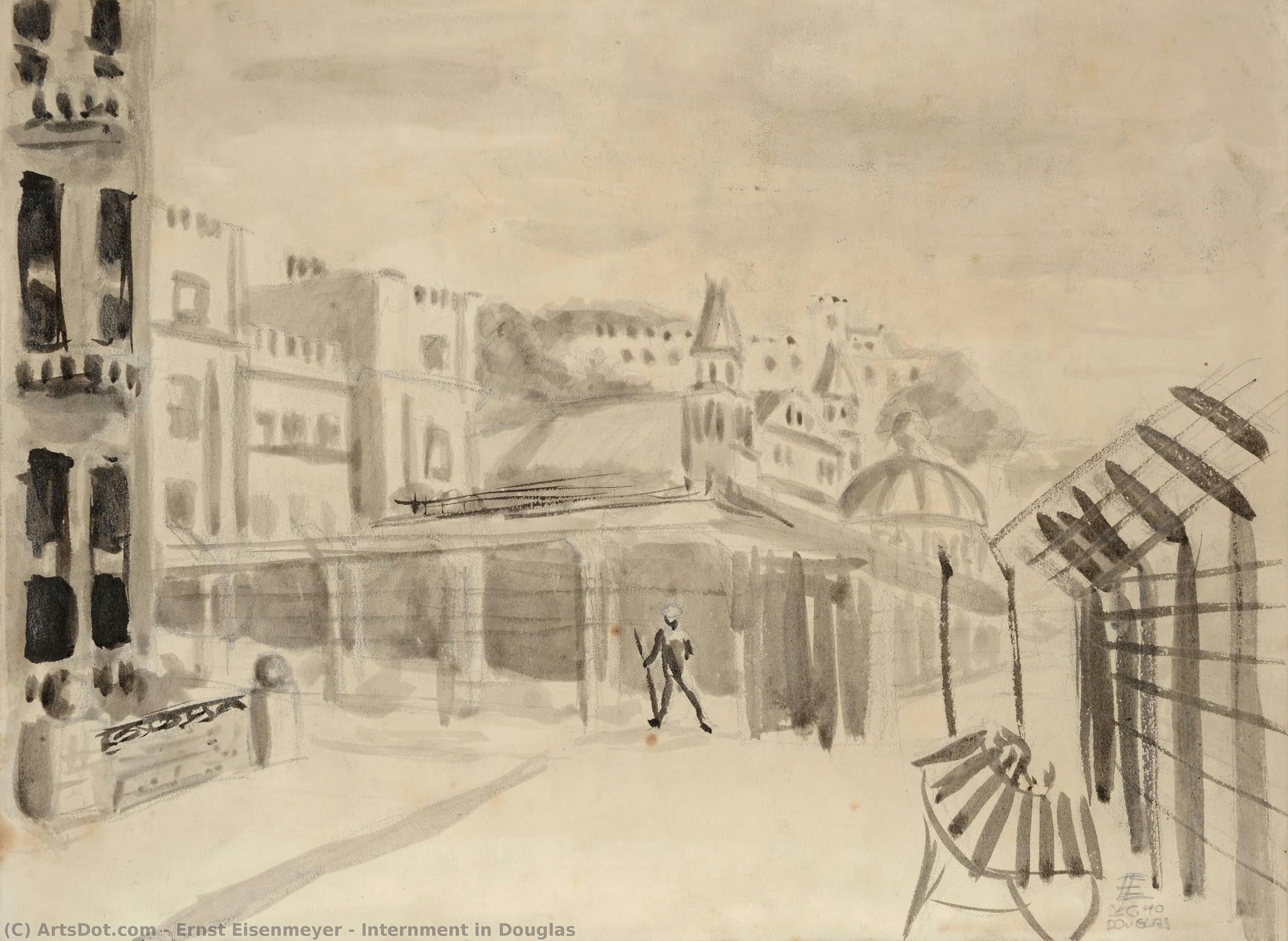
Internment in Douglas

A poignant black and white drawing capturing an urban street scene from 1940 by Ernst Eisenmeyer that evokes the profound atmosphere of wartime internment, inviting you to explore this evocative piece of history.

Explore the powerful art of Ernst Eisenmeyer (1920-2018), an Austrian painter & sculptor whose evocative works reflect WWII experiences, exile, and resilience. Discover his unique style influenced by Vienna School & beyond.

Giclée / Art Print

Museum-quality giclée or canvas print with fast production and flexible finish options. (Switch to hand made Painting Switch to hand made PaintingSwitch to Image Switch to Image)

P118B $10
P118H $10
P118W $10
P438Z $10
P508JH $12
P508YH $12
P805H $10
P805Z $10
P919BZ $10
P919G $10
P919XJ $10
P959ZH $10
P968JZ $12
W106C $8
W218G $10
W218JH $8
W218Y $10
W307PJ $10
W316G $10
W316PJ $8
W316Y $10
W398PJ $8
W4111J $10
W500HY $15
W500JH $15
W692G $12
W849H $8
W940BG $15
W953PJ $8

Standard
custom
CM
INCH

Pick from our preset sizes that match the artwork's original proportions.

width
height

You may enter your own dimensions to fit a specific frame or space. If your selected size does not match the original image's proportions, we will either crop the artwork or extend the image with a mirrored or solid-fill edge. A digital mockup will be sent for your approval before production begins.
Please note that the on-screen preview does not reflect the actual cropping or extension. Only the mockup will accurately show the final composition.
While custom sizes are available, we recommend selecting a dimension from the predefined list to preserve the original proportions.

Worldwide Delivery () in 2 weeks instead of standard 4/5 weeks. (10 August)

why_choose_icon
Free Worldwide Express Shipping
why_choose_icon
High-Quality Linen Canvas
why_choose_icon
Full Shipping Insurance
why_choose_icon
Customs Tax Refund Guarantee
why_choose_icon
True Color Matching Guarantee
why_choose_icon
60-Day Return Policy (Defects Only)
why_choose_icon
100% Money-Back Guarantee
why_choose_icon
Bulk Discount Offer

Total Price

$ 70

reproduction

Internment in Douglas

Giclée / Art Print

Reproduction Size

-

Total Price

$ 70

Quick Facts

  • Artist: Ernst Eisenmeyer
  • Subject or theme: Urban street scene and daily activity
  • Title: Internment in Douglas
  • Year: 1940
  • Medium: Drawing

Collectible Description

A Window into Displacement: The Poignant Reality of Internment in Douglas

In the delicate, monochromatic strokes of Internment in Douglas, we are invited to witness a moment frozen in the amber of history. Created in 1940 by the Austrian master Ernst Eisenmeyer, this evocative drawing serves as more than just a depiction of an urban street; it is a profound psychological landscape. The scene captures a bustling city thoroughfare, yet beneath the surface of daily activity lies a heavy layer of historical tension. As Eisenmeyer navigated the turbulent waters of displacement following the Anschluss, his work became a vessel for the anxieties of an era. Here, the rhythmic movement of figures—a man traversing the street with his belongings, the quiet presence of passersby—contrasts sharply with the underlying reality of confinement and the uncertainty of life during the Second World War.

The technique employed in this piece is a masterclass in tonal control and atmospheric depth. Utilizing the stark, honest medium of black and white, Eisenmeyer utilizes light and shadow to sculpt the architecture of the street. The fine lines that define the buildings and the hanging clock create a sense of structural permanence, which stands in poignant opposition to the transient nature of the human figures moving through the frame. Every element, from the parked bicycle to the scattered street furniture, is rendered with a precision that grounds the viewer in this specific time and place. For the collector, this drawing offers a sophisticated interplay of texture and contrast, making it an intellectually stimulating addition to any curated collection.

Beyond its technical prowess, Internment in Douglas resonates through its deep emotional symbolism. The street, while appearing functional, acts as a metaphor for the liminal space inhabited by those in internment—a world that is visible yet unreachable, a life continuing just out of grasp. The presence of personal items, like the suitcase carried by the central figure, speaks to the weight of baggage, both literal and emotional, carried by those fleeing persecution. This piece does not merely document a setting; it captures the very essence of resilience in the face of upheaval. It is an evocative work that invites contemplation on the fragility of peace and the enduring strength of the human spirit.

For interior designers and art enthusiasts alike, a high-quality reproduction of this work offers a unique opportunity to introduce a sense of historical gravity and contemplative elegance into a space. The monochromatic palette allows it to integrate seamlessly into modern, minimalist, or classical settings, providing a focal point that sparks conversation and invites deep reflection. Owning a piece of Eisenmeyer’s legacy is an act of preserving a vital chapter of twentieth-century history, bringing the profound empathy and haunting beauty of his vision into the contemporary home.


Artist Biography

The Crucible of Memory: The Life and Art of Ernst Eisenmeyer

To encounter the work of Ernst Eisenmeyer is to witness a profound dialogue between the fragility of human existence and the indomitable strength of the spirit. Born in Vienna in 1920 to a Jewish family of Austro-Hungarian descent, Eisenmeyer’s early years were shadowed by the rising tides of antisemitism that swept through Europe. The annexation of Austria in 1938 did more than just alter his nationality; it shattered his world, thrusting him into a harrowing odyssey of displacement and survival. His journey from the streets of Vienna to the grim confines of the Dachau concentration camp at the age of eighteen remains one of the most poignant chapters of his life. It was within this crucible of unimaginable suffering that Eisenmeyer first grasped the power of the pencil as a tool for bearing witness, producing seminal drawings that captured the dehumanizing reality of the camp with a raw, unflinching honesty.

The trajectory of his life, marked by both peril and resilience, eventually led him to England. After escaping the horrors of the concentration camp through the intervention of family in London, he found himself once again caught in the machinery of war as an "enemy alien" on the Isle of Man. Yet, even amidst the isolation of internment, his artistic impulse flourished. During this period, he turned his gaze toward his fellow detainees, creating a series of intimate portraits that served as a testament to human connection in the face of adversity. These works from the Isle of Man are not merely records of a time; they are soulful explorations of identity and endurance, reflecting a deep empathy for the displaced and the forgotten.

A Synthesis of Tradition and Trauma

Eisenmeyer’s artistic evolution was shaped by a unique confluence of European traditions and personal upheaval. His formal training at the Slade School of Fine Art and later at the Camberwell School of Arts introduced him to the rich textures of British Impressionism and Expressionism. He found a kindred spirit in the unsettling, emotive anatomical explorations of Egon Schiele, whose influence can be seen in Eisenmeyer’s ability to render the human form with both meticulous precision and a palpable sense of vulnerability. This stylistic duality—the marriage of technical mastery with emotional depth—became the hallmark of his oeuvre.

As his career progressed, Eisenmeyer expanded his creative vocabulary far beyond the two-dimensional plane. While he established himself as a significant painter in London during the late 1940s, the mid-1960s saw his emergence as an international sculptor. His sculptural works, crafted from materials such as bronze, stone, and wrought steel, offered a more tactile dimension to his explorations of space and memory. Whether through the delicate line of a drawing or the heavy presence of a metal sculpture, his work consistently grappled with themes of place, encounter, and the indelible marks left by history upon the individual soul.

Legacy of an Émigré Visionary

The significance of Ernst Eisenmeyer lies in his ability to transform personal trauma into universal art. His life was a testament to the complex, multi-sited trajectories of the twentieth-century émigré, and his work serves as a bridge between the shattered landscapes of pre-war Europe and the reconstructed world that followed. Throughout his long career, which saw exhibitions spanning from London and Vienna to Osaka and New York, he remained a steadfast chronicler of the human condition.

His achievements were recognized not only by the art community but also by his homeland; receiving the Medal of Honour from the City of Vienna stands as a profound tribute to an artist who, despite being driven from his birthplace by hatred, returned through his art to honor its history. Today, Eisenmeyer’s legacy endures through:

  • The Dachau Drawings: Essential historical documents that provide a visceral, firsthand account of the Holocaust through the eyes of a survivor.
  • The Isle of Man Portraits: A compassionate collection of works that celebrate the resilience of the human spirit during wartime internment.
  • Sculptural Innovation: His transition into large-scale sculpture, which contributed to the international dialogue of post-war modernism.
  • A Universal Language: An artistic style that transcends national boundaries, speaking to the shared experiences of loss, exile, and rebirth.

ernst eisenmeyer

ernst eisenmeyer

1920 - 2018 , Austria

Quick Facts

  • Artistic Movement Or Style: Vienna School
  • Artists Or Movements Influenced By This Artist: ['Pablo Picasso']
  • Artists Who Influenced This Artist: ['Egon Schiele']
  • Date Of Birth: September 18, 1920
  • Date Of Death: 2018
  • Full Name: Ernst Eisenmeyer
  • Nationality: Austrian
  • Notable Artworks:
    • Reclining Girl on Pillow
    • Internment in Douglas
  • Place Of Birth: Vienna, Austria
Explore artworks organized by themes, styles, and characteristics.
© TopImpressionists.com — All Rights Reserved  ·  100% Hand-Painted · Satisfaction Guaranteed · Free Worldwide Shipping
VISA MASTERCARD