


 Preview
 Send
Send Share
Share
 Details
 Guide
Guide

 Download
 Similars
 X-Ray
X-Ray Diaporama
 Stats
StatsJerry
 Drawing
- WallArt
- Abstract Expressionism
 1945
1945- Modern
 25.0 x 27.0 cm
 Penrith Regional Gallery - Home of the Lewers Bequest
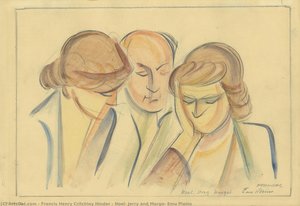
A poignant black and white sketch by Frank Hinder capturing Gerald Lewers in 1945, offering a rare intimate glimpse into Australia's post-war modernist circle that you can bring to your private collection.
 Read More
Discover Francis Hinder: Australian painter & sculptor known for WWII camouflage designs & modernist sculpture. Explore his legacy in art education & pioneering Australian modernism.
The artwork displayed on this page is protected by copyright law, which means we cannot legally create or sell an identical reproduction. This protection is enforced under international agreements such as the Berne Convention and by national laws, including those outlined by the U.S. Copyright Law - Title 17.
This method fully complies with copyright regulations because it does not involve copying or duplicating the protected artwork. Instead, it is a creative reinterpretation - a new painting that is influenced by the original but not identical to it.
Giclée / Art Print
Museum-quality giclée or canvas print with fast production and flexible finish options. ( Buy Hand Made Painting Switch to Digital Image)




P118B $10

P118H $10

P118W $10

P438Z $10

P508JH $12

P508YH $12

P805H $10

P805Z $10

P919BZ $10

P919G $10

P919XJ $10

P959ZH $10

P968JZ $12

W106C $8

W218G $10

W218JH $8

W218Y $10

W307PJ $10

W316G $10

W316PJ $8

W316Y $10

W398PJ $8

W4111J $10

W500HY $15

W500JH $15

W692G $12

W849H $8

W940BG $15

W953PJ $8




Standard
custom
CM
INCH
Pick from our preset sizes that match the artwork's original proportions.
Loading sizes...

width
height
Type the width and the height you need, to fit your frame or your wall. A print can only be cut, never made bigger than the picture, so a size with a different shape loses a part of the image. We send you a digital mockup to approve before we print anything. The picture shown on this page does not show the real cut — only the mockup does.
Worldwide Delivery () in 2 weeks instead of standard 4/5 weeks. (26 October)

Free Worldwide Express Shipping

High-Quality Linen Canvas

Full Shipping Insurance

Customs Tax Refund Guarantee

True Color Matching Guarantee

100-Day Return Policy (Defects Only)

100% Money-Back Guarantee

Bulk Discount Offer
 Glass option is only available in size under 110 CM

Jerry
Giclée / Art Print
Reproduction Size
-


Total Price
$ 70
A Quiet Moment in Post-War Intimacy
In the delicate, monochromatic strokes of Jerry, we are invited into a private sanctuary of the Australian mid-century avant-garde. Created in 1945 by the visionary Frank Hinder, this intimate drawing serves as more than just a portrait; it is a profound temporal window into a specific, vanished era of creative camaraderie. The subject, Gerald Lewers—a close friend and fellow pioneer of abstraction—is captured in a moment of stillness, seated with a stoic, contemplative gravity. Through Hinder’s masterful use of line and shadow, the viewer feels the weight of the post-World War II atmosphere, where the boundaries between domestic life and artistic pursuit were beautifully blurred.
The composition breathes with the lived-in energy of the Lewers household. While the central figure commands our attention through his steady gaze and grounded posture, the periphery of the work tells a story of communal existence. The presence of figures drifting in the background and the skeletal suggestion of a dining table evoke a sense of shared meals, quiet reading, and the rhythmic pulse of a close-knit circle of intellectuals and artists. It is a scene that celebrates the "art of living," where every corner of the home is infused with the spirit of creation.
Mastery of Line and Abstract Foundations
Technically, Jerry showcases Hinder’s ability to bridge the gap between representational sketching and the burgeoning language of modernism. Though the subject matter is figurative, there is an underlying structural tension in the way the forms are rendered. The interplay of light and dark creates a sculptural depth, hinting at Hinder's later mastery of abstract expressionism and his fascination with making philosophy visible through form. Each stroke carries a deliberate weight, capturing the texture of the fabric and the somber mood of the room with an economy of line that is both efficient and deeply emotive.
For the discerning collector or interior designer, this piece offers a sophisticated touch of historical gravity. The black and white palette provides a timeless elegance that integrates seamlessly into contemporary minimalist settings or classic, curated galleries. It acts as a focal point of quiet strength, inviting conversation about the roots of Australian modernism. To possess a reproduction of such a work is to hold a fragment of art history—a piece that does not merely decorate a wall but anchors a room with its profound sense of peace, intellect, and enduring human connection.
Questions & Answers
What aliases or alternate names does Francis Henry Critchley Hinder have?
Other names recorded for Francis Henry Critchley Hinder, creator of "Jerry", include Frank Hinder.
What are the author and date of "Jerry"?
Francis Henry Critchley Hinder made "Jerry" in 1945.
How can I get a digital file of "Jerry" by Francis Henry Critchley Hinder?
A digital image of "Jerry" by Francis Henry Critchley Hinder can be purchased on its Digital Image page: a high-resolution digital image download.
Artist Biography
early life and career
francis henry critchley hinder, an australian painter, sculptor, and art teacher, was born on june 26, 1906, in summer hill, australia. his artistic journey began with training at the julian ashton art school in sydney. this foundation would later influence his contributions to modernist sculpture and painting.contributions to modernism
hinder's most notable contributions include his camouflage designs during world war ii, which not only showcased his artistic versatility but also played a crucial role in the war effort. as a founding member of the contemporary art society in sydney, hinder was at the forefront of australia's modern art movement.notable works and exhibitions
* **camouflage designs (1940s)**: a collection of his wartime designs can be found in the australian war memorial's archives. * **sculpture and painting exhibitions**: numerous exhibitions at the art gallery of new south wales feature hinder's works, showcasing his evolving style.legacy and influence
- modernist sculpture: hinder's work in this area is considered a benchmark for australian modernism.
- art education: as an art teacher, he influenced generations of artists, shaping the country's artistic landscape.
references and further reading
* for more on hinder's contributions to modernist sculpture and painting, visit francis henry critchley hinder | TopImpressionists * explore the contemporary art society's archives for a deeper understanding of his role in australian modernism: art movements 2/2 | TopImpressionistsconclusion
francis henry critchley hinder's legacy as a pioneer of australian modernism is undeniable. his contributions to camouflage design, modernist sculpture, and painting, coupled with his influence on art education, have left an indelible mark on the country's artistic history.
Francis Henry Critchley Hinder
1906 - 1992 , Australia
Quick Facts
- Full Name: Francis Henry Critchley Hinder
- Nationality: Australian
- Date Of Birth: 1906
- Date Of Death: 1992
- Place Of Birth: Summer Hill, Australia
- Notable Artworks:
- Camouflage designs
- Hinder Spider Design
- Artistic Movement Or Style: Modernism, Abstract Art
- Artists Who Influenced This Artist:
- Dattilo Rubbo
- Jay Hambidge
- Artists Or Movements Influenced By This Artist:
- Grace Crowley
- Rah Fizelle
Related Articles

Monochrome Visions: Exploring the Aesthetic & Historical Significance of Black & White Photography
Explore the rich history & artistic power of black and white photography. From early techniques to iconic masters like Ansel Adams, discover why monochrome continues to captivate art lovers today. Expert insights for collectors.

White on Canvas: 10 Masterpieces & Timeless Elegance for Your Home Decor
Explore 10 iconic white paintings by Monet, Whistler & Rothko! Discover the stories behind these serene masterpieces and their impact on art history. Find museum-quality reproductions for your home decor at .

The Art of Monochrome: Transforming Personal Memories into Timeless Black & White Fine Art Masterpieces
Elevate your most cherished memories with TopImpressionists’s bespoke service. We transform your personal photos into breathtaking, hand-painted black & white oil masterpieces. Experience museum-quality craftsmanship and timeless elegance for your private collection. Discover the art of legacy.

Shadow & Soul: Why Black & White Photography Remains the Ultimate Power Move in Modern Art
Discover why black & white photography remains a powerful force in contemporary art. Explore the impact of light, shadow, and texture through a visual journey of monochrome mastery and learn how to elevate your space with timeless grayscale aesthetics.

Dark Masterpieces: 10 Iconic Paintings Dominated by Black Tones |
Explore 10 iconic paintings dominated by black tones, from Rembrandt’s chiaroscuro to Goya's dark expressions. Discover the stories behind these masterpieces & find museum-quality art reproductions for your home at .
Explore artworks organized by themes, styles, and characteristics.





![[untitled]](/media/artworks/images-thumb/16/33/16330d46dd964ea0fca32b2cbeec7162.jpg)
