


 Preview
 Send
Send Share
Share
 Details
 Guide
Guide

 Download
 Similars
 X-Ray
X-Ray Diaporama
 Stats
Statsuntitled
 Drawing
- WallArt
- Modernism
 1945
1945- Modern
 14.0 x 20.0 cm
 Penrith Regional Gallery - Home of the Lewers Bequest
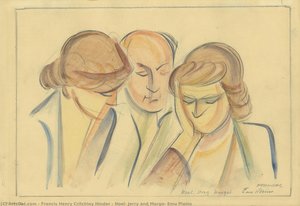
A poignant black and white drawing by Australian modernist pioneer Francis Hinder captures a contemplative man in 1945, offering a rare glimpse into mid-century abstraction for your private collection.
 Read More
Discover Francis Hinder: Australian painter & sculptor known for WWII camouflage designs & modernist sculpture. Explore his legacy in art education & pioneering Australian modernism.
The artwork displayed on this page is protected by copyright law, which means we cannot legally create or sell an identical reproduction. This protection is enforced under international agreements such as the Berne Convention and by national laws, including those outlined by the U.S. Copyright Law - Title 17.
As a respectful and legal alternative, we offer custom, hand-painted artworks inspired by the original. Our skilled and professional artists carefully study the original's style, mood, and artistic essence to create a new, unique piece that evokes the same feeling - while remaining an original creation in its own right.
This method fully complies with copyright regulations because it does not involve copying or duplicating the protected artwork. Instead, it is a creative reinterpretation - a new painting that is influenced by the original but not identical to it.
Hand Made Oil Reproduction
Hand-painted oil on canvas in your size and frame, made to order by our artists. ( Switch to Print Switch to Digital Image)




































Standard
custom
CM
INCH
Pick from our preset sizes that match the artwork's original proportions.
Loading sizes...

width
height
Type the width and the height you need, to fit your frame or your wall. This is hand-painted, so for a size with a different shape the artist can paint a bit more around the picture, or cut a bit — you choose. We send you a digital mockup to approve before the painting starts. The picture shown on this page does not show the real result — only the mockup does.
Examples of what can be changed: Replace face with customer photo; Add pet (e.g., replace cat with dog); Include hidden message in background; Change background landscape or elements.
After order, TopImpressionists.com team will email client for instructions and provide a mockup preview
After order, TopImpressionists.com team will email client for instructions and provide a mockup preview
Worldwide Delivery () in 3/4 weeks instead of standard 5 weeks. (26 October). No compromise on quality.

Free Worldwide Express Shipping

High-Quality Linen Canvas

Full Shipping Insurance

Customs Tax Refund Guarantee

True Color Matching Guarantee

100-Day Return Policy (Defects Only)

100% Money-Back Guarantee

Bulk Discount Offer
 Glass option is only available in size under 110 CM

untitled
Reproduction Medium
Reproduction Size
-


Total Price
$ 269
A Moment Frozen in Contemplation
In this evocative black and white drawing from 1945, we are invited into a private, quiet moment of profound introspection. The subject, a man seated in a chair, is captured in a posture of deep thought, his head resting heavily in his hands. There is an undeniable weight to the composition; the way his elbows press against his knees and his frame leans forward suggests a soul grappling with the complexities of a world in transition. Through the masterful use of light and shadow, the artist directs our gaze toward this central figure, creating a sense of intimacy that makes the viewer feel like a silent witness to a deeply personal psychological state. For collectors of mid-century works, this piece offers more than just a portrait; it offers a window into the human condition during the closing chapters of World and II.
The technique employed here speaks to the burgeoning modernist movement in Australia, where artists like Francis Hinder began to bridge the gap between traditional representation and the raw emotionality of abstraction. While the subject is clearly defined, the artist utilizes a delicate interplay of tonal values to create depth and atmosphere. The starkness of the monochrome palette strips away the distractions of color, forcing us to confront the texture of the man's suit, the structural lines of the chair, and the heavy, somber mood that permeates the space. This focus on form and light serves as a precursor to Hinder’s later, more celebrated forays into geometric abstraction, revealing a foundational mastery of capturing essence through line and shadow.
Historical Resonance and Artistic Legacy
To understand this work is to understand the era of its creation. In 1945, as the world emerged from the shadows of global conflict, there was a palpable sense of both exhaustion and rebirth. This drawing captures that specific tension—the stillness of a man reflecting on a period of immense upheaval. As a pioneer of Australian abstraction, Hinder’s early works like this one provide an essential historical document of the mid-century zeitgeist. The piece sits at the intersection of traditional figurative drawing and the experimental spirit that would soon define the Sydney art scene in the 1950s and 60s.
For the discerning interior designer or art enthusiast, this artwork serves as a sophisticated focal point. Its understated elegance and monochromatic depth allow it to integrate seamlessly into modern, minimalist, or classic academic settings. It does not merely decorate a wall; it commands a presence, inviting conversation about the nature of solitude and the beauty found in quiet reflection. Owning a high-quality reproduction of such a significant piece allows one to bring a fragment of Australian modernist history into a contemporary living space, providing a timeless connection to the pioneers of abstract expressionism.
Questions & Answers
How strong is the contrast in "untitled" by Francis Henry Critchley Hinder?
"untitled" by Francis Henry Critchley Hinder shows a serene contrast between its light and dark areas.
Is "untitled" by Francis Henry Critchley Hinder a portrait, landscape or square composition?
The format of "untitled" is portrait. This is useful when planning where a reproduction will be placed.
What are the medium and dimensions of "untitled" by Francis Henry Critchley Hinder?
"untitled" was made in drawing and measures 14 x 20 cm in its original form.
Artist Biography
early life and career
francis henry critchley hinder, an australian painter, sculptor, and art teacher, was born on june 26, 1906, in summer hill, australia. his artistic journey began with training at the julian ashton art school in sydney. this foundation would later influence his contributions to modernist sculpture and painting.contributions to modernism
hinder's most notable contributions include his camouflage designs during world war ii, which not only showcased his artistic versatility but also played a crucial role in the war effort. as a founding member of the contemporary art society in sydney, hinder was at the forefront of australia's modern art movement.notable works and exhibitions
* **camouflage designs (1940s)**: a collection of his wartime designs can be found in the australian war memorial's archives. * **sculpture and painting exhibitions**: numerous exhibitions at the art gallery of new south wales feature hinder's works, showcasing his evolving style.legacy and influence
- modernist sculpture: hinder's work in this area is considered a benchmark for australian modernism.
- art education: as an art teacher, he influenced generations of artists, shaping the country's artistic landscape.
references and further reading
* for more on hinder's contributions to modernist sculpture and painting, visit francis henry critchley hinder | TopImpressionists * explore the contemporary art society's archives for a deeper understanding of his role in australian modernism: art movements 2/2 | TopImpressionistsconclusion
francis henry critchley hinder's legacy as a pioneer of australian modernism is undeniable. his contributions to camouflage design, modernist sculpture, and painting, coupled with his influence on art education, have left an indelible mark on the country's artistic history.
Francis Henry Critchley Hinder
1906 - 1992 , Australia
Quick Facts
- Full Name: Francis Henry Critchley Hinder
- Nationality: Australian
- Date Of Birth: 1906
- Date Of Death: 1992
- Place Of Birth: Summer Hill, Australia
- Notable Artworks:
- Camouflage designs
- Hinder Spider Design
- Artistic Movement Or Style: Modernism, Abstract Art
- Artists Who Influenced This Artist:
- Dattilo Rubbo
- Jay Hambidge
- Artists Or Movements Influenced By This Artist:
- Grace Crowley
- Rah Fizelle
Related Articles

Monochrome Visions: Exploring the Aesthetic & Historical Significance of Black & White Photography
Explore the rich history & artistic power of black and white photography. From early techniques to iconic masters like Ansel Adams, discover why monochrome continues to captivate art lovers today. Expert insights for collectors.

Shadow & Soul: Why Black & White Photography Remains the Ultimate Power Move in Modern Art
Discover why black & white photography remains a powerful force in contemporary art. Explore the impact of light, shadow, and texture through a visual journey of monochrome mastery and learn how to elevate your space with timeless grayscale aesthetics.

The Art of Monochrome: Transforming Personal Memories into Timeless Black & White Fine Art Masterpieces
Elevate your most cherished memories with TopImpressionists’s bespoke service. We transform your personal photos into breathtaking, hand-painted black & white oil masterpieces. Experience museum-quality craftsmanship and timeless elegance for your private collection. Discover the art of legacy.

White on Canvas: 10 Masterpieces & Timeless Elegance for Your Home Decor
Explore 10 iconic white paintings by Monet, Whistler & Rothko! Discover the stories behind these serene masterpieces and their impact on art history. Find museum-quality reproductions for your home decor at .

Dark Masterpieces: 10 Iconic Paintings Dominated by Black Tones |
Explore 10 iconic paintings dominated by black tones, from Rembrandt’s chiaroscuro to Goya's dark expressions. Discover the stories behind these masterpieces & find museum-quality art reproductions for your home at .
Explore artworks organized by themes, styles, and characteristics.





![[untitled]](/media/artworks/images-thumb/16/33/16330d46dd964ea0fca32b2cbeec7162.jpg)
