Atelier — Complimentary worldwide shipping — Delivery 2–6 weeks
Painting from Photo Wishlist Cart
PreviewPreview AR previewAR preview Switch to hand made Painting Switch to hand made PaintingSwitch to Image Switch to Image SendSend
DetailsDetails Add to favorites Add to favorites DownloadDownload SimilarsSimilars X-RayX-Ray DiaporamaDiaporama

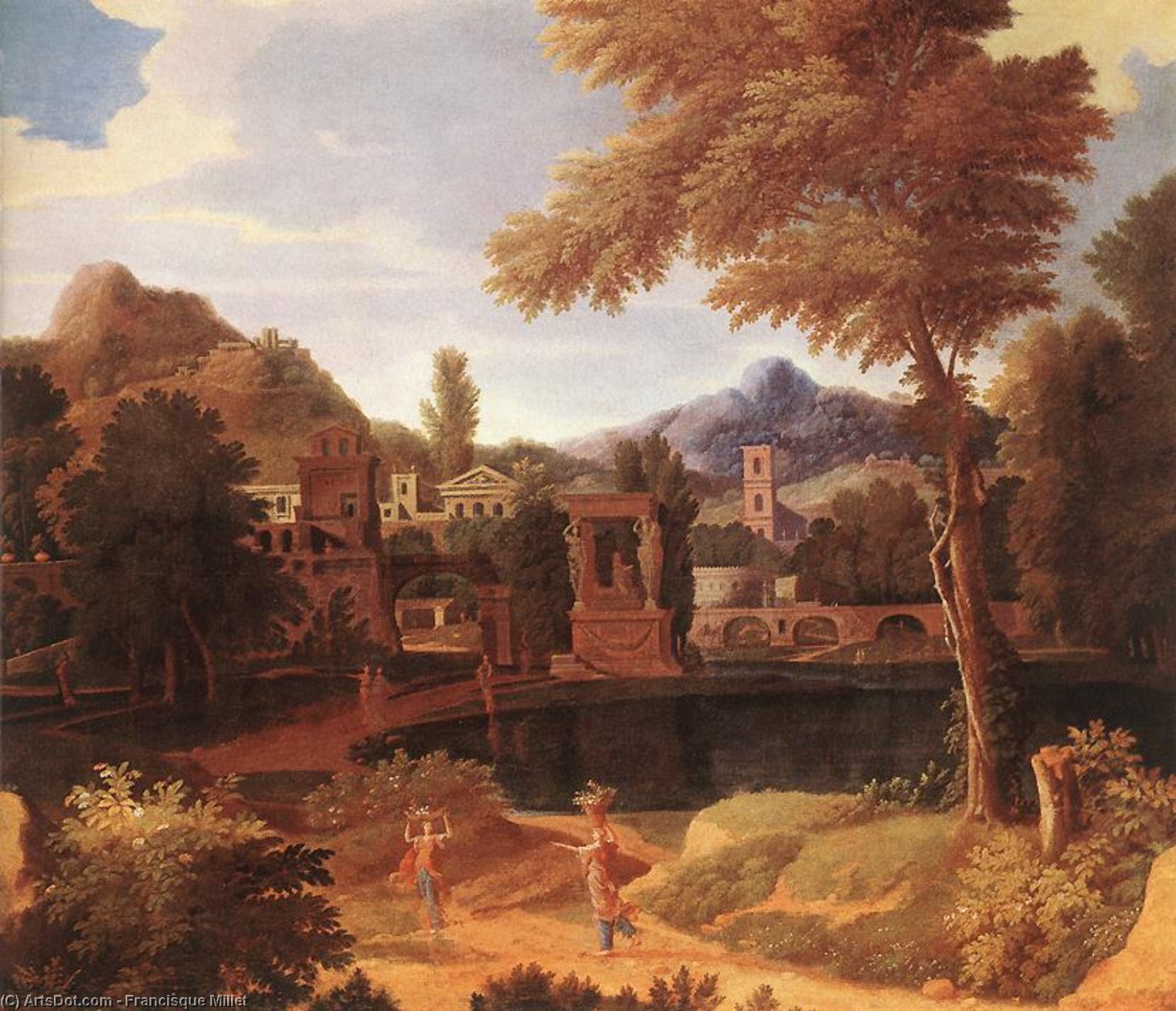
Imaginary Landscape

Explore Francisque Millet's 'Imaginary Landscape,' a serene Belgian Baroque masterpiece inspired by Poussin and Dughet, depicting figures strolling amidst mountains and classical architecture.

Francisque Millet (1642-1679): Flemish-French Baroque painter of serene Italianate landscapes & figures, influenced by Poussin. Discover his legacy & artworks!

Giclée / Art Print

Museum-quality giclée or canvas print with fast production and flexible finish options. (Switch to hand made Painting Switch to hand made PaintingSwitch to Image Switch to Image)

P118B $10
P118H $10
P118W $10
P438Z $10
P508JH $12
P508YH $12
P805H $10
P805Z $10
P919BZ $10
P919G $10
P919XJ $10
P959ZH $10
P968JZ $12
W106C $8
W218G $10
W218JH $8
W218Y $10
W307PJ $10
W316G $10
W316PJ $8
W316Y $10
W398PJ $8
W4111J $10
W500HY $15
W500JH $15
W692G $12
W849H $8
W940BG $15
W953PJ $8

Standard
custom
CM
INCH

Pick from our preset sizes that match the artwork's original proportions.

width
height

You may enter your own dimensions to fit a specific frame or space. If your selected size does not match the original image's proportions, we will either crop the artwork or extend the image with a mirrored or solid-fill edge. A digital mockup will be sent for your approval before production begins.
Please note that the on-screen preview does not reflect the actual cropping or extension. Only the mockup will accurately show the final composition.
While custom sizes are available, we recommend selecting a dimension from the predefined list to preserve the original proportions.

Worldwide Delivery () in 2 weeks instead of standard 4/5 weeks. (30 July)

why_choose_icon
Free Worldwide Express Shipping
why_choose_icon
High-Quality Linen Canvas
why_choose_icon
Full Shipping Insurance
why_choose_icon
Customs Tax Refund Guarantee
why_choose_icon
True Color Matching Guarantee
why_choose_icon
60-Day Return Policy (Defects Only)
why_choose_icon
100% Money-Back Guarantee
why_choose_icon
Bulk Discount Offer

Total Price

$ 70

reproduction

Imaginary Landscape

Giclée / Art Print

Reproduction Size

-

Total Price

$ 70

Quick Facts

  • Influences:
    • Nicolas Poussin
    • Gaspard Dughet
  • Artist: Francisque Millet
  • Movement: Italianate Landscape
  • Dimensions: 57 x 66 cm
  • Medium: Oil on Canvas
  • Subject or theme: Serene pastoral scene
  • Notable elements or techniques: Detailed depiction of classical architecture and vegetation.

Art Quiz

There is only one correct answer for each question.

Question 1:
What artistic style is Francisque Millet’s ‘Imaginary Landscape’ primarily influenced by?
Question 2:
Who served as Francisque Millet's mentor during his artistic training?
Question 3:
What prominent artist’s brother-in-law did Laurentius Frank collaborate with, influencing Millet's artistic vision?
Question 4:
The painting depicts a scene inspired by what geographical location?
Question 5:
What is notable about Francisque Millet’s ability as described by Abraham Genoels?

Collectible Description

A Serene Vision of Antiquity: Exploring Francisque Millet’s Imaginary Landscape

Francisque Millet's "Imaginary Landscape," painted in 1660, stands as a testament to the enduring influence of Italianate landscape painting during Louis XIV’s reign. More than just a depiction of scenery, it embodies a profound philosophical statement about humanity’s relationship with nature and its yearning for idealized beauty—a sentiment deeply rooted in the artistic currents sweeping across Europe at the time.

  • Subject Matter: The canvas portrays a tranquil valley bathed in soft sunlight, dominated by a majestic oak tree – a symbol of strength and longevity – beneath which two figures stroll leisurely. A distant bridge adds depth to the composition, hinting at connection and aspiration.
  • Style & Influences: Millet’s style is unmistakably indebted to Nicolas Poussin and Gaspard Dughet, masters of Italianate landscape whose works championed a harmonious blend of observation and imagination. Like his predecessors, Millet sought not merely to represent the external world but to convey an inner state of contemplation and spiritual elevation.
  • Technique: Executed in oil paint on canvas, Millet employed meticulous brushwork—characteristic of the Flemish tradition—to achieve remarkable tonal gradations and textural nuances. The artist skillfully captured the dappled light filtering through the foliage, creating a palpable sense of atmosphere that transports the viewer to a timeless realm of pastoral serenity.
The painting’s historical context is crucial to understanding its significance. Louis XIV's court embraced classical ideals as a means of asserting royal authority and glorifying France’s grandeur. Millet’s landscape reflects this preoccupation with antiquity, presenting a vision of paradise—a carefully constructed illusion designed to inspire awe and reaffirm faith in divine order. The oak tree itself is laden with symbolism; it represents resilience, nobility, and the enduring presence of God's grace – concepts central to Jansenist theology, which profoundly shaped intellectual life during Millet’s era.
  • Symbolism: Beyond its visual beauty, “Imaginary Landscape” speaks volumes about humanist concerns. The figures embody human dignity and tranquility, suggesting a harmonious coexistence with the natural world—a counterpoint to the anxieties of the turbulent political landscape of Louis XIV's France.
Ultimately, Millet’s masterpiece resonates with an emotional depth that transcends its formal conventions. It invites contemplation on themes of beauty, faith, and human aspiration. Its luminous palette and masterful brushwork evoke a feeling of profound peace—a reminder that even amidst worldly concerns, glimpses of idealized perfection can be found in the simplest of landscapes. Reproductions of “Imaginary Landscape” continue to captivate collectors and inspire interior designers seeking to infuse their spaces with an aura of timeless elegance and spiritual serenity.

Artist Biography

Francisque Millet: Life and Legacy

Early Life and Training

  • Born in Antwerp, Belgium in 1642, Francisque Millet (also known as Jean-François Milée) was the son of a French ivory worker who had settled in the region.
  • He began his artistic training with Laurentius Frank, a cousin of Abraham Genoels.
  • Remarkable Talent: Genoels noted Millet’s extraordinary ability to copy artworks quickly and accurately from memory, without needing to constantly refer to the original.
  • At the age of eighteen, he married his master's daughter, solidifying his position within the artistic community.

Artistic Development and Influences

  • Italianate Landscapes: Millet specialized in Italianate landscapes populated with figures, a style heavily influenced by Nicolas Poussin and his brother-in-law, Gaspard Dughet.
  • His work often depicted serene scenes inspired by the Roman countryside, featuring classical architecture, lush vegetation, and pastoral figures.
  • Travels and Exposure: He traveled extensively throughout France, England, and Holland, gaining exposure to different artistic styles and patrons. However, he was known for spending beyond his means.

Major Works and Style

  • Millet produced a substantial body of work including landscapes with religious themes like “Landscape with Christ and His Disciples” as well as mythological scenes such as "Mercury and Battus".
  • Characteristic Features: His paintings are characterized by their balanced compositions, atmospheric perspective, and meticulous attention to detail.
  • He skillfully integrated figures into his landscapes, creating harmonious and visually appealing scenes.
  • Examples of notable works include “Imaginary Landscape”, “Italian Scene With A Shrine” and "Classical Landscape".

Later Life and Death

  • Millet’s life was tragically cut short in 1679 at the age of 36.
  • Sudden Illness: He succumbed to a sudden high fever that led to insanity, and he died shortly thereafter.
  • He was buried in the St Nicolas-des-Champs church in Paris.

Family Legacy and Historical Significance

  • Jean-François Millet II: His son, also named Jean François Millet (1666–1723), followed in his father’s footsteps and became a member of the Academy of Painting in 1709.
  • The younger Millet consulted artists like Watteau to enhance the figures within his landscapes.
  • Influence on Later Artists: While overshadowed by later artists with the same name, Francisque Millet’s work paved the way for subsequent generations of landscape painters.
  • Mark Twain even drew inspiration from Millet's life (and the confusion surrounding his name) to write the farcical play “Is He Dead?”.
  • Millet’s contribution lies in his skillful execution of Italianate landscapes and his ability to blend classical influences with Baroque sensibilities.
Francisque Millet

Francisque Millet

1642 - 1679 , Belgium

Quick Facts

  • Birth Date: 1642-04-27
  • Birth Place: Antwerp, Belgium
  • Death Date: 1679-06-03
  • Influenced:
    • Jean-François Millet II
    • Jean Coustel
  • Influenced By: Nicolas Poussin, Gaspard Dughet
  • Movement: Baroque
  • Name: Francisque Millet
  • Nationality: Flemish-French
  • Notable Works:
    • Landscape with Christ and His Disciples
    • Imaginary Landscape
    • Mountain Landscape With Lightning
Explore artworks organized by themes, styles, and characteristics.
© TopImpressionists.com — All Rights Reserved  ·  100% Hand-Painted · Satisfaction Guaranteed · Free Worldwide Shipping
VISA MASTERCARD