Preview
 Send
Send Share
Share
 Details
 Guide
Guide

 Download
 Similars
 X-Ray
X-Ray Diaporama
 Stats
StatsA Seated Scribe
 Oil On Panel
- International Gothic
 1480
1480 14.0 x 18.0 cm
 Isabella Stewart Gardner Museum
Discover 'A Seated Scribe' by Gentile da Fabriano – a stunning 1480 Ottoman portrait in Persian miniature style. Explore intricate detail, opulent design & cultural significance.
 Read More
Gentile da Fabriano (c. 1370-1427): Master of International Gothic style. Explore opulent altarpieces like 'Adoration of the Magi' & his influence on Renaissance art.
Giclée / Art Print
Museum-quality giclée or canvas print with fast production and flexible finish options. ( Buy Hand Made Painting Switch to Digital Image)




P118B $10

P118H $10

P118W $10

P438Z $10

P508JH $12

P508YH $12

P805H $10

P805Z $10

P919BZ $10

P919G $10

P919XJ $10

P959ZH $10

P968JZ $12

W106C $8

W218G $10

W218JH $8

W218Y $10

W307PJ $10

W316G $10

W316PJ $8

W316Y $10

W398PJ $8

W4111J $10

W500HY $15

W500JH $15

W692G $12

W849H $8

W940BG $15

W953PJ $8




Standard
custom
CM
INCH
Pick from our preset sizes that match the artwork's original proportions.
Loading sizes...

width
height
Type the width and the height you need, to fit your frame or your wall. A print can only be cut, never made bigger than the picture, so a size with a different shape loses a part of the image. We send you a digital mockup to approve before we print anything. The picture shown on this page does not show the real cut — only the mockup does.
Worldwide Delivery () in 2 weeks instead of standard 4/5 weeks. (21 October)

Free Worldwide Express Shipping

High-Quality Linen Canvas

Full Shipping Insurance

Customs Tax Refund Guarantee

True Color Matching Guarantee

100-Day Return Policy (Defects Only)

100% Money-Back Guarantee

Bulk Discount Offer
 Glass option is only available in size under 110 CM

A Seated Scribe
Giclée / Art Print
Reproduction Size
-


Total Price
$ 70
A Window into Ottoman Grandeur: The Seated Scribe
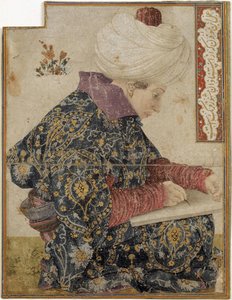
Gentile da Fabriano’s “A Seated Scribe” is more than just a portrait; it's a meticulously crafted window into the vibrant world of 15th-century Ottoman society. Painted around 1480, this exquisite work exemplifies the peak of the International Gothic style – a period renowned for its opulent detail, refined elegance, and profound sense of realism. The painting depicts a man immersed in his craft, a scribe diligently recording knowledge upon parchment, radiating an aura of authority and intellectual pursuit. The scene immediately transports us to a time of burgeoning scholarship and artistic patronage within the Ottoman Empire, a realm where literacy was highly valued and calligraphy held immense cultural significance.
At first glance, the composition is strikingly centered, drawing the viewer’s eye directly to the figure of the scribe. He occupies nearly the entire frame, his posture conveying both formality and intense concentration. The artist masterfully employs a slightly elevated viewpoint, as if observing him from a position of respect – a subtle gesture that elevates the subject beyond a mere depiction and imbues him with a sense of importance. The background, far from being merely decorative, is a carefully orchestrated tapestry of floral motifs and intricate calligraphic inscriptions, reflecting the scribe’s role as a guardian of knowledge and tradition within his community.
A Masterclass in Persian Miniature Technique
Da Fabriano's skill lies not just in capturing likeness but in executing a remarkably detailed and layered technique. The painting is executed in the style of Persian miniature painting, a method characterized by its painstaking precision, vibrant colors, and flattened perspective. Each element – from the folds of the scribe’s voluminous robe to the delicate quill pen held in his hand – is rendered with an astonishing level of detail. This meticulous approach creates a sense of depth and texture that invites close examination, revealing the artist's mastery of layering thin glazes of egg tempera upon a wooden panel.
The use of color is particularly noteworthy. The palette is rich and luminous, dominated by deep purples, vibrant reds, and shimmering golds – colors associated with royalty, wealth, and spiritual significance in Ottoman culture. The artist skillfully employs light and shadow to sculpt the figure’s form, creating a sense of three-dimensionality that belies the painting's flattened perspective. The subtle gradations of color and tone contribute significantly to the overall sense of realism and immediacy.
Symbolism and Cultural Significance
Beyond its technical brilliance, “A Seated Scribe” is laden with symbolic meaning. The scribe himself represents a cornerstone of Ottoman society – a keeper of knowledge, a recorder of history, and an embodiment of intellectual pursuits. His attire—the turban, the elaborate robe adorned with gold patterns, and the purple sash—underscores his elevated status and connection to the ruling elite. The open parchment before him symbolizes the transmission of wisdom and the continuity of tradition.
Furthermore, the inclusion of calligraphic inscriptions in the background reinforces the scribe’s role as a conduit between the material world and the realm of ideas. These inscriptions likely contain excerpts from religious texts or classical literature, highlighting the importance of learning and scholarship within Ottoman society. The very act of writing itself is imbued with spiritual significance, representing a connection to the divine and a commitment to preserving cultural heritage.
A Timeless Legacy: Reproduction and Artistic Inspiration
Created by the renowned Italian master Gentile da Fabriano in 1480, “A Seated Scribe” stands as a testament to the enduring power of art to capture both the beauty and complexity of human experience. Today, through meticulously crafted reproductions, this remarkable painting can be brought into homes and galleries around the world, offering a glimpse into the artistic traditions and cultural values of the Ottoman Empire. Its intricate detail, vibrant colors, and profound symbolism continue to inspire artists and collectors alike, ensuring that the legacy of Gentile da Fabriano endures for generations to come.
Questions & Answers
What is the color identity of "A Seated Scribe" by Gentile da Fabriano?
"A Seated Scribe" is defined by an earthy palette led by espresso (#413b36).
What aliases or alternate names does Gentile da Fabriano have?
Gentile da Fabriano appears under the alternate names Gentile Di Niccolò Di Giovanni Di Massio.
Is a download available for "A Seated Scribe"?
The image of "A Seated Scribe" by Gentile da Fabriano can be downloaded from the artwork's Download page: a high-resolution digital image download.
Artist Biography
A Luminary of the International Gothic: The Life and Art of Gentile da Fabriano
Gentile da Fabriano, a name synonymous with the opulent grace of the International Gothic style, emerged from the artistic landscape of late 14th-century Italy. Born around 1370 in the picturesque town of Fabriano, nestled in the Marche region, his early life remains shrouded in some mystery. We know his mother passed away before 1380 and that his father, Niccolò di Giovanni Massi, sought solace within a monastery by 1385 – events that likely shaped the young Gentile’s formative years. Though details of his initial training are scarce, it's evident from his earliest known work, the Madonna with Child (c. 1395-1400), now in Berlin, that he absorbed the refined aesthetics of late Gothic painting prevalent in northern Italy. This early piece already hints at the delicate precision and elegant forms that would come to define his mature style.Venetian Flourishes and a Rising Reputation
By approximately 1405, Gentile had established himself as a working artist in Venice, a vibrant hub of commerce and cultural exchange. Here, he undertook commissions such as a panel for the church of Santa Sofia – sadly now lost to time – and collaborated with prominent artists like Jacopo Bellini. His Venetian period brought him into contact with other influential figures, including Pisanello and Michelino da Besozzo, fostering an artistic dialogue that enriched his evolving style. It was during this time he began to develop a reputation for meticulous detail and a sophisticated use of color, characteristics that would become hallmarks of his work. The frescoes commissioned for the Doge’s Palace, depicting a naval battle, though also lost, demonstrate his ability to tackle large-scale narrative compositions. His travels and collaborations broadened his artistic horizons, preparing him for even greater achievements in the years to come.Masterpieces of Faith and Form: Florence and Beyond
The period between 1410 and 1412 saw Gentile creating one of his most celebrated works, the Valle Romita Polyptych, now housed in the Pinacoteca di Brera. This complex altarpiece showcases his mastery of composition, color harmony, and intricate detail. However, it was his move to Florence in 1420 that truly cemented his legacy. Commissioned by the wealthy merchant Palla Strozzi, Gentile embarked on what is arguably his most iconic creation: the Adoration of the Magi (1423), now gracing the halls of the Uffizi Gallery. This masterpiece exemplifies the International Gothic style at its zenith – a dazzling display of opulent fabrics, exquisite jewels, and graceful figures arranged in a meticulously crafted scene. The painting is not merely a religious depiction; it’s a celebration of wealth, power, and artistic skill. Gentile's use of gold leaf and vibrant colors creates an otherworldly luminescence, drawing the viewer into the sacred narrative. His Florentine period also yielded other significant works, including the Intercession Altarpiece and the Quaratesi Polyptych, each demonstrating his continued refinement of technique and artistic vision.A Lasting Influence: Legacy and Historical Significance
Gentile da Fabriano’s life was tragically cut short; he died before October 14, 1427, and was buried either in Rome or Florence – the exact location of his final resting place remains uncertain. Despite his relatively brief career, his impact on Italian art was profound. He bridged the gap between the late Gothic tradition and the emerging Renaissance aesthetic, influencing a generation of artists with his refined technique and elegant style. His emphasis on detailed observation, naturalistic representation, and sophisticated color palettes paved the way for the innovations of artists like Masaccio and Fra Angelico. Gentile’s work stands as a testament to the enduring power of beauty, craftsmanship, and artistic vision – a shining example of the International Gothic at its most glorious.- Explore further insights into the International Gothic style through resources available at TopImpressionists.com.
- Delve deeper into his life and work with information from Wikipedia.

Gentile da Fabriano
1370 - 1427 , Italy
Quick Facts
- Full Name: Gentile da Fabriano
- Nationality: Italian
- Date Of Birth: 1370
- Date Of Death: 1427
- Place Of Birth: Fabriano, Italy
- Notable Artworks:
- Adoration of the Magi
- Valle Romita Polyptych
- Artistic Movement Or Style: International Gothic
- Artists Who Influenced This Artist: ['Northern Italian late-Gothic']
- Artists Or Movements Influenced By This Artist: ['Early Renaissance painters']
Related Articles

Louvre Masterpieces: Explore the Top 25 Artworks for Your Home | TopImpressionists
Journey through the Louvre's 25 most iconic artworks! Explore masterpieces by Leonardo da Vinci, Michelangelo & Delacroix. Discover art history, techniques & find museum-quality reproductions for your home at TopImpressionists.com.

Leonardo da Vinci: A Renaissance Master’s Synthesis of Art, Science & Human Observation – Reinterpreted for the Collector
Explore Leonardo da Vinci’s timeless masterpieces with TopImpressionists. Discover insights into his art, science, and legacy – trusted expertise for discerning collectors seeking authentic reproductions & investment opportunities.

Renaissance Humanism's Greatest Art: 10 Masterpieces for Your Home
Explore 10 Renaissance Humanism masterpieces by Leonardo da Vinci, Michelangelo & Raphael. Discover the stories behind these iconic paintings & sculptures and bring timeless art into your home with museum-quality reproductions from TopImpressionists.com. Explore the full collection online!

Leonardo da Vinci's Masterpieces: Explore 25 Iconic Artworks for Your Home | TopImpressionists
Journey through Leonardo da Vinci's genius with our curated selection of 25 iconic artworks. Explore the stories behind Mona Lisa, The Last Supper & more Renaissance masterpieces. Find museum-quality art reproductions for your home at TopImpressionists.com.

Antonello da Messina: Innovation, Devotion & the Sicilian Renaissance Master's Enduring Legacy
Explore the groundbreaking art of Antonello da Messina, a pivotal figure of the Renaissance. Discover his innovative oil painting techniques, captivating portraits, and lasting influence on Italian masters. Learn more at TopImpressionists.
Explore artworks organized by themes, styles, and characteristics.