


 Preview
 Send
Send Share
Share
 Details
 Guide
Guide

 Download
 Similars
 X-Ray
X-Ray Diaporama
 Stats
StatsGreen Tree Form
 Oil On Canvas
- WallArt
- Surreal Expressionism
 1940
1940- Modern
 61.0 x 55.0 cm
 British Council Collection
This artwork exemplifies Sutherland's signature style, merging English landscape painting traditions with European avant-garde influences like Surrealism. Notable exhibitions include Tate Britain and the National Gallery, showcasing his enduring contribution to British Modern art.
 Read More
Graham Vivian Sutherland (1903-1980) was a leading British Modern artist renowned for his surreal landscapes, religious themes & iconic Coventry Cathedral tapestry. Explore his prints, portraits, and war art reflecting nature's strangeness & post-war
The artwork displayed on this page is protected by copyright law, which means we cannot legally create or sell an identical reproduction. This protection is enforced under international agreements such as the Berne Convention and by national laws, including those outlined by the U.S. Copyright Law - Title 17.
As a respectful and legal alternative, we offer custom, hand-painted artworks inspired by the original. Our skilled and professional artists carefully study the original's style, mood, and artistic essence to create a new, unique piece that evokes the same feeling - while remaining an original creation in its own right.
This method fully complies with copyright regulations because it does not involve copying or duplicating the protected artwork. Instead, it is a creative reinterpretation - a new painting that is influenced by the original but not identical to it.
Hand Made Oil Reproduction
Hand-painted oil on canvas in your size and frame, made to order by our artists. ( Switch to Print Switch to Digital Image)




P118B $10

P118H $10

P118W $10

P438Z $10

P508JH $12

P508YH $12

P805H $10

P805Z $10

P919BZ $10

P919G $10

P919XJ $10

P959ZH $10

P968JZ $12

W106C $8

W218G $10

W218JH $8

W218Y $10

W307PJ $10

W316G $10

W316PJ $8

W316Y $10

W398PJ $8

W4111J $10

W500HY $15

W500JH $15

W692G $12

W849H $8

W940BG $15

W953PJ $8




Standard
custom
CM
INCH
Pick from our preset sizes that match the artwork's original proportions.
Loading sizes...

width
height
Type the width and the height you need, to fit your frame or your wall. This is hand-painted, so for a size with a different shape the artist can paint a bit more around the picture, or cut a bit — you choose. We send you a digital mockup to approve before the painting starts. The picture shown on this page does not show the real result — only the mockup does.
Examples of what can be changed: Replace face with customer photo; Add pet (e.g., replace cat with dog); Include hidden message in background; Change background landscape or elements.
After order, TopImpressionists.com team will email client for instructions and provide a mockup preview
After order, TopImpressionists.com team will email client for instructions and provide a mockup preview
Worldwide Delivery () in 3/4 weeks instead of standard 5 weeks. (24 October). No compromise on quality.

Free Worldwide Express Shipping

High-Quality Linen Canvas

Full Shipping Insurance

Customs Tax Refund Guarantee

True Color Matching Guarantee

100-Day Return Policy (Defects Only)

100% Money-Back Guarantee

Bulk Discount Offer
 Glass option is only available in size under 110 CM

Green Tree Form
Reproduction Medium
Reproduction Size
-


Total Price
$ 269
A Visionary Encounter with Nature's Hidden Soul
In the quiet tension of 1940, amidst the gathering shadows of World War II, Graham Vivian Sutherland birthed a masterpiece that would redefine the boundaries of the British landscape. “Green Tree Form” is not merely a depiction of flora; it is a profound psychological encounter with the natural world. At first glance, the viewer is met with a vibrant, lush vitality—a large, commanding green tree with a striking yellow trunk that seems to bend under an unseen weight. Yet, as one lingers before the canvas, the initial impression of pastoral beauty gives way to something far more complex and enigmatic. The composition possesses a rhythmic, almost breathing quality, where the sinuous branches and dense foliage create a sense of movement that is both captivating and subtly unsettling.
Sutherland, a titan of British Modernism, possessed a singular ability to infuse the familiar contours of the earth with a sense of spiritual unease. In this work, he masterfully employs the principles of Surrealism and Expressionism to transcend literal representation. The way the trunk arches suggests a living, sentient entity, perhaps reacting to the very atmospheric anxieties of the era. This is not the tranquil landscape of the English tradition; it is a dreamscape where the organic forms are slightly distorted, inviting the observer to look beyond the surface and contemplate the deeper, often turbulent, emotional truths hidden within the woods.
The Alchemy of Texture and Light
Technically, “Green Tree Form” serves as a testament to Sutherland’s meticulous command over medium and texture. The painting is a study in the interplay between light and shadow, where the verdant greens are layered to create a sense of immense depth and density. The artist utilizes a palette that balances the brightness of the yellow trunk against more muted, earthy tones, ensuring that the central focal point commands the viewer's attention while allowing the surrounding elements—such as the two delicate birds positioned within the canopy—to provide moments of unexpected grace. These avian figures act as small anchors of life within the larger, more imposing structure of the tree, adding a layer of narrative intrigue and movement to the scene.
For the discerning collector or interior designer, this piece offers an unparalleled opportunity to introduce a sense of sophisticated drama into a space. The dynamic composition and the bold use of color make it a versatile centerpiece, capable of anchoring a room with its commanding presence. Whether placed in a contemporary gallery setting or a classic study, the painting’s ability to evoke both tranquility and mystery ensures it remains a conversation piece for generations. To possess a reproduction of this work is to bring a fragment of 20th-century modernism into one's home—a piece that does not merely decorate a wall but breathes life and intellectual depth into the very atmosphere of a room.
Questions & Answers
Is "Green Tree Form" one of Graham Vivian Sutherland's most popular works?
"Green Tree Form" is classified as recognized.
What feeling is "Green Tree Form" associated with?
The emotional tone recorded for "Green Tree Form" by Graham Vivian Sutherland is mysterious. It summarizes the feeling the work expresses.
What is the dominant color of "Green Tree Form" by Graham Vivian Sutherland?
phthalo green (#1c161c) is the leading color of "Green Tree Form" by Graham Vivian Sutherland.
Artist Biography
The Visionary Landscapes of Graham Vivian Sutherland
Graham Vivian Sutherland, a titan of British Modernism, possessed the rare ability to transform the familiar contours of the natural world into something profoundly unsettling and deeply spiritual. Born in Streatham, London, in 1903, Sutherland’s journey was one of constant metamorphosis. While his early years were shaped by a classical education at Epsom College, his true calling emerged far from the legal circles of his family. His initial foray into the technical world of an apprenticeship at the Midland Railway Locomotive Works provided a foundation of precision that would later manifest in his intricate printmaking and textured oil paintings. As he transitioned to Goldsmiths' School of Art, Sutherland began to move away from traditional representation, finding himself drawn to the evocative power of engraving and etching.
The artist’s early aesthetic was deeply rooted in the romanticism of Samuel Palmer, yet he refused to remain anchored to the past. Instead, Sutherland acted as a bridge between the English pastoral tradition and the radical energy of European avant-garde movements. By absorbing the dreamlike logic of Surrealism and the raw emotionality of Expressionism, he developed a visual language that could capture both the physical landscape and the psychological state. His early prints, characterized by a sense of mystery and organic form, laid the groundwork for a career defined by an obsession with the "strangeness" of nature—a theme that would become his most enduring legacy.
Nature’s Shadow and the War Years
The 1940s marked a pivotal era in Sutherland's development, as his focus shifted from the delicate medium of printmaking to the visceral, impasto textures of oil painting. It was during this period that the rugged, windswept landscapes of Pembrokeshire became his primary muse. In works such as Thorn Tree, one can witness the artist’s mastery in blending botanical reality with surrealist distortion. He did not merely paint trees; he painted the tension, the struggle, and the skeletal architecture of life itself. This period saw him move toward a more abstract, yet deeply symbolic, way of seeing, where thorns, roots, and twisted branches served as metaphors for human vulnerability and resilience.
The Second World War brought a different, more somber dimension to his work. Serving as an official war artist, Sutherland turned his gaze toward the industrial and often haunting scenes of the British home front. His paintings from this era, such as Flying Bomb Depot The Caverns, are masterclasses in atmosphere. Through heavy textures and a palette that evokes both decay and dread, he captured the eerie desolation of wartime interiors. These works were not merely documentation; they were psychological portraits of an era marked by anxiety and the looming presence of destruction, reflecting the fractured reality of a world at war.
A Legacy of Symbolism and Grandeur
In the post-war years, Sutherland’s work ascended to new heights of spiritual and public significance. He began to integrate religious symbolism with his organic motifs, creating a powerful synthesis of the sacred and the natural. This culminated in one of his most monumental achievements: the design of the massive central tapestry for the new Coventry Cathedral, titled Christ in Glory in the Tetramorph. This work, which utilized his ability to manipulate form and color on a grand scale, stands as a testament to his role in the cultural reconstruction of post-war Britain.
Throughout his prolific career, Sutherland’s versatility allowed him to leave an indelible mark across multiple disciplines:
- Portraiture: His ability to capture the psychological depth of public figures, such as his dignified and melancholic Somerset Maugham.
- Printmaking: A lifelong dedication to the precision of etching and engraving that informed his sense of line and structure.
- Decorative Arts: His contributions to tapestry design and glass art, bringing modern abstraction into the realm of functional beauty.
Ultimately, Graham Sutherland remains a cornerstone of 20th-century art because he dared to look beneath the surface of the landscape. He found the surreal within the real and the divine within the organic. His legacy is not just found in museums, but in the way we perceive the hidden, often jagged, beauty of the world around us—a world where every thorn holds a story and every shadow contains a mystery.

Graham Vivian Sutherland
1903 - 1980 , United Kingdom
Quick Facts
- Full Name: Graham Vivian Sutherland
- Nationality: British
- Date Of Birth: 1903
- Date Of Death: 1980
- Place Of Birth: Streatham, United Kingdom
- Notable Artworks:
- Flying Bomb Depot
- Entrance to a Lane
- Artistic Movement Or Style: Surrealism
- Artists Who Influenced This Artist:
- Samuel Palmer
- F.L. Griggs
- Artists Or Movements Influenced By This Artist: ['Paul Nash']
Related Articles

Capturing the Soul of Nature: A Journey Through the Sublime Majesty of American Romanticism
Explore the breathtaking beauty of American Romanticism. Discover how Hudson River School masters captured the sublime spirit of the wilderness through luminous oil landscapes and emotional depth. A journey into the soul of nature for the true art enthusiast.
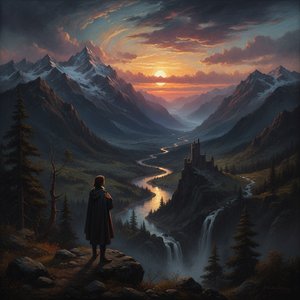
Capturing the Soul: The Emotional Majesty and Sublime Power of Romantic Landscape Painting
Explore the profound emotional depth of Romantic landscape painting. Discover how masters like Turner and Friedrich captured the sublime power of nature through intuition and imagination in this expert art history retrospective.

Capturing the Soul: The Emotional Magic and Sublime Grandeur of Romantic Landscape Painting
Explore the profound emotional depth of Romantic landscape painting. Discover how masters like Friedrich and Turner captured the sublime through light, shadow, and nature's power in this expert art history retrospective for discerning collectors.
Explore artworks organized by themes, styles, and characteristics.


