

 Preview
 Send
Send Share
Share
 Details
 Guide
Guide

 Download
 Similars
 X-Ray
X-Ray Diaporama
 Stats
StatsMedicine (composition draft)


 Read More
Hand Made Oil Reproduction
Hand-painted oil on canvas in your size and frame, made to order by our artists. ( Switch to Print Switch to Digital Image)




P118B $10

P118H $10

P118W $10

P438Z $10

P508JH $12

P508YH $12

P805H $10

P805Z $10

P919BZ $10

P919G $10

P919XJ $10

P959ZH $10

P968JZ $12

W106C $8

W218G $10

W218JH $8

W218Y $10

W307PJ $10

W316G $10

W316PJ $8

W316Y $10

W398PJ $8

W4111J $10

W500HY $15

W500JH $15

W692G $12

W849H $8

W940BG $15

W953PJ $8




Standard
custom
CM
INCH
Pick from our preset sizes that match the artwork's original proportions.
Loading sizes...

width
height
Type the width and the height you need, to fit your frame or your wall. This is hand-painted, so for a size with a different shape the artist can paint a bit more around the picture, or cut a bit — you choose. We send you a digital mockup to approve before the painting starts. The picture shown on this page does not show the real result — only the mockup does.
Examples of what can be changed: Replace face with customer photo; Add pet (e.g., replace cat with dog); Include hidden message in background; Change background landscape or elements.
After order, TopImpressionists.com team will email client for instructions and provide a mockup preview
After order, TopImpressionists.com team will email client for instructions and provide a mockup preview
Worldwide Delivery () in 3/4 weeks instead of standard 5 weeks. (21 October). No compromise on quality.

Free Worldwide Express Shipping

High-Quality Linen Canvas

Full Shipping Insurance

Customs Tax Refund Guarantee

True Color Matching Guarantee

100-Day Return Policy (Defects Only)

100% Money-Back Guarantee

Bulk Discount Offer
 Glass option is only available in size under 110 CM

Medicine (composition draft)
Reproduction Medium
Reproduction Size
-


Total Price
$ 269
Medicine (composition draft)
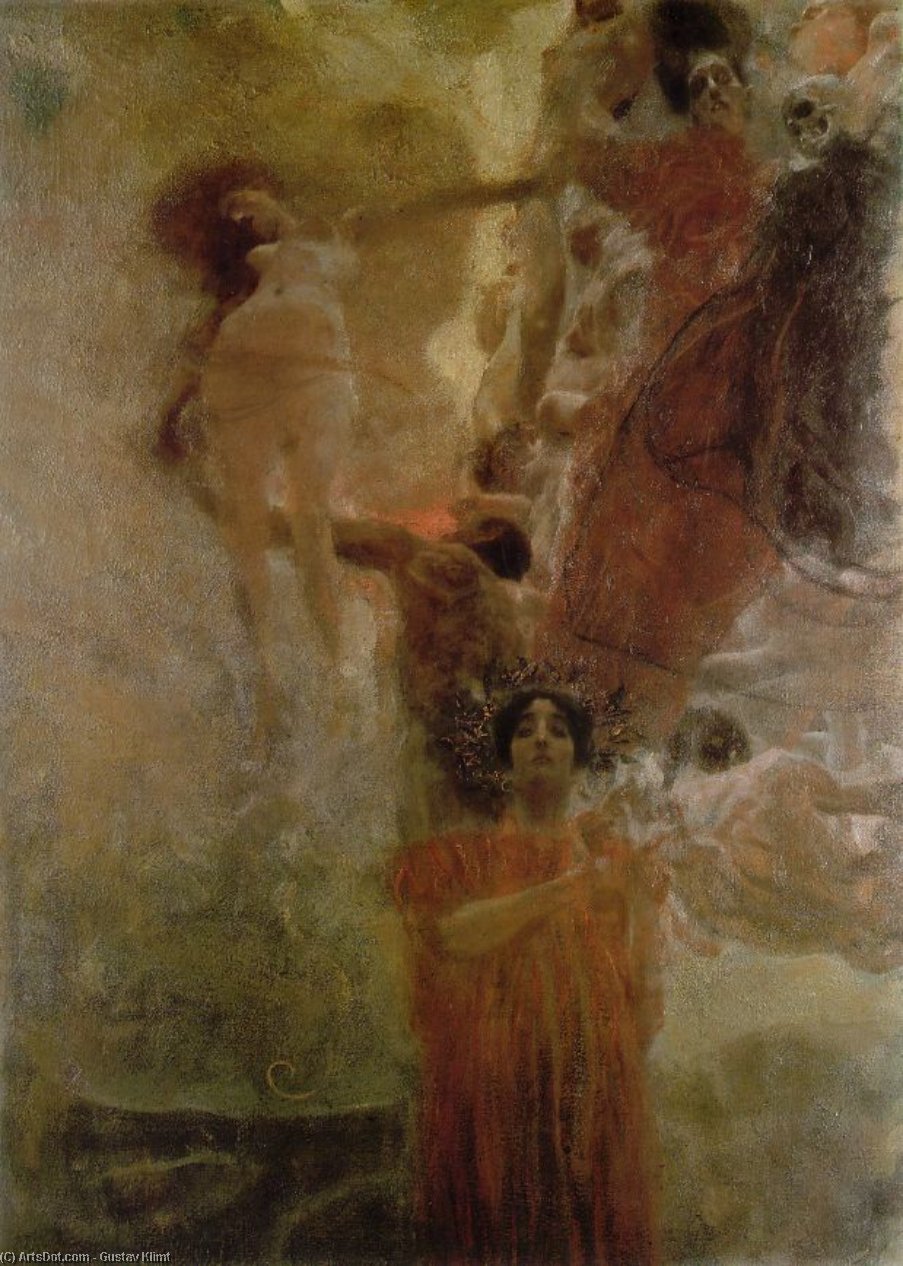
Gustav Klimt was a renowned Austrian symbolist painter who profoundly impacted the art world with his unique style and approach to Art Nouveau. One of his notable works, Medicine, is a remarkable example of this style, showcasing the artist’s skillful use of color, pattern, and composition.The Painting 'Medicine'
Medicine is an oil painting on canvas that portrays a female figure, symbolizing medicine, surrounded by allegorical figures representing various aspects of health and illness. The painting’s intricate details and visually captivating composition invite viewers to explore its depths. Gustav Klimt’s approach to Art Nouveau is characterized by his flattening of the female form onto the same even plane as the decorative background, turning it into another design shape.Collecting Oil Paintings: Hand-Painted Reproductions
For those interested in collecting oil paintings, Medicine by Gustav Klimt is an excellent choice. As a reputable online art gallery, TopImpressionists.com offers high-quality hand-painted reproductions of this masterpiece. Our skilled artists meticulously recreate each detail to ensure the reproduction captures the essence and beauty of the original painting. You can find more information about our hand-painted reproductions on our website, including this page.Why Choose Hand-Painted Reproductions?
Hand-painted reproductions offer several benefits, including:- Unique and original artwork
- High-quality materials and craftsmanship
- Affordable prices compared to original paintings
-A-Comprehensive-Guide/Gustav-Klimt-Medicine-composition-draft-.JPG) The painting is a beautiful artwork by the artist Gustave Klimt. The piece is titled Medicine (composition draft). It features a woman in red clothing as the main subject of the painting. She appears to be looking downward and has her hands folded together. In addition to the main figure, there are several other people present in the scene. Some of them are located near the top left corner of the image, while others can be seen scattered throughout the background. The overall composition of the painting is quite intricate and captivating.
This page provides detailed information about the artwork's dimensions, materials, and artistic techniques—essential considerations for discerning collectors seeking authenticity and appreciating Klimt’s masterful craftsmanship.
### Additional Research:
Gustav Klimt was a visionary artist who pushed the boundaries of artistic expression during his time. His distinctive style—characterized by opulent gold leaf embellishments and intricate geometric patterns—established him as one of the foremost figures in Art Nouveau. Medicine exemplifies this aesthetic perfectly, reflecting Klimt’s fascination with mythology and symbolism while simultaneously exploring themes of femininity and healing. The painting's deliberate flatness disrupts traditional perspective, prioritizing decorative elements over realistic representation, aligning seamlessly with the broader artistic movement's rejection of academic conventions.
Gustav Klimt (14 July 1862 – 6 February 1918) was an Austrian Symbolist painter and a founding member of the Vienna Secession movement. His work helped define the Art Nouveau style in Europe. Klimt is known for his paintings, murals, sketches, and other objets d'art. Klimt's primary subject was the female body, and his works are marked by a frank eroticism. Amongst his figurative works,The Kiss (Klimt) is an oil painting with added gold leaf, silver and platinum by the Austrian Symbolist painter Gustav Klimt. It was painted at some point in 1907 and 1908, during the height of what scholars call his “Golden Period”. It was exhibited in 1908 under the title Liebespaar (the lovers) as stated in the catalogue of the exhibition. The painting depicts a couple embracing each other, their
The painting is a beautiful artwork by the artist Gustave Klimt. The piece is titled Medicine (composition draft). It features a woman in red clothing as the main subject of the painting. She appears to be looking downward and has her hands folded together. In addition to the main figure, there are several other people present in the scene. Some of them are located near the top left corner of the image, while others can be seen scattered throughout the background. The overall composition of the painting is quite intricate and captivating.
This page provides detailed information about the artwork's dimensions, materials, and artistic techniques—essential considerations for discerning collectors seeking authenticity and appreciating Klimt’s masterful craftsmanship.
### Additional Research:
Gustav Klimt was a visionary artist who pushed the boundaries of artistic expression during his time. His distinctive style—characterized by opulent gold leaf embellishments and intricate geometric patterns—established him as one of the foremost figures in Art Nouveau. Medicine exemplifies this aesthetic perfectly, reflecting Klimt’s fascination with mythology and symbolism while simultaneously exploring themes of femininity and healing. The painting's deliberate flatness disrupts traditional perspective, prioritizing decorative elements over realistic representation, aligning seamlessly with the broader artistic movement's rejection of academic conventions.
Gustav Klimt (14 July 1862 – 6 February 1918) was an Austrian Symbolist painter and a founding member of the Vienna Secession movement. His work helped define the Art Nouveau style in Europe. Klimt is known for his paintings, murals, sketches, and other objets d'art. Klimt's primary subject was the female body, and his works are marked by a frank eroticism. Amongst his figurative works,The Kiss (Klimt) is an oil painting with added gold leaf, silver and platinum by the Austrian Symbolist painter Gustav Klimt. It was painted at some point in 1907 and 1908, during the height of what scholars call his “Golden Period”. It was exhibited in 1908 under the title Liebespaar (the lovers) as stated in the catalogue of the exhibition. The painting depicts a couple embracing each other, their
Questions & Answers
What is the dominant color of "Medicine (composition draft)" by Gustav Klimt?
espresso (#5a3f20) is the leading color of "Medicine (composition draft)" by Gustav Klimt.
What technique and style characterize "Medicine (composition draft)" by Gustav Klimt?
"Medicine (composition draft)" is made in oil on canvas, in the Art Nouveau style.
Can I use augmented reality to see "Medicine (composition draft)" by Gustav Klimt in my room?
"Medicine (composition draft)" has an augmented reality preview: the artwork's AR Preview page shows it in your own space on a compatible device.
Artist Biography
A Life Forged in Gold and Shadow
Born on July 14, 1862, in Baumgarten, near Vienna, Gustav Klimt entered a world where the boundaries of art and craft were intimately linked. His father, Ernst Klimt, worked as a gold engraver, a profession that left an indelible mark on his son’s visual language. The young Gustav learned to appreciate the weight of precious metals and the precision of fine detail long before he ever held a brush. This early exposure to the luster of gold leaf would later define his most famous period. Despite the financial hardships that forced his family through frequent moves within Vienna, his talent was undeniable. By 1876, he had entered the Vienna Kunstgewerbeschule, focusing on architectural painting under Ferdinand Laufberger.
His early professional years were marked by a steady, academic success. Alongside his brother Ernst and Franz von Matsch, Klimt formed a partnership that secured essential commissions for decorative murals and ceilings. These works required a disciplined hand and an eye for large-scale ornamentation. He found himself working on significant projects, such as the staircases of the Burgtheater in Vienna, earning the Gold Cross of Merit from Emperor Franz Joseph I. During this time, he looked toward the historical styles of Hans Makart, yet a restless energy was already beginning to stir beneath his formal training.
The Rebellion of the Secession
By the late 1890s, the constraints of the Viennese academic establishment had become stifling. Klimt sought a space where innovation could exist outside the rigid dictates of tradition. In 1897, he became the first president of the Vienna Secession, a movement designed to embrace new currents like Art Nouveau, Symbolism, and Japonism. This was an era of profound change, and Klimt stood at its center. He rejected the heavy, historical academicism in favor of organic lines and symbolic depth. His work began to explore the complexities of human intimacy, sexuality, and mortality with a frankness that often unsettled the conservative public.
This period of defiance brought both significant friction and profound creative growth. A notable instance occurred around 1900, when his commissions for the University of Vienna ceiling paintings—specifically Philosophy—were criticized as being too provocative. The backlash was severe enough that Klimt eventually withdrew from further public commissions, choosing instead to focus on private patronage. This shift allowed him to refine a more personal, decorative style. He drew heavily from the flattened perspectives and patterned aesthetics of Japanese art, integrating these elements into compositions that blurred the distinction between fine painting and ornamental design.
The Golden Era and Final Transitions
Around 1900, Klimt entered his most recognizable phase, often called his golden period. Inspired by the mosaics of Ravenna and medieval manuscripts, he began using gold leaf to create surfaces that seemed to radiate their own light. Works such as The Kiss (1907-1908) demonstrate this mastery, featuring figures enveloped in a shimmering, patterned aura. His portraits from this time, including the Portrait of Adele Bloch-Bauer I, captured more than mere physical likeness; they conveyed a psychological weight through the use of intricate, mosaic-like textures.
As his life drew toward its end, Klimt’s style underwent another subtle transformation. The heavy ornamentation of the golden phase began to give way to a more restrained and angular aesthetic. In works completed in 1918, such as The Jurisprudence, there is a move toward expressive simplification and sharper lines, perhaps reflecting the influence of the burgeoning Expressionist movement. His final years were marked by this continued evolution, even as he faced the physical toll of the Spanish Flu pandemic. He passed away on February 6, 1918, leaving behind a body of work that fundamentally altered the trajectory of Austrian modernism.

Gustav Klimt
1862 - 1918 , Austria
Quick Facts
- Artistic Movement Or Style:
- Symbolism
- Art Nouveau
- Vienna Secession
- Artists Or Movements Influenced By This Artist:
- Egon Schiele
- Art Nouveau
- Artists Who Influenced This Artist: ['Hans Makart']
- Full Name: Gustav Klimt
- Nationality: Austrian
- Notable Artworks:
- The Kiss
- Portrait of Adele Bloch-Bauer I
- Place Of Birth: Baumgarten, Austria
- Date Of Birth: 1862
- Date Of Death: 1918
Related Articles

The Elegance of Art Nouveau: Embracing Nature's Fluid Beauty and the Belle Époque Spirit
Discover the enchanting world of Art Nouveau. Explore the organic beauty, flowing lines, and Belle Époque elegance that defined an era of unparalleled craftsmanship and natural inspiration.

The Vienna Secession: A Golden Revolution of Symbolism and Modernity
Explore the profound impact of the Vienna Secession. Discover how Gustav Klimt and the masters of Viennese Modernism revolutionized art through symbolism, gold-leafed beauty, and the concept of Gesamtkunstwerk. A deep dive into a golden era of aesthetic rebellion.
Explore artworks organized by themes, styles, and characteristics.


