

 Preview
 Send
Send Share
Share
 Details
 Guide
Guide

 Download
 Similars
 X-Ray
X-Ray Diaporama
 Stats
StatsVirgin, The


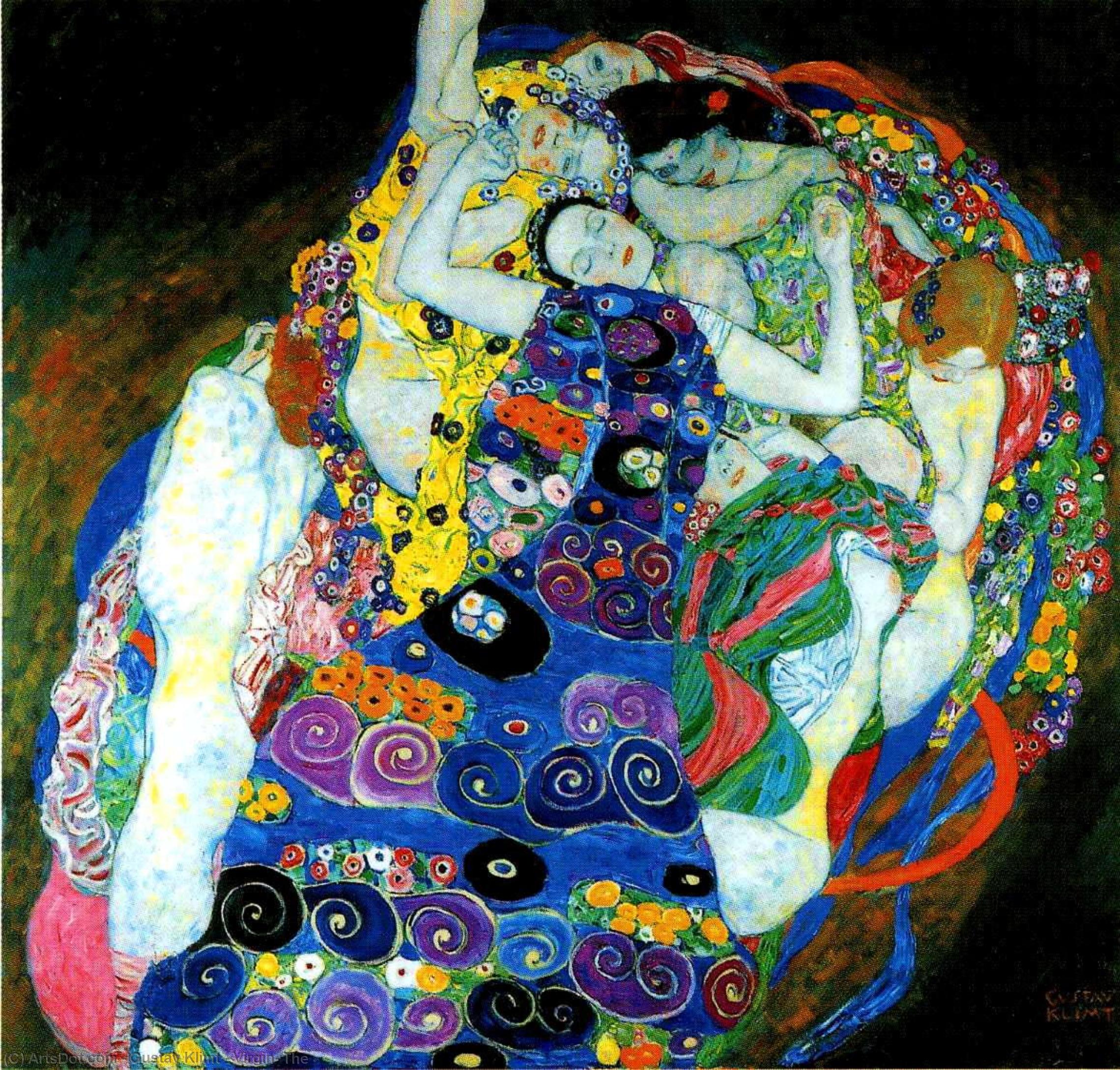
Explore Gustav Klimt’s ‘The Virgin,’ a mesmerizing 1913 oil painting showcasing Art Nouveau symbolism & rich colors. Discover its intricate patterns, nude figures, and historical significance.
 Read More
Gustav Klimt was an Art Nouveau master known for The Kiss. Explore his shimmering golden phase and iconic portraits today.
Purchase a high-resolution, enhanced digital image, far superior to the online preview.
Each file is meticulously prepared by our in-house specialists using advanced tools and expert manual retouching. We ensure every image has exceptional clarity, precise color accuracy, and fine detail.
The final file is delivered via email within 72 hours, optimized for immediate use in professional, editorial, and print environments. This is the same quality trusted by top-tier design studios, publishers, and galleries.
Digital Image
Download a high-resolution file for personal display, printing, and creative projects. ( Switch to Print Buy Hand Made Painting)
Included in Every Digital Image Order
Expert Digital Delivery, Guaranteed
When you choose TopImpressionists.com, you're not just getting an image - you're receiving a professionally enhanced digital artwork, crafted with precision and backed by a satisfaction guarantee. Here's everything that comes with your order, automatically:

Fast Email Delivery
Your high-resolution digital image file will be emailed to you within 72 hours of ordering - ready for immediate use.

AI-Enhanced Digital File
Your artwork is professionally optimized using advanced AI tools and manual editing, ensuring maximum detail, clarity, and color accuracy.

Free Lifetime Re-Delivery
Accidentally deleted or lost your file? No worries - we'll resend it to you anytime, free of charge.

No Import Fees - Ever
Enjoy your artwork instantly with zero customs, duties, or delivery fees - digital downloads are always tax-free.

Color Accuracy Guarantee
We ensure your digital image reflects the original colors as closely as possible using professional tools and color management.

100-Day Satisfaction Guarantee
If you're not satisfied with your digital image, we'll revise it or refund 100% within 100 days - no questions asked.

100% Money-Back Guarantee
Not satisfied? Get a full refund within 100 days of receiving your digital file - no questions asked.

Bulk Order Discounts
Buy 3 images, save 10% - Buy 5, save 15% - Buy 10+, save 20%. Great for creative projects, galleries, and agencies.
A Symphony of Femininity: Decoding Klimt’s ‘The Virgin’
Gustav Klimt's 1913 masterpiece, *The Virgin*, is far from a traditional depiction of motherhood or religious iconography. Instead, it presents an intimate and enigmatic scene – three intertwined female figures enveloped in a swirling embrace of color and pattern. This oil on canvas transcends mere portraiture; it’s a profound exploration of femininity, sensuality, and the cyclical nature of life itself.Composition & Visual Language
The painting immediately draws the eye into its circular composition, creating a sense of enclosure and intimacy. The women are not presented as distinct individuals but rather as facets of a unified whole, their bodies merging seamlessly with the decorative background. Klimt’s signature style is on full display: richly patterned surfaces, flattened perspective, and an opulent use of color. Shades of purple, pink, yellow, and green dominate, creating a visually arresting and emotionally resonant experience. A clock positioned above the figures subtly introduces the concept of time's passage, while a vase adds a touch of domesticity to this otherwise dreamlike setting. The overall effect is one of luxurious confinement and sensual awakening.Symbolism & Interpretation
The title, *The Virgin*, is deliberately provocative. It challenges conventional notions of purity and motherhood, suggesting instead a celebration of female sexuality and the power of collective feminine energy. The intertwined figures can be interpreted as representing different stages of womanhood – maiden, mother, and crone – or perhaps as embodying various aspects of a single complex personality. The floral motifs woven throughout the composition symbolize growth, fertility, and the blossoming of life. The circular form itself evokes images of the womb and the cyclical rhythms of nature.Klimt’s Artistic Style & Influences
*The Virgin* exemplifies Klimt's unique blend of Symbolism and Art Nouveau. He moved beyond realistic representation, employing decorative patterns and stylized forms to convey deeper emotional and psychological truths. The influence of Byzantine mosaics – particularly the shimmering gold backgrounds found in religious art – is evident in his use of rich color and surface ornamentation. He was a leading figure in the Vienna Secession movement, which rejected academic traditions in favor of innovative artistic expression. His work often explored themes of love, death, and the human condition with unflinching honesty and psychological depth.Historical Context & Klimt’s Legacy
Painted during a period of significant social and political upheaval, *The Virgin* reflects the changing attitudes towards sexuality and gender roles in early 20th-century Vienna. Klimt's work challenged societal norms and sparked controversy, but it also captivated audiences with its beauty and emotional power. He built upon the foundations laid by Romantic painters like Goya, Constable, and Turner who championed “art for art’s sake”. Klimt’s legacy continues to inspire artists and designers today, and his paintings remain highly sought after by collectors worldwide.Emotional Impact & Interior Design
*The Virgin* is a painting that invites contemplation and evokes a range of emotions – from sensuality and warmth to mystery and melancholy. Its rich colors and intricate patterns create a visually stimulating experience, while its enigmatic subject matter encourages viewers to project their own interpretations onto the work. As an interior design element, this artwork would lend itself well to spaces seeking a touch of bohemian luxury or artistic sophistication. It pairs beautifully with jewel-toned furnishings, organic textures, and ambient lighting, creating an atmosphere of intimate elegance. Its presence is sure to spark conversation and inspire creativity.Further Exploration
- Related Works: Explore Klimt’s *The Bride (unfinished)* for a similar exploration of intertwined figures and symbolic imagery. Also, consider his portrait of *Eugenia Primavesi* to see how he applied his stylistic elements to individual portraits.
- Artistic Movement: Delve deeper into the world of Symbolism and Art Nouveau to understand the broader artistic context in which Klimt worked.
- Museums & Collections: Visit museums housing Klimt’s works, such as the Belvedere in Vienna, to experience his art firsthand.
Questions & Answers
Which palette and lead color define "Virgin, The"?
The color identity of "Virgin, The" by Gustav Klimt: an earthy palette, dominated by sea green (#375a7f).
What technique was used for "Virgin, The" by Gustav Klimt?
The medium of "Virgin, The" by Gustav Klimt is oil on canvas. Reproductions aim to render the appearance of this technique.
Where and for what purpose is "Virgin, The" recommended?
Use (statement) and space (living room) are the two recommendations recorded for "Virgin, The" by Gustav Klimt.
Artist Biography
A Life Forged in Gold and Shadow
Born on July 14, 1862, in Baumgarten, near Vienna, Gustav Klimt entered a world where the boundaries of art and craft were intimately linked. His father, Ernst Klimt, worked as a gold engraver, a profession that left an indelible mark on his son’s visual language. The young Gustav learned to appreciate the weight of precious metals and the precision of fine detail long before he ever held a brush. This early exposure to the luster of gold leaf would later define his most famous period. Despite the financial hardships that forced his family through frequent moves within Vienna, his talent was undeniable. By 1876, he had entered the Vienna Kunstgewerbeschule, focusing on architectural painting under Ferdinand Laufberger.
His early professional years were marked by a steady, academic success. Alongside his brother Ernst and Franz von Matsch, Klimt formed a partnership that secured essential commissions for decorative murals and ceilings. These works required a disciplined hand and an eye for large-scale ornamentation. He found himself working on significant projects, such as the staircases of the Burgtheater in Vienna, earning the Gold Cross of Merit from Emperor Franz Joseph I. During this time, he looked toward the historical styles of Hans Makart, yet a restless energy was already beginning to stir beneath his formal training.
The Rebellion of the Secession
By the late 1890s, the constraints of the Viennese academic establishment had become stifling. Klimt sought a space where innovation could exist outside the rigid dictates of tradition. In 1897, he became the first president of the Vienna Secession, a movement designed to embrace new currents like Art Nouveau, Symbolism, and Japonism. This was an era of profound change, and Klimt stood at its center. He rejected the heavy, historical academicism in favor of organic lines and symbolic depth. His work began to explore the complexities of human intimacy, sexuality, and mortality with a frankness that often unsettled the conservative public.
This period of defiance brought both significant friction and profound creative growth. A notable instance occurred around 1900, when his commissions for the University of Vienna ceiling paintings—specifically Philosophy—were criticized as being too provocative. The backlash was severe enough that Klimt eventually withdrew from further public commissions, choosing instead to focus on private patronage. This shift allowed him to refine a more personal, decorative style. He drew heavily from the flattened perspectives and patterned aesthetics of Japanese art, integrating these elements into compositions that blurred the distinction between fine painting and ornamental design.
The Golden Era and Final Transitions
Around 1900, Klimt entered his most recognizable phase, often called his golden period. Inspired by the mosaics of Ravenna and medieval manuscripts, he began using gold leaf to create surfaces that seemed to radiate their own light. Works such as The Kiss (1907-1908) demonstrate this mastery, featuring figures enveloped in a shimmering, patterned aura. His portraits from this time, including the Portrait of Adele Bloch-Bauer I, captured more than mere physical likeness; they conveyed a psychological weight through the use of intricate, mosaic-like textures.
As his life drew toward its end, Klimt’s style underwent another subtle transformation. The heavy ornamentation of the golden phase began to give way to a more restrained and angular aesthetic. In works completed in 1918, such as The Jurisprudence, there is a move toward expressive simplification and sharper lines, perhaps reflecting the influence of the burgeoning Expressionist movement. His final years were marked by this continued evolution, even as he faced the physical toll of the Spanish Flu pandemic. He passed away on February 6, 1918, leaving behind a body of work that fundamentally altered the trajectory of Austrian modernism.

Gustav Klimt
1862 - 1918 , Austria
Quick Facts
- Artistic Movement Or Style:
- Symbolism
- Art Nouveau
- Vienna Secession
- Artists Or Movements Influenced By This Artist:
- Egon Schiele
- Art Nouveau
- Artists Who Influenced This Artist: ['Hans Makart']
- Full Name: Gustav Klimt
- Nationality: Austrian
- Notable Artworks:
- The Kiss
- Portrait of Adele Bloch-Bauer I
- Place Of Birth: Baumgarten, Austria
- Date Of Birth: 1862
- Date Of Death: 1918