

Shown: · With its frame:
 Preview
 Send
Send Share
Share
 Details
 Guide
Guide

 Download
 Similars
 X-Ray
X-Ray Diaporama
 Q&A
Q&A Stats
Stats

$ 269
Hand Made Oil Reproduction
Hand-painted oil on canvas in your size and frame, made to order by our artists. ( Switch to Print Switch to Digital Image)
Size
·Standard
custom
CM
INCH
Pick from our preset sizes that match the artwork's original proportions.
Loading sizes...

width
height
Type the width and the height you need, to fit your frame or your wall. This is hand-painted, so for a size with a different shape the artist can paint a bit more around the picture, or cut a bit — you choose. We send you a digital mockup to approve before the painting starts. The picture shown on this page does not show the real result — only the mockup does.
 Read more
Finish
·
White $1

Blurside $1

Extended $1

P118B $10

P118H $10

P118W $10

P438Z $10

P508JH $12

P508YH $12

P805H $10

P805Z $10

P919BZ $10

P919G $10

P919XJ $10

P959ZH $10

P968JZ $12

W106C $8

W218G $10

W218JH $8

W218Y $10

W307PJ $10

W316G $10

W316PJ $8

W316Y $10

W398PJ $8

W4111J $10

W500HY $15

W500JH $15

W692G $12

W849H $8

W940BG $15

W953PJ $8

H24-GOLD $30

H24-SILVER $30

H36-GOLD $45

H36-SILVER $45
Shipped in a protective tube, ready for your own framer.
Above 105 cm the frame is shipped as a kit for a professional framer — read the details.
Extras
optionalWhat do the extras include?
Examples of what can be changed: Replace face with customer photo; Add pet (e.g., replace cat with dog); Include hidden message in background; Change background landscape or elements.
After order, TopImpressionists.com team will email client for instructions and provide a mockup preview
After order, TopImpressionists.com team will email client for instructions and provide a mockup preview
Worldwide Delivery () in 3/4 weeks instead of standard 5 weeks. (3 November). No compromise on quality.
Protective Varnish
Nameplate
Engraved Bronze Plaque Details
This elegant plaque features the artist's name and the title of the artwork, finely engraved for a timeless presentation.
It is made from bronze with a refined, elegant finish. The text is precisely laser-engraved for a sharp and permanent result. Measuring 9x2 cm, the plaque is compact yet easy to read. It's built to be durable and scratch-resistant, offering a professional, museum-quality look. Mounting is simple thanks to the included adhesive backing.
Transparent Acrylic Plaque Details
The plaque includes essential engraved details such as the artist's name, the title of the artwork, the date it was created, the type of media used-like oil on canvas or watercolor-a brief description of the piece, and a QR code that links to the complete artwork information.
It is crafted from clear acrylic, offering a sleek, modern appearance. The text is UV-engraved in black to ensure strong visual contrast. With a size of 10x15 cm, it ensures optimal readability. It comes equipped with two metal hooks for secure wall mounting. The plaque is designed to be weather-resistant, making it suitable for various environments, and it includes interactive features that work seamlessly with smartphone scanning.
Black Acrylic Plaque Details
This elegant plaque includes engraved information such as the artist's name, the title of the artwork, the date it was created, the type of media used (like oil on canvas or watercolor), a short description of the artwork, and a QR code for quick access to more information.
The plaque itself is made from refined black acrylic with a premium finish. The text is laser-engraved in white for high contrast and readability. Its size is 10x15 cm, designed to be easy to read. It comes with two metal hooks for professional mounting. The design is sleek and fits any interior style. It is also weather-resistant and durable, with built-in digital integration for mobile compatibility.
Glass option is only available in size under 110 CM
 Glass option is only available in size under 110 CM
- Free Worldwide Express Shipping
- High-Quality Linen Canvas
- Full Shipping Insurance
- Customs Tax Refund Guarantee
- True Color Matching Guarantee
- 100-Day Return Policy (Defects Only)
- 100% Money-Back Guarantee
- Bulk Discount Offer


Collectible Description
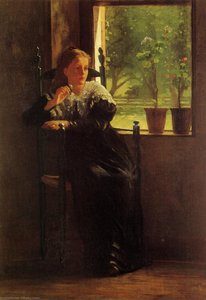
The painting depicts a woman seated on a bench with clasped hands, accompanied by a flower arrangement and butterflies against a vibrant red backdrop. A vase adds to the serene atmosphere as she contemplates her surroundings.
Artist Biography
Gustave Courbet (1819-1877): Pioneer of Realism. Explore paintings depicting everyday life & working class subjects like 'A Burial at Ornans'. Discover his revolutionary impact on 19th-century art.
About the painting
A Quiet Revolution in Realism
In the mid-19th century, the art world was often dominated by grand, idealized narratives and theatrical flourishes. However, Gustave Courbet, a defiant pioneer of the Realism movement, chose to turn his gaze toward the profound beauty found in the ordinary. His masterpiece, "Mere Grégoire," serves as a breathtaking window into this philosophy. Executed in 1862, the painting transcends a simple portrait of a peasant woman; it is an intimate study of stillness and the dignity of the human spirit. When one encounters this work, whether in a gallery or as a meticulously crafted reproduction in a private collection, there is an immediate sense of being invited into a moment of sacred, quiet contemplation.
The subject matter is deceptively simple yet emotionally complex. A woman sits upon a bench, her posture embodying a deep sense of repose and introspection. Her hands, clasped gently before her chest, act as a silent language, communicating a subtle vulnerability and the weight of inner reflection. Courbet deliberately avoids the aristocratic subjects favored by his contemporaries, choosing instead to champion the complexity of everyday life. This choice imbues the piece with a timeless social relevance, making it an ideal selection for those who appreciate art that speaks to the fundamental truths of the human experience.
The Mastery of Texture and Light
To behold "Mere Grégoire" is to witness Courbet’s technical brilliance and his commitment to the tactile reality of the world. Eschewing the smooth, polished finishes of academic painting, Courbet utilized a heavy impasto technique. By applying pigment in thick, textured layers, he created a palpable physicality that allows light to dance across the surface of the canvas, capturing the nuances of shadow and form with remarkable accuracy. This ruggedness is not merely a stylistic choice but a way to ground the subject in a tangible, earthy reality.
The artist’s palette is a masterclass in understated elegance. He relies on muted, organic tones—rich ochres, deep browns, and warm reds—which create a sense of warmth and stability. The striking red background provides a dramatic contrast that adds immense depth to the composition, pushing the figure forward and demanding the viewer's attention. For interior designers, this sophisticated use of color offers a versatile anchor for a room, providing a sense of historical weight and classical luxury that complements both modern minimalist settings and traditional, richly textured decors.
Symbolism and Emotional Resonance
Beyond the physical presence of the sitter, Courbet weaves delicate threads of symbolism throughout the composition to enrich its narrative depth. Beside the woman rests a vase of flowers, a classic motif representing beauty, fragility, and the fleeting nature of life. The addition of two butterflies fluttering through the scene introduces an element of ephemeral grace, contrasting the heavy, grounded presence of the woman with the lightness of nature. These elements work in harmony to create an atmosphere of serenity, inviting the observer to slow down and find peace within the frame.
For the discerning collector, "Mere Grégoire" offers more than just visual appeal; it offers an emotional sanctuary. The painting’s ability to evoke a sense of calm and introspection makes it a powerful tool for creating atmosphere in any living space. It is a piece that does not shout for attention but rather commands respect through its quiet strength. Owning a high-quality reproduction of this work allows one to bring a fragment of 19th-century revolutionary spirit into the home, serving as a constant reminder of the profound beauty found in life's most silent, unadorned moments.
Questions & Answers
What saturation and intensity does "mere gregoire" by Gustave Courbet show?
The color of "mere gregoire" is muted in saturation and monochromatic in intensity.
Is Gustave Courbet, creator of "mere gregoire", known under other names?
Gustave Courbet appears under the alternate names Courbet.
Is "mere gregoire" by Gustave Courbet a bright or a dark artwork?
Overall, "mere gregoire" is recorded as deep_shadow. Perceived brightness describes how light or dark the work appears.
Quick facts and art quiz
About Gustave Courbet

Gustave Courbet
1819 - 1877, France
Artist Biography
A Rebel’s Brush: The Life and Legacy of Gustave Courbet
Born in the quiet village of Ornans, France, in 1819, Jean Désiré Gustave Courbet emerged as a defiant force against the established artistic norms of his time. His story isn't simply one of paint and canvas; it’s a narrative woven with threads of social commentary, political conviction, and an unwavering commitment to portraying the world exactly as he saw it – unidealized, raw, and profoundly real. Growing up in a relatively prosperous bourgeois family, Courbet received encouragement from his mother to pursue his artistic inclinations, a nurturing that would ultimately fuel a revolution in the art world. His formal training began at the École des Beaux-Arts in Paris in 1839, but he quickly found himself chafing against the academic conventions and Romantic idealism prevalent there. While acknowledging influences like Eugène Delacroix and Théodore Géricault, Courbet forged his own path, one that prioritized observation over imagination and truth over tradition.The Birth of Realism: Challenging Artistic Conventions
Courbet’s artistic development was marked by a deliberate rejection of the prevailing aesthetic standards. He wasn't interested in mythological narratives or heroic allegories; his gaze was fixed on the everyday lives of ordinary people, particularly those engaged in labor and rural existence. This commitment to depicting the world without embellishment – what would become known as Realism – initially met with scorn and derision from critics accustomed to more polished and idealized representations. Early works explored landscapes and portraits, but soon shifted towards scenes of working-class life, rendered on a monumental scale traditionally reserved for historical or religious paintings. This deliberate choice wasn’t merely stylistic; it was a statement about the inherent dignity and importance of these often-overlooked subjects. The Stone Breakers, completed in 1849 but tragically destroyed during World War II, exemplified this approach – a stark depiction of two laborers toiling away, their faces obscured by exhaustion and hardship. This painting, along with others like A Burial at Ornans (1850), challenged the very definition of what constituted “worthy” subject matter for high art.Major Works and Artistic Philosophy
A Burial at Ornans, a colossal canvas depicting a provincial funeral, caused an uproar when it was exhibited in 1850-51. Its sheer size – typically reserved for grand historical paintings – combined with its unflinching realism and lack of emotional idealization shocked audiences. Courbet didn’t portray the mourners as noble or grief-stricken figures; he presented them as ordinary people, their faces etched with a mixture of sorrow, boredom, and resignation. This honesty was revolutionary. His artistic philosophy extended beyond subject matter to encompass technique. He favored a direct, impasto style – applying paint thickly onto the canvas – that emphasized the materiality of the medium itself. The Painter’s Studio (1855), an allegorical work reflecting his artistic beliefs and engagement with contemporary social issues, further solidified his reputation as a provocative and independent artist. His participation in the Salon des Refusés in 1863 – an exhibition of works rejected by the official Salon – cemented his status as a rebel and champion of artistic freedom. Even landscapes like View in the Forest of Fontainebleau (1855) were imbued with a sense of realism, capturing the natural beauty of the forest without romanticizing it.Legacy and Historical Significance
Gustave Courbet’s influence on subsequent art movements is undeniable. While he drew inspiration from earlier masters like Caravaggio for their dramatic realism and use of light and shadow, his impact extended far beyond mere imitation. He profoundly influenced the Impressionists and Post-Impressionists by liberating them from the constraints of traditional representation, encouraging them to explore new ways of seeing and depicting the world. His emphasis on social commentary paved the way for later socially engaged artists who used their work as a platform for political activism. Courbet wasn’t just a painter; he was a vocal advocate for artistic freedom and political change, actively participating in the tumultuous events of his time, including the Paris Commune of 1871 – an involvement that led to a period of exile in Switzerland. He died in 1877, leaving behind a body of work that continues to inspire and provoke audiences today.- Pioneer of Realism
- Challenged academic conventions
- Influenced Impressionism & Post-Impressionism
- Advocate for artistic freedom
Related Artworks




Explore artworks organized by themes, styles, and characteristics.


Gustave Courbet
mere gregoire
() ·
With its frame: · Hand-painted in oil on linen
Total