Preview
 Send
Send Share
Share
 Details
 Guide
Guide

 Download
 Similars
 X-Ray
X-Ray Diaporama
 Stats
StatsThe Barber


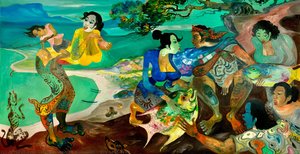
A vivid depiction of a bustling barbershop scene captures the lively atmosphere of Hendra Aprida Gunawan's 1941 painting where figures gather for grooming, inviting you to explore this captivating piece of art.
 Read More
Explore Hendra Aprida Gunawan's unique blend of magic & art! Indonesian illusionist & inventor creating innovative magic boxes & captivating canvases. Discover his work.
The artwork displayed on this page is protected by copyright law, which means we cannot legally create or sell an identical reproduction. This protection is enforced under international agreements such as the Berne Convention and by national laws, including those outlined by the U.S. Copyright Law - Title 17.
This method fully complies with copyright regulations because it does not involve copying or duplicating the protected artwork. Instead, it is a creative reinterpretation - a new painting that is influenced by the original but not identical to it.
Giclée / Art Print
Museum-quality giclée or canvas print with fast production and flexible finish options. ( Buy Hand Made Painting Switch to Digital Image)




P118B $10

P118H $10

P118W $10

P438Z $10

P508JH $12

P508YH $12

P805H $10

P805Z $10

P919BZ $10

P919G $10

P919XJ $10

P959ZH $10

P968JZ $12

W106C $8

W218G $10

W218JH $8

W218Y $10

W307PJ $10

W316G $10

W316PJ $8

W316Y $10

W398PJ $8

W4111J $10

W500HY $15

W500JH $15

W692G $12

W849H $8

W940BG $15

W953PJ $8




Standard
custom
CM
INCH
Pick from our preset sizes that match the artwork's original proportions.
Loading sizes...

width
height
Type the width and the height you need, to fit your frame or your wall. A print can only be cut, never made bigger than the picture, so a size with a different shape loses a part of the image. We send you a digital mockup to approve before we print anything. The picture shown on this page does not show the real cut — only the mockup does.
Worldwide Delivery () in 2 weeks instead of standard 4/5 weeks. (24 October)

Free Worldwide Express Shipping

High-Quality Linen Canvas

Full Shipping Insurance

Customs Tax Refund Guarantee

True Color Matching Guarantee

100-Day Return Policy (Defects Only)

100% Money-Back Guarantee

Bulk Discount Offer
 Glass option is only available in size under 110 CM

The Barber
Giclée / Art Print
Reproduction Size
-


Total Price
$ 70
A Vivid Slice of Life: The Essence of The Barber
In the heart of a bustling community, where the rhythm of daily life unfolds in shared spaces, Hendra Aprida Gunawan captures a moment of profound human connection in his 1941 masterpiece, The Barber. This painting is far more than a mere depiction of a grooming session; it is a vibrant tapestry of social interaction and communal intimacy. The scene unfolds within the confines of a lively barber shop, where the air seems thick with the low hum of conversation and the rhythmic snip of shears. At the center of this composition, two skilled hands work in unison to shave a man's head, a focal point that draws the viewer into the very soul of the workshop. The presence of other figures—some resting on benches, others standing in quiet observation—creates a sense of a living, breathing ecosystem, where every individual contributes to the shared atmosphere of the room.
The artist’s technique breathes life into the mundane, using a palette that feels both grounded and energetic. Through masterful brushwork, Gunawan imbue the scene with a palpable texture, making the wooden furniture, the heavy presence of an umbrella, and the very skin of the subjects feel tangible to the observer. There is a remarkable sense of depth achieved through the arrangement of figures; the way some individuals are seated while others lie down creates a layered perspective that pulls the eye through the crowded space. This complexity does not overwhelm but rather invites the viewer to linger, searching for the small, quiet details—the tilt of a head, the placement of a tool, or the subtle play of light across the room.
Symbolism and the Art of Connection
Beyond its surface-level realism, The Barber serves as a poignant exploration of ritual and community. The act of grooming is a universal symbol of care and transformation, a private moment made public within the sanctuary of the shop. The barber shop acts as a social crossroads, a place where hierarchies dissolve and stories are exchanged. Even the inclusion of an umbrella, perhaps a shield against the elements outside, suggests a sense of refuge and protection found within these communal walls. Gunawan, whose background is uniquely intertwined with the art of illusion and magic, brings a certain theatricality to this piece; there is a choreographed grace to the movements of the barbers that mirrors the precision of a stage performance, turning a routine task into a captivating spectacle.
For the discerning collector or interior designer, this artwork offers a profound emotional resonance. It evokes nostalgia for a time when community spaces were the anchors of social identity. The painting’s ability to balance a sense of organized chaos with moments of stillness makes it an extraordinary centerpiece for any sophisticated collection. Whether placed in a contemporary gallery setting or a classic study, The Barber commands attention through its warmth and narrative depth. It is a piece that does not merely decorate a wall but enriches the very atmosphere of a room, offering a window into a world where every shared moment is an opportunity for artful connection.
Questions & Answers
What mood does "The Barber" by Hendra Aprida Gunawan express within Contemporary Realism?
The dramatic emotion of "The Barber" accompanies its Contemporary Realism style.
What space is suggested for "The Barber" by Hendra Aprida Gunawan?
The recommended space for "The Barber" by Hendra Aprida Gunawan is a coffee shop. The suggestion can of course be adapted to your interior.
Which artist and which style stand behind "The Barber"?
Hendra Aprida Gunawan created "The Barber" within the Contemporary Realism movement.


Artist Biography
early life and magical beginnings
hendra aprida gunawan, an indonesian magician, also known as hendramagic, has been a member of the society of indonesian magicians since his early days. born in 1982, hendra developed his magical prowess in jakarta, which eventually led to a career-defining collaboration with alford the magician, indonesia's top illusionist.the artistic journey
- after performing three days of magic shows with alford, hendra resolved to make a career in the profession.
- he studied under mr. lee, uncle tan, and dui montero, further honing his skills.
- gradually, he began performing in his local church, eventually receiving bookings for shows at malls, hotels, and corporate events.
innovative magic boxes and artistic expression
aside from performing, hendra is also an inventor of innovative magic boxes, which have received orders from as far away as the united states and serbia. this unique blend of magic and art showcases his versatility.notable mentions and exhibitions
- hendra aprida gunawan's work has been featured in various exhibitions, including a notable retrospective at ciputra artpreneur gallery and museum in jakarta.
- his style, which evolved after meeting nuraeni, an art student at the prison, is a testament to his adaptability and growth as an artist.
online presence and artistic legacy
- hendra aprida gunawan's work can be found on TopImpressionists.com, where his 55 artworks are showcased, including oil on canvas pieces.
- his wikipedia page (hendra gunawan (magician)) provides a comprehensive overview of his life and career.
conclusion
hendra aprida gunawan's enigmatic blend of magic and art has solidified his position as a unique figure in the indonesian art scene. through his innovative approach, he continues to inspire and intrigue audiences worldwide.- view hendra aprida gunawan's artwork on TopImpressionists.com
- explore his magical journey and artistic evolution on his wikipedia page

Hendra Aprida Gunawan
1982 - , Indonesia
Quick Facts
- Full Name: Hendra Aprida Gunawan
- Nationality: Indonesian
- Date Of Birth: 1982
- Place Of Birth: Jakarta, Indonesia
- Notable Artworks:
- Cirebon Mask
- Melasti Ceremony
- The Struggle
- Artistic Movement Or Style: Contemporary Magic Art
- Artists Who Influenced This Artist:
- Alford The Magician
- Lee
- Uncle Tan
- Dui Montero
- Artists Or Movements Influenced By This Artist: ['Nuraeni']
Related Articles

Mastering the Layered Look: An Expert Guide to Art Groupings and Multi-Panel Displays for Luxury Hotel Interiors
Elevate hospitality interiors with our expert guide on mastering art groupings and multi-panel displays. Discover professional techniques for curating luxurious, layered wall installations that define high-end hotel aesthetics through texture, scale, and bespoke fine art.

The Art of Legacy: Commissioning Grand-Scale Custom Group Portraits for Families and Organizations
Transform your family's history into a timeless masterpiece. TopImpressionists specializes in luxury, large-scale custom group portrait commissions for 10+ people. Hand-painted by master artists using traditional oil techniques to create an enduring legacy for your home or organization.

Capturing Collective Memories: Commissioned Group Portraits for Enduring Legacies
Commission a breathtaking group portrait with TopImpressionists’s master artists. Preserve your family's legacy with museum-quality paintings, crafted to cherish for generations. Expert guidance & personalized service – start creating your timeless heirloom today!

Robert Bevan: Pioneering British Post-Impressionism & the Camden Town Group's Intimate Vision
Explore the life & work of Robert Bevan, a pioneer of British Post-Impressionism and founding member of the Camden Town Group. Discover his vibrant landscapes and lasting impact on early 20th-century art.

Arthur Lismer: A Pioneer of Canadian Modernism & the Group of Seven's Visionary Spirit
Explore the life & art of Arthur Lismer, a pivotal figure in Canadian Modernism and founding member of the Group of Seven. Discover his landscapes, teaching legacy & lasting influence on Canadian art history.
Explore artworks organized by themes, styles, and characteristics.