


 Preview
 Send
Send Share
Share
 Details
 Guide
Guide

 Download
 Similars
 X-Ray
X-Ray Diaporama
 Stats
StatsHoly Trinity


A celestial vision of the Holy Trinity unfolds through God, Jesus, and the Holy Spirit amidst angelic hosts in this 1620 Flemish Baroque masterpiece by Hendrik van Balen I, inviting you to bring divine grace into your home.
 Read More
Hendrick van Balen I (1575-1632) was a Flemish Baroque painter renowned for his captivating mythological & allegorical scenes, and as an influential teacher of Anthony van Dyck.
Giclée / Art Print
Museum-quality giclée or canvas print with fast production and flexible finish options. ( Buy Hand Made Painting Switch to Digital Image)




P118B $10

P118H $10

P118W $10

P438Z $10

P508JH $12

P508YH $12

P805H $10

P805Z $10

P919BZ $10

P919G $10

P919XJ $10

P959ZH $10

P968JZ $12

W106C $8

W218G $10

W218JH $8

W218Y $10

W307PJ $10

W316G $10

W316PJ $8

W316Y $10

W398PJ $8

W4111J $10

W500HY $15

W500JH $15

W692G $12

W849H $8

W940BG $15

W953PJ $8




Standard
custom
CM
INCH
Pick from our preset sizes that match the artwork's original proportions.
Loading sizes...

width
height
Type the width and the height you need, to fit your frame or your wall. A print can only be cut, never made bigger than the picture, so a size with a different shape loses a part of the image. We send you a digital mockup to approve before we print anything. The picture shown on this page does not show the real cut — only the mockup does.
Worldwide Delivery () in 2 weeks instead of standard 4/5 weeks. (23 October)

Free Worldwide Express Shipping

High-Quality Linen Canvas

Full Shipping Insurance

Customs Tax Refund Guarantee

True Color Matching Guarantee

100-Day Return Policy (Defects Only)

100% Money-Back Guarantee

Bulk Discount Offer
 Glass option is only available in size under 110 CM

Holy Trinity
Giclée / Art Print
Reproduction Size
-


Total Price
$ 70
A Celestial Vision in Baroque Splendor
In the vast, swirling expanse of the seventeenth-century Flemish sky, few images command the soul with as much reverence as Hendrik van Balen I’s Holy Trinity. Painted around 1620, this masterpiece serves as a profound window into the spiritual heights of the Baroque era. The composition unfolds within a breathtaking celestial realm, where the boundaries between the earthly and the divine dissolve amidst billowing, luminous clouds. At the heart of this cosmic drama sits the Holy Trinity: God the Father, Jesus Christ, and the Holy Spirit, arranged in a triad of divine unity. The scene is not merely a religious depiction but a choreographed movement of light and grace, where the figures emerge from the heavens to offer a glimpse of eternal peace to the viewer below.
The artistry of van Balen I shines through his meticulous command of detail and his ability to weave complex allegorical layers into a single, cohesive vision. As a master who influenced even the great Anthony van Dyck, van Balen brings a sophisticated elegance to the piece. Surrounding the central figures is a host of celestial attendants—angels whose presence adds both movement and weight to the composition. Some angels are depicted with the solemnity of guardians, wielding swords and shields, while others drift with a weightless grace. A solitary bird soars above the assembly, acting as a subtle yet powerful symbol of the Holy Spirit’s descent, bridging the gap between the high heavens and the natural world visible in the distant, verdant trees.
Symbolism and the Mastery of Light
Every element within this painting is imbued with deep theological significance, designed to guide the observer toward contemplation. The arrangement of the Father, Son, and Spirit creates a triangular stability that reflects the concept of divine perfection. The interplay of light and shadow—a hallmark of the Baroque style—serves to sculpt the figures out of the ether, giving them a tangible, almost sculptural presence despite their heavenly nature. This technique, known as chiaroscuro, directs the eye toward the central mystery of the Trinity, ensuring that the viewer’s gaze is constantly drawn back to the source of light and life.
For the discerning collector or interior designer, this artwork offers more than just historical value; it provides a profound emotional anchor for any space. The painting’s palette, rich with the soft tones of a breaking dawn and the deep, earthy greens of the background landscape, creates an atmosphere of serene majesty. Whether placed in a grand library, a formal dining hall, or a quiet sanctuary, a high-quality reproduction of this work brings a sense of timelessness and spiritual depth. It is a piece that invites long periods of study, rewarding the viewer with new discoveries of texture, light, and meaning with every glance, making it an incomparable centerpiece for those who appreciate the intersection of fine art and profound devotion.
Questions & Answers
What is the color identity of "Holy Trinity" by Hendrik van Balen I?
"Holy Trinity" by Hendrik van Balen I uses an earthy palette, with espresso (#402c20) as the dominant color.
In which year and which movement was "Holy Trinity" made?
"Holy Trinity" was made in 1620, within the Baroque movement.
Where is "Holy Trinity" by Hendrik van Balen I on display today?
You can see the original "Holy Trinity" at the Sint-Jacobskerk, Antwerp, Belgium.
Artist Biography
A Master of Myth and Miniature: The World of Hendrick van Balen I
Hendrick van Balen I, a name perhaps less immediately recognizable than those of his contemporaries Rubens or Van Dyck, nevertheless occupies a crucial position in the vibrant artistic landscape of 17th-century Antwerp. Born around 1575 into a prosperous merchant family, van Balen benefited from an upbringing that fostered both intellectual curiosity and artistic inclination. This fortunate combination allowed him to pursue rigorous training, initially under Adam van Noort—a painter steeped in the Mannerist tradition—and potentially also with Maerten de Vos. These early influences laid the groundwork for a career defined by meticulous detail, elegant composition, and a penchant for mythological and allegorical subjects. His family’s financial stability afforded him opportunities beyond mere technical skill; he cultivated linguistic abilities that would later prove valuable during his travels and collaborations. Van Balen wasn't simply a craftsman but a humanist scholar immersed in the classical narratives that fueled much of Baroque art.From Altarpieces to Intimate Visions
Van Balen’s artistic journey began with larger-scale religious works, altarpieces reflecting the powerful Romanist style inherited from his teacher, Adam van Noort. These early pieces demonstrate a solid command of anatomy and dramatic composition, yet it was in the realm of smaller cabinet pictures that he truly found his voice. Around 1595, he embarked on an artistic pilgrimage to Italy—a journey not definitively documented but evidenced by his subsequent membership in the Guild of Romanists upon his return to Antwerp. This sojourn exposed him to the burgeoning Baroque style and the works of artists like Annibale Carracci and Palma Giovane, influencing a shift towards more refined color palettes and graceful figure arrangements. He became a master within the Antwerp Guild of Saint Luke in 1592-93, rising through its ranks to become dean on multiple occasions—a testament to his standing within the artistic community. His workshop flourished, becoming a hub for aspiring painters, most notably Anthony van Dyck, who received crucial early training under van Balen’s tutelage.A Collaborative Spirit and The Garland Painting
Van Balen was not an artist who worked in isolation. Collaboration was central to his practice, particularly with Jan Brueghel the Elder, a master of still life painting. Together, they pioneered the genre of garland paintings—a uniquely Flemish innovation that combined devotional or mythological imagery encircled by lush floral arrangements. These works weren’t merely decorative; they were imbued with symbolic meaning, reflecting the religious fervor and artistic sophistication of the Habsburg court. The commission from Cardinal Federico Borromeo for a garland painting around 1607-1608 stands as a landmark achievement in this genre—a testament to their combined skill and innovative spirit. Brueghel’s meticulous rendering of flowers and fruits provided a vibrant frame for van Balen's graceful figures, creating a harmonious synthesis of naturalism and idealism. Beyond Brueghel, he frequently partnered with other artists like Joos de Momper, Abraham Govaerts, and Frans Snyders, demonstrating his adaptability and willingness to embrace diverse artistic perspectives.Legacy and Lasting Influence
Hendrick van Balen I’s influence extended far beyond the confines of his workshop. His emphasis on refined technique, elegant composition, and mythological subject matter resonated with a generation of Flemish artists. Anthony van Dyck, perhaps his most celebrated pupil, absorbed much from his master's approach to figure painting and compositional principles. Van Balen’s cabinet pictures—often executed on copper supports—became highly sought after by collectors, prized for their intimate scale and exquisite detail. While he may not have achieved the same level of widespread fame as Rubens or Van Dyck, van Balen played a vital role in revitalizing Flemish painting in the early 17th century. He bridged the gap between Mannerism and Baroque, forging a distinctive style that blended classical ideals with Flemish realism. His legacy endures through his surviving works—testaments to a master craftsman who brought myth and allegory to life with unparalleled grace and artistry. His contribution lies not in grand pronouncements but in the quiet perfection of miniature worlds.
Hendrik van Balen I
1575 - 1632 , Belgium
Quick Facts
- Full Name: Hendrick van Balen I
- Nationality: Flemish
- Date Of Birth: 1575
- Date Of Death: 1632
- Place Of Birth: Antwerp, Belgium
- Notable Artworks:
- Moses Striking the Rock
- A Bacchic Procession
- The Rest on the Flight…
- Artistic Movement Or Style: Baroque
- Artists Who Influenced This Artist:
- Adam van Noort
- Maerten de Vos
- Artists Or Movements Influenced By This Artist:
- Anthony van Dyck
- Frans Snyders
Related Articles
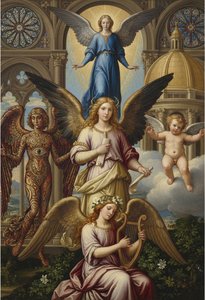
Divine Beauty: A Curated Guide to the Celestial Majesty of Angelic Figures in Art History
Explore the profound beauty of angelic figures in art history. From Renaissance masterpieces to celestial symbolism, our expert guide offers a sophisticated journey through the divine imagery of the Old Masters for discerning collectors and art enthusiasts.

Celestial Messengers: Angels in Painting – A Historical & Artistic Exploration
Explore the captivating history of angels in painting! Discover symbolism, iconic Renaissance & Byzantine masterpieces, and renowned artists. Expert insights for art lovers & collectors at TopImpressionists.

Mastering Drama and Light: A Definitive Guide to the Flemish Baroque Art Movement
Explore the dramatic brilliance of the Flemish Baroque movement. Discover how masters like Peter Paul Rubens utilized chiaroscuro and dynamic composition to redefine art history through light, shadow, and unparalleled emotion.

Baroque Drama: Bringing Opulence & Emotion into Contemporary Interiors
Explore the opulent world of Baroque interior design! Discover key elements, modern applications & how to bring dramatic elegance into your home with TopImpressionists.com's authentic reproductions.

Celestial Messengers: A Comprehensive Exploration of Angelic Representation in Art History
Explore the captivating history of angels in art! Discover symbolism, iconic Renaissance masterpieces & renowned artists. Expert insights for art lovers & collectors at TopImpressionists.
Explore artworks organized by themes, styles, and characteristics.


