

Shown: · With its frame:
 Preview
 Send
Send Share
Share
 Details
 Guide
Guide

 Download
 Similars
 X-Ray
X-Ray Diaporama
 Q&A
Q&A Stats
Stats

$ 269
Hand Made Oil Reproduction
Hand-painted oil on canvas in your size and frame, made to order by our artists. ( Switch to Print Switch to Digital Image)
Size
·Standard
custom
CM
INCH
Pick from our preset sizes that match the artwork's original proportions.
Loading sizes...

width
height
Type the width and the height you need, to fit your frame or your wall. This is hand-painted, so for a size with a different shape the artist can paint a bit more around the picture, or cut a bit — you choose. We send you a digital mockup to approve before the painting starts. The picture shown on this page does not show the real result — only the mockup does.
 Read more
Finish
·
White $1

Blurside $1

Extended $1

P118B $10

P118H $10

P118W $10

P438Z $10

P508JH $12

P508YH $12

P805H $10

P805Z $10

P919BZ $10

P919G $10

P919XJ $10

P959ZH $10

P968JZ $12

W106C $8

W218G $10

W218JH $8

W218Y $10

W307PJ $10

W316G $10

W316PJ $8

W316Y $10

W398PJ $8

W4111J $10

W500HY $15

W500JH $15

W692G $12

W849H $8

W940BG $15

W953PJ $8

H24-GOLD $30

H24-SILVER $30

H36-GOLD $45

H36-SILVER $45
Shipped in a protective tube, ready for your own framer.
Above 105 cm the frame is shipped as a kit for a professional framer — read the details.
Extras
optionalWhat do the extras include?
Examples of what can be changed: Replace face with customer photo; Add pet (e.g., replace cat with dog); Include hidden message in background; Change background landscape or elements.
After order, TopImpressionists.com team will email client for instructions and provide a mockup preview
After order, TopImpressionists.com team will email client for instructions and provide a mockup preview
Worldwide Delivery () in 3/4 weeks instead of standard 5 weeks. (10 November). No compromise on quality.
Protective Varnish
Nameplate
Engraved Bronze Plaque Details
This elegant plaque features the artist's name and the title of the artwork, finely engraved for a timeless presentation.
It is made from bronze with a refined, elegant finish. The text is precisely laser-engraved for a sharp and permanent result. Measuring 9x2 cm, the plaque is compact yet easy to read. It's built to be durable and scratch-resistant, offering a professional, museum-quality look. Mounting is simple thanks to the included adhesive backing.
Transparent Acrylic Plaque Details
The plaque includes essential engraved details such as the artist's name, the title of the artwork, the date it was created, the type of media used-like oil on canvas or watercolor-a brief description of the piece, and a QR code that links to the complete artwork information.
It is crafted from clear acrylic, offering a sleek, modern appearance. The text is UV-engraved in black to ensure strong visual contrast. With a size of 10x15 cm, it ensures optimal readability. It comes equipped with two metal hooks for secure wall mounting. The plaque is designed to be weather-resistant, making it suitable for various environments, and it includes interactive features that work seamlessly with smartphone scanning.
Black Acrylic Plaque Details
This elegant plaque includes engraved information such as the artist's name, the title of the artwork, the date it was created, the type of media used (like oil on canvas or watercolor), a short description of the artwork, and a QR code for quick access to more information.
The plaque itself is made from refined black acrylic with a premium finish. The text is laser-engraved in white for high contrast and readability. Its size is 10x15 cm, designed to be easy to read. It comes with two metal hooks for professional mounting. The design is sleek and fits any interior style. It is also weather-resistant and durable, with built-in digital integration for mobile compatibility.
Glass option is only available in size under 110 CM
 Glass option is only available in size under 110 CM
- Free Worldwide Express Shipping
- High-Quality Linen Canvas
- Full Shipping Insurance
- Customs Tax Refund Guarantee
- True Color Matching Guarantee
- 100-Day Return Policy (Defects Only)
- 100% Money-Back Guarantee
- Bulk Discount Offer


Collectible Description
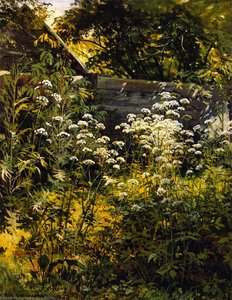
Explore Ivan Shishkin’s "Pine Forest" – a serene 1889 oil painting showcasing impressionistic brushwork & natural beauty. Admire the vertical lines, dappled light, and tranquil atmosphere.
Artist Biography
A master of Russian landscape realism known for Morning in a Pine Forest. Explore his soulful depictions of the vast Russian forest today.
About the painting
Quick facts and art quiz
About Ivan Ivanovich Shishkin

Ivan Ivanovich Shishkin
1832 - 1898, Russia
Artist Biography
Early Life, Family and Training
Ivan Ivanovich Shishkin was born on 25 January 1832 in Yelabuga, Vyatka Governorate. He grew up in a family of merchants, the son of Ivan Vasilyevich Shishkin, a grain merchant who lived until 1872. His lineage was rooted in the region, tracing back to his grandfather, Vasily Afanasyevich Shishkin-Serebryakov, who was a palace peasant and later a third-guild merchant in Yelabuga.
His formal education began at the age of 12 when he was enrolled in the First Kazan Boys' Gymnasium. This early schooling provided the foundation for a life spent observing the natural world. After his time in Kazan, he moved toward professional artistic study, entering the Moscow School of Painting, Sculpture and Architecture in 1852. He remained there for four years, honing his technical skills before moving on to the Saint Petersburg Imperial Academy of Arts in 1857. He completed his studies at the Academy in 1860.
Artistic Training and Travels
After his early schooling, Shishkin moved to the Saint Petersburg Imperial Academy of Arts, where he studied from 1857 to 1860. He worked under the guidance of Professor Sokrat Vorobyov, a landscape painter who helped shape his technical foundation. His dedication to his craft was recognized upon his graduation when he earned a gold medal from the Academy. This achievement opened doors to further study beyond the borders of Russia.
The Academy granted him an imperial scholarship, allowing him to spend three years living and working abroad. This period of travel was essential to his development. In 1861, he visited Munich, Germany, to observe the works of established artists. His travels eventually took him through Switzerland and Germany, where he spent much of his time sketching and painting from life. These years away from home allowed him to refine his ability to render the natural world with precision.
Technique and Artistic Style
Shishkin’s approach to the canvas was rooted in a deep, analytical study of the natural world. He did not merely look at the forest; he observed its smallest intricacies, from the texture of old stumps to the way driftwood rests on the earth. This commitment to realism allowed him to translate the physical reality of the Russian landscape into his works. His method was precise, driven by a need to understand how light and form actually behaved in the wild. He was as skilled with a pen as he was with a brush, proving himself an outstanding draftsman and a printmaker who could capture detail through various means.
His technical repertoire was broad, spanning oil painting, watercolor, and pen drawings. He also experimented with etching using aqua regia, a process that required significant technical control. One of the most striking aspects of his work is his handling of color, particularly the endless variations of green found in the woods. To achieve this, he utilized an extensive range of pigments, including Permanent Green, Veronese Green, Cobalt Green, Chrome Green, Cinnabar Green, Green Earth, and Emerald Green. By mixing these with various shades of yellow and blue, he could recreate the specific, shifting light of a forest floor or the deep shadows of a thicket.
His ability to render the atmosphere of a scene relied on this careful color work and his mastery of detail. Whether he was depicting the sunlight filtering through branches or the dampness of a forest after rain, his work remained grounded in the actual appearance of the land. He focused on the tangible elements of nature—the bark of a tree, the blades of grass, and the specific quality of light—to build his compositions.
Key Works and Masterpieces
Shishkin’s brush often found its way to the quietest corners of the woods. In 1869, he produced Walk in a forest, a work that offers a glimpse into a tranquil woodland scene, capturing a moment frozen in time. His ability to translate the stillness of nature was evident in his 1884 painting, Forest in Winter, which immerses the viewer in the silent grandeur of a snowy landscape. These works show a man who spent countless hours observing the intricacies of the trees and the way light moves through the branches.
His connection to the Russian landscape was perhaps most clearly felt in his 1878 oil painting, Rye. This piece depicts a field of ripening yellow rye near the village of Lekarevo, west of Yelabuga. The scene captures the vastness of the plains under a hazy summer sky. His most famous work, Morning in a Pine Forest, remains a central part of his legacy, showing sunlight filtering through towering pines to create a sense of peace and strength.
During his time spent traveling through Europe, he also looked toward the dramatic scenery of the mountains. His painting Staubbach Falls in the Lauterbrunnen Valley is held in a museum’s permanent exhibition, reflecting the influence of the Swiss landscapes he encountered during his years abroad. His output was vast, covering many different aspects of the natural world:
- Morning in a Pine Forest
- Rye (1878)
- Forest in Winter (1884)
- Walk in a forest (1869)
- Staubbach Falls in the Lauterbrunnen Valley
Professional Roles and Memberships
Shishkin’s commitment to the art community was deeply felt through his involvement with several influential groups. He was a member of the Peredvizhniki, also known as the Wanderers, a group that sought to bring art directly to the people rather than keeping it confined to academic circles. His influence extended into specialized circles as well; he was a member of the Circle of the Itinerants and the Society of Russian Etchers in St. Petersburg, as well as the Society of Russian Watercolorists. These affiliations reflected a man who was deeply embedded in the evolving landscape of Russian artistic life.
His expertise was not limited to his own canvas. From 1873 to 1898, he held the position of professor of painting. During this time, he also headed the landscape painting class at the Highest Art School in St. Petersburg. In these roles, he helped shape the technical skills of many students, passing on the meticulous methods he had refined throughout his own career. He was a constant presence in the academic and professional structures of the city, helping to guide the next generation of painters through the complexities of their craft.
Later Years and Death
The final years of Shishkin's life were spent in St. Petersburg, where he remained deeply immersed in his craft. Even as he aged, his commitment to the study of nature never wavered. On March 20, 1898, he passed away in the city. At the time of his death, he was actively working on a new painting, a detail that speaks to the constant, quiet labor of his studio life.
His passing marked the end of a life spent largely in the company of the forests he so carefully observed. He was initially buried at the Smolensk Orthodox Cemetery. Decades later, in 1950, his remains were moved to the Tikhvin Cemetery, located within the Necropolis of the Masters of Art.
Where to See the Works Today
To experience the quiet presence of Shishkin’s forests, one can visit several significant collections across Russia. The Tretyakov Gallery in Moscow holds a substantial number of his paintings, including his detailed studies of grain and woodland. These works allow viewers to see the textures of the Russian landscape up close, from the sweeping expanse of a rye field to the dense shadows of a pine grove.
Other important repositories of his art include the Yaroslavl Arts Museum and the Kartinnaja Galerija in Tambov. These institutions preserve the visual history of the landscapes he spent his life observing. In Voronezh, Russia, the Kramskoy Museum of Fine Arts also maintains his works, ensuring his specific way of seeing the natural world remains available to those who seek it.
- Rye (about 1878)
- Morning in a Pine Forest
- Forest in Winter (1884)
- Walk in a forest (1869)
Quick facts about Ivan Ivanovich Shishkin
- Artistic Movement Or Style: Realism, Peredvizhniki
- Artists Who Influenced This Artist:
- Sokrat Vorobyov
- Benno Adam
- Franz Adam
- Rudolf Koller
- Full Name: Ivan Ivanovich Shishkin
- Nationality: Russian
- Notable Artworks:
- Morning in a Pine Forest
- A Rye Field
- Rain in an Oak Forest
- Place Of Birth: Yelabuga, Russia
- Date Of Birth: 1832
- Date Of Death: 1898
Related Artworks


Explore artworks organized by themes, styles, and characteristics.




Ivan Ivanovich Shishkin
Pine forest
() ·
With its frame: · Hand-painted in oil on linen
Total