


 Preview
 Send
Send Share
Share
 Details
 Guide
Guide

 Download
 Similars
 X-Ray
X-Ray Diaporama
 Q&A
Q&A Stats
StatsTheodore Roosevelt


 Read More
Giclée / Art Print
Museum-quality giclée or canvas print with fast production and flexible finish options. ( Buy Hand Made Painting Switch to Digital Image)




































Standard
custom
CM
INCH
Pick from our preset sizes that match the artwork's original proportions.
Loading sizes...

width
height
Type the width and the height you need, to fit your frame or your wall. A print can only be cut, never made bigger than the picture, so a size with a different shape loses a part of the image. We send you a digital mockup to approve before we print anything. The picture shown on this page does not show the real cut — only the mockup does.
Worldwide Delivery () in 2 weeks instead of standard 4/5 weeks. (30 October)

Free Worldwide Express Shipping

High-Quality Linen Canvas

Full Shipping Insurance

Customs Tax Refund Guarantee

True Color Matching Guarantee

100-Day Return Policy (Defects Only)

100% Money-Back Guarantee

Bulk Discount Offer
 Glass option is only available in size under 110 CM

Theodore Roosevelt
Giclée / Art Print
Reproduction Size
-


Total Price
$ 70
Bronze death mask of Theodore Roosevelt created from the cast taken by James Earle Fraser at Sagamore Hill on January 6, 1919, after Roosevelt
Questions & Answers
Can I see an X-ray view of "Theodore Roosevelt" by James Earle Fraser?
The X-Ray view of "Theodore Roosevelt" by James Earle Fraser is on the artwork's X-Ray page: an interactive examination of the image through eleven optical layers.
Are there works similar to "Theodore Roosevelt"?
Artworks similar to "Theodore Roosevelt" by James Earle Fraser are gathered on the artwork's Similars page.
Can I use augmented reality to see "Theodore Roosevelt" by James Earle Fraser in my room?
"Theodore Roosevelt" has an augmented reality preview: the artwork's AR Preview page shows it in your own space on a compatible device.
Artist Biography
A Life Sculpted by the American West
James Earle Fraser, born in Winona, Minnesota, in 1876, was an artist whose life and work became inextricably linked to the spirit of the American West. His story isn’t simply one of artistic talent, but a narrative woven with threads of frontier experience, familial legacy, and a deep reverence for Native American culture. Fraser's father, Thomas Alexander Fraser, was a railroad engineer who played a poignant role in recovering remains from the Battle of Little Bighorn – an event that cast a long shadow over young James’s imagination. This early exposure to the realities of westward expansion, coupled with his mother’s lineage tracing back to the Plymouth Pilgrims, instilled within him a complex understanding of America's evolving identity. The family’s move to Mitchell, South Dakota, when Fraser was just four years old cemented this connection; he grew up immersed in frontier life, forging friendships with Native American children and learning their ways, experiences that would profoundly shape his artistic vision. Even as a child, an innate talent manifested itself – he began sculpting figures from limestone slabs found near his home, foreshadowing the monumental works that would later define his career.From Paris to Saint-Gaudens: Forging an Artistic Identity
Fraser’s formal artistic journey began at the Art Institute of Chicago in 1890, but it was his subsequent studies in Paris – at the prestigious École des Beaux Arts and Académie Julian – that truly honed his skills. It was during this period he absorbed the influences of the Impressionist movement, learning to capture fleeting moments and the subtle nuances of light and shadow. However, perhaps the most significant turning point came with his mentorship under Augustus Saint-Gaudens, a towering figure in American sculpture. Serving as Saint-Gaudens’ assistant proved invaluable, providing Fraser with not only technical expertise but also an understanding of monumental design and the power of symbolic representation. This apprenticeship instilled within him a dedication to realism combined with a sensitivity to form that would become hallmarks of his style. He returned to America imbued with European training, yet deeply committed to portraying uniquely American themes – particularly those rooted in the history and landscape of the West. Fraser also began teaching at the Art Students League in New York City in 1906, eventually becoming its director, generously sharing his knowledge and passion for sculpture with a new generation of artists. His collaborative spirit extended to his personal life as well; his marriage to fellow sculptor Laura Gardin Fraser resulted in several joint projects, including the Oregon Trail Memorial half dollar.Iconic Forms: ‘End of the Trail’ and the Buffalo Nickel
James Earle Fraser's artistic legacy is anchored by two particularly iconic works: *End of the Trail* and the Buffalo nickel. *End of the Trail*, initially conceived in 1894 but gaining prominence at the 1915 Panama-Pacific International Exposition, remains a profoundly moving depiction of a weary Native American on horseback – a powerful symbol of the decline of their culture and way of life. The sculpture’s emotional weight lies not just in its subject matter, but also in Fraser's masterful rendering of exhaustion and resignation. It is a poignant commentary on the consequences of westward expansion and the displacement of indigenous peoples. Simultaneously, his design for the Buffalo nickel (officially known as the Indian Head nickel), introduced in 1913, cemented his place in American popular culture. Featuring a stoic Native American portrait and a majestic American bison, the coin was lauded for its artistic merit and remains one of the most beloved and recognizable coins in U.S. history. The Buffalo nickel wasn’t merely currency; it was a miniature work of art that captured the essence of the American West for millions.A Sculptural Legacy in Stone and Bronze
Beyond these celebrated pieces, Fraser left an indelible mark on the architectural landscape of Washington D.C. His contributions to iconic structures such as the Supreme Court – with sculptures representing *The Authority of Law* and *The Contemplation of Justice* – the National Archives, the Treasury Building, and the Jefferson Memorial demonstrate his ability to translate complex ideas into monumental forms. These works aren’t simply decorative elements; they are integral components of these buildings' symbolic programs, enhancing their meaning and grandeur. He also created significant medal designs, including *For Humanity Obverse* (1918) and *Comité américain pour les régions dévastées de la France* (1919), showcasing his versatility as an artist. His sculptures weren’t limited to grand public spaces; he also produced busts and smaller works that reveal a keen eye for detail and a sensitivity to human emotion.Enduring Significance: A Voice of the American West
James Earle Fraser's legacy extends far beyond his individual artworks. He captured the spirit – both triumphant and tragic – of the American West, offering a nuanced portrayal of its history and people. His work served as a counterpoint to romanticized depictions of frontier life, acknowledging the complexities and consequences of westward expansion. The Buffalo nickel remains a celebrated example of artistic achievement in coin design, influencing subsequent numismatic works and demonstrating the power of art to shape national identity. Fraser’s sculptures continue to inspire artists and historians today, serving as a powerful reminder of America's past and its ongoing cultural dialogue. He received numerous accolades throughout his career, including the Saltus Medal from the American Numismatic Society and the gold medal from the National Institute of Arts and Letters, solidifying his place among the most important sculptors of his generation. His work is integral to many of Washington D.C.’s most iconic structures, ensuring that his artistic vision will continue to resonate for generations to come. He was a sculptor who didn’t just create art; he sculpted a lasting memory of an era.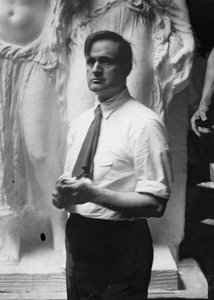
James Earle Fraser
1876 - 1953 , United States of America
Quick Facts
- Full Name: James Earle Fraser
- Nationality: American
- Date Of Birth: 1876
- Date Of Death: 1953
- Place Of Birth: Winona, United States of America
- Notable Artworks:
- End of the Trail
- Buffalo Nickel
- For Humanity Obverse
- Artistic Movement Or Style: Realist, Impressionist
- Artists Who Influenced This Artist: ['Augustus Saint-Gaudens']
- Artists Or Movements Influenced By This Artist: ['Numismatic art']
Explore artworks organized by themes, styles, and characteristics.


